Provenance
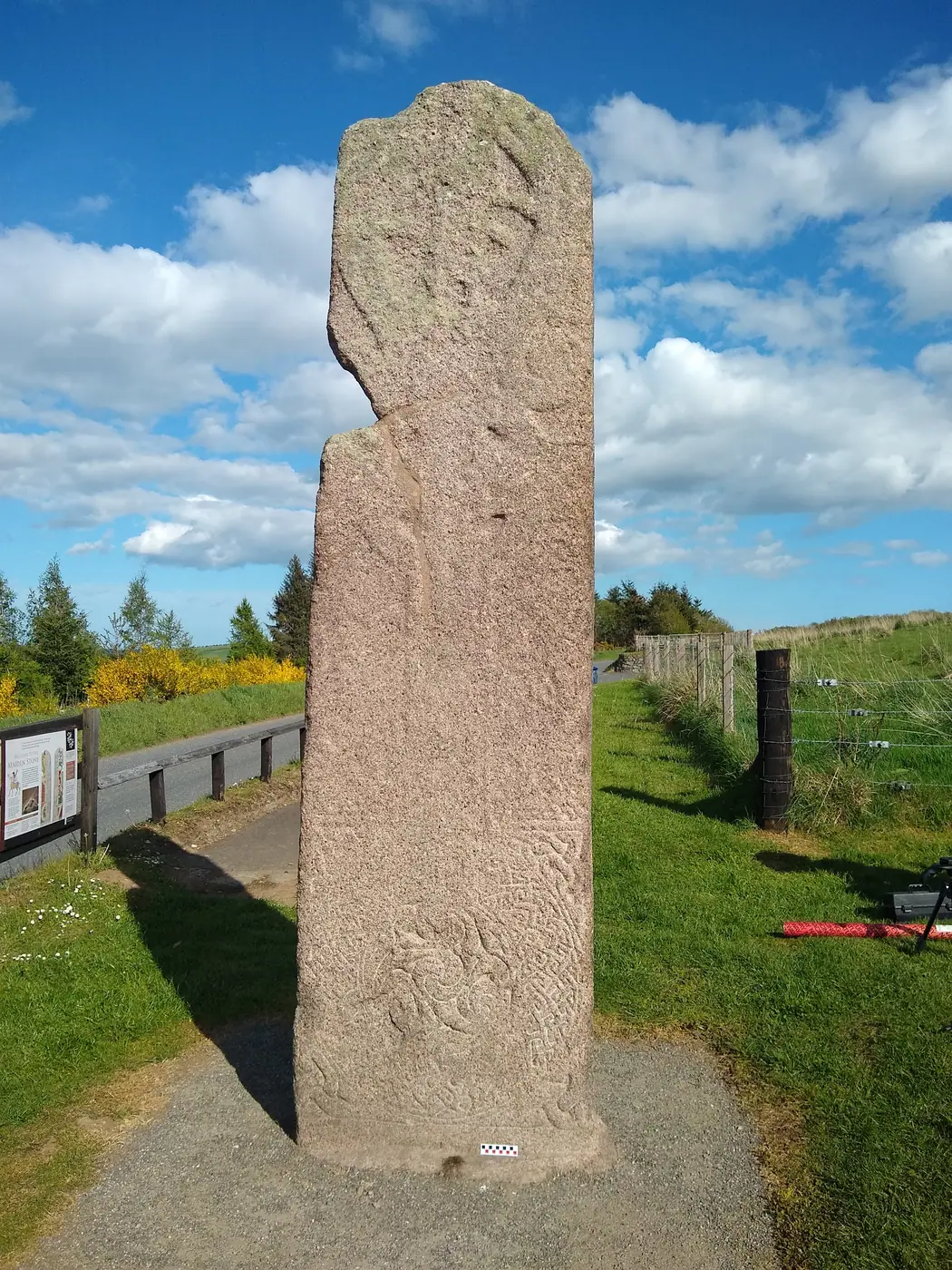
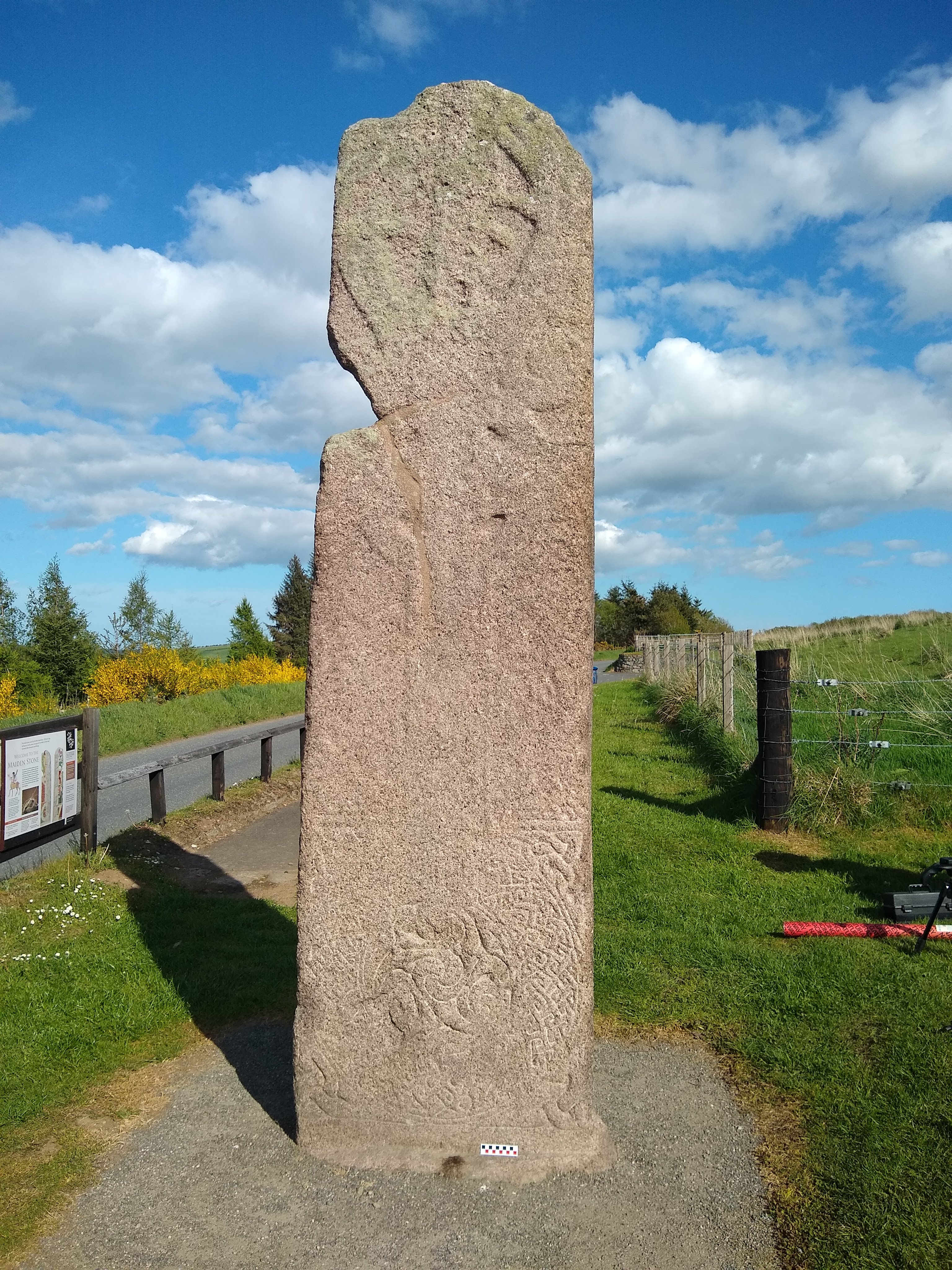
Discovery: Also known as the ‘Maiden Stone’ or the ‘Drumdurno Stone’, the stone was first recorded in 1726 (Gordon 1726, 59) and first illustrated in 1788 (Cordiner 1788, 33). It is in state care. The inscription was first spotted in 2014 by Ewan Campbell and confirmed by Katherine Forsyth in April 2015. It was first mentioned in print in the HES Statement of Significance (Barnes 2017, 2-3). According to Ritchie (2017), it ‘appears to have stood on a small mound, but it was moved when the road was built, sometime between 1832 and the early 1850s. Its location near the foot of a gentle slope suggests that it may have stood beside an old trackway’. It is now set into a concrete base but until recently stood directly in the ground with grass growing up around the lower reaches which undoubtedly contributed to the overlooking of the ogham. It is now clearly visible.
Findspot: Chapel Of Garioch, Aberdeenshire, Scotland (National Grid Reference: NJ c 7038 2472)
Last recorded location(s): Recorded beside a minor road at NJ 70378 24714 on May 19th 2022.
Support
Trove 18978
Object type: Class II cross-slab
Material: Granite
Dimensions: H 3.01 × W 0.91-0.81 × D 0.30-0.15 m
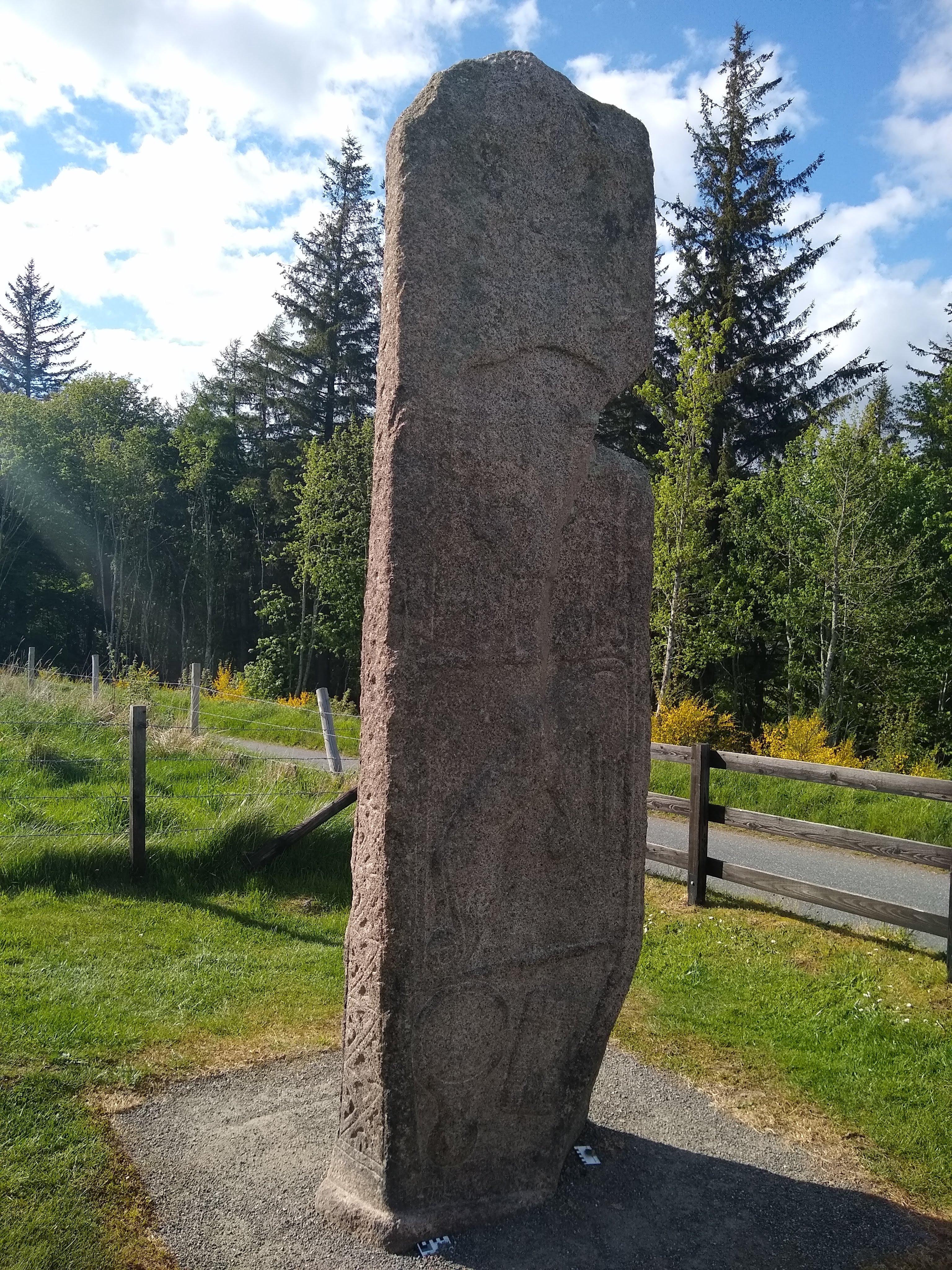
Decoration: ‘The front face exhibits a ring-headed Christian cross, carved all in relief, with a male figure and two fish monsters above. There are numerous panels decorated with interlace, knotwork and key-pattern below this, including a circular design with spiral work at its centre. ‘The sides are also both carved. The north facing side is carved with Stafford knots, and the south facing side with interlace’ (Allen 1903, 191; Barnes 2017, 4). The back face is split into four panels. The top panel exhibits a centaur and three quadrupeds’ (Barnes 2017, 4). Continuing downwards, the second panel depicts a ‘notched rectangle and z-rod’. Lower down, the third panel which consists of an elaborately decorated ‘Pictish beast’ (Barnes 2017, 4). The bottom panel exhibits a ‘fine mirror and double-sided comb’ (Barnes 2017, 4)
Condition: A large upright cross-slab of pinkish granite, rectangular in shape and tapering from the bottom upwards. The slab ‘is missing a triangular shaped fragment from one of its sides and has a triangular cutaway at its base’ (Barnes 2017, 2). The first three letters of the ogham inscription are clear but thereafter the surface has delaminated and the rest of the inscription has been lost. Much of the easily reachable surface has been re-cut in the modern age but the letters escaped this attention. The carvings on the back face of the slab, however, are excellently preserved but the interlace carving in the arms of the cross and on both sides of the cross-shaft on the front face of the slab is badly damaged (Barnes 2017, 3-4). Despite this damage, the ‘Maiden Stone’ is considered the ‘finest of all the Class II cross-slabs in the North-east’ (Forsyth 1996, 389).
Inscription
Text field: The ogham inscription runs horizontally along the lower frame at the very bottom of the reverse face. The inscription starts immediately below the left edge of the panel above (below the handle of the Mirror Symbol).
Letters: The ogham letters, though comparatively small and unobtrusive, are carefully formed. Given the hardness of the stone, they are unlikely to be graffiti. The inscription features a hammer-head A and two Ls which are carefully spaced to ensure they are read separately. The strokes of the two consonants slope forward, in the expected direction of reading.
Date: Eighth to ninth century
Edition
Ogham text: ᚐᚂᚂ[---
Transcription: ALL[---] →
Translation
The extant inscription is insufficient for producing a translation.
Commentary
This impressive stone is one of the most beautiful to have survived in situ. Barnes (2017, 5) suggests that the slab likely functioned as ‘a prayer cross or boundary marker and would have been erected under elite patronage – secular or ecclesiastical aristocracy’.
According to Barnes (2017, 6), there are two possible origins for the name ‘Maiden Stone’. The first is the potential link between the cult of St Medan and the stone, and the other is a legend which may have started ‘with the death of the daughter of the laird Balquharn’, but has since evolved into the tale of ‘a maid losing a bet with the devil and subsequently being turned to stone’.
The inscription at Golspie opens with the same three letters. It may represent the word preserved in Pictish/(Northern) British place-names as *al ‘rock’, or Old Gaelic oil ‘large stone or pillar-stone (fixed) in the ground’, used with reference to memorial and boundary stones, which DIL suggests is the same word as ail ‘rock, boulder’ (Taylor with Markus 2012, 278-279).
References
- Allen and Anderson 1903, 190-191
- Barnes 2017, 2-13
- Cordiner 1788, 33
- Forsyth 1996, 389
- Gordon 1726, 59
- Ritchie 2017
- Taylor and Márkus 2012