Provenance
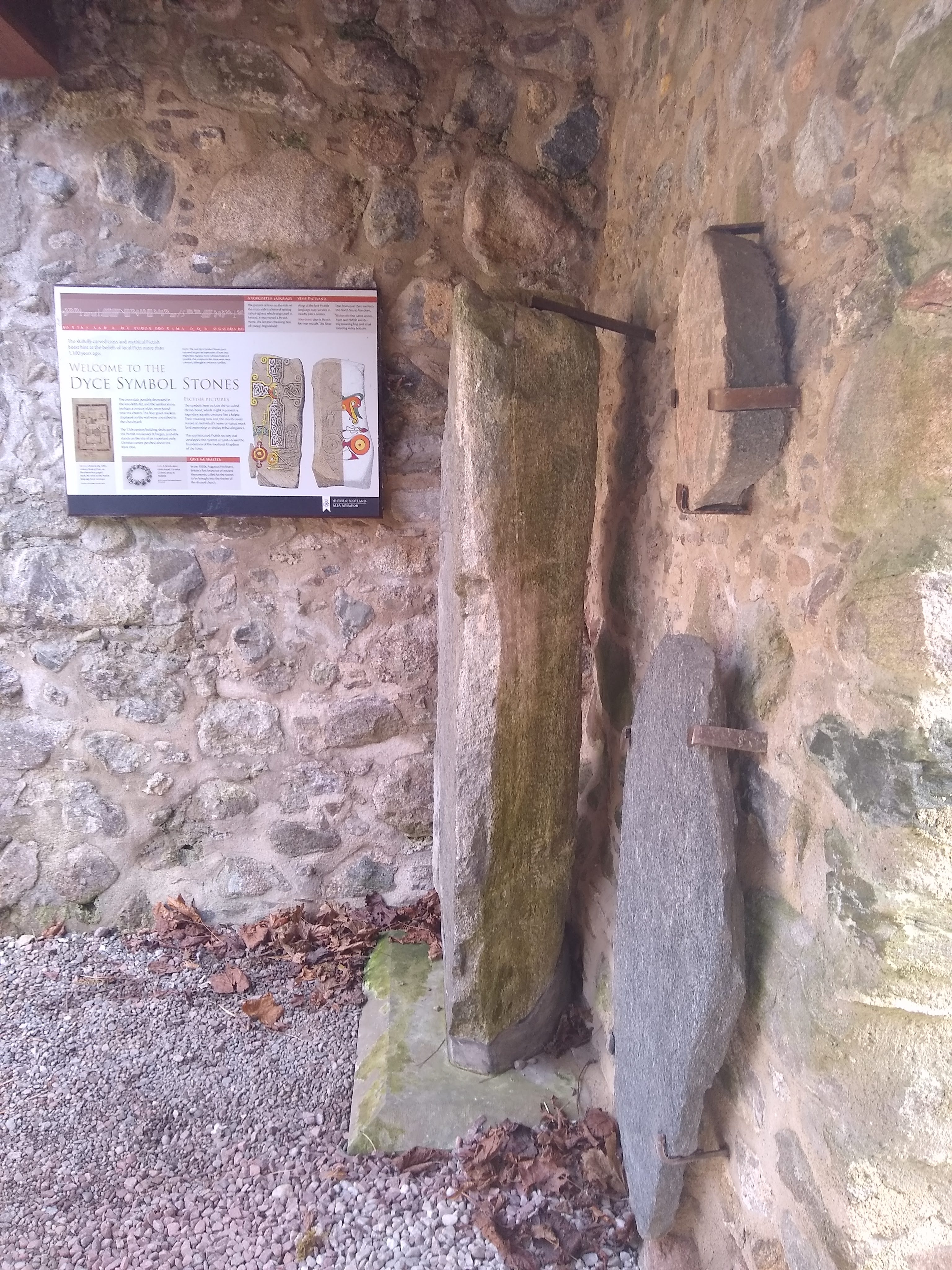
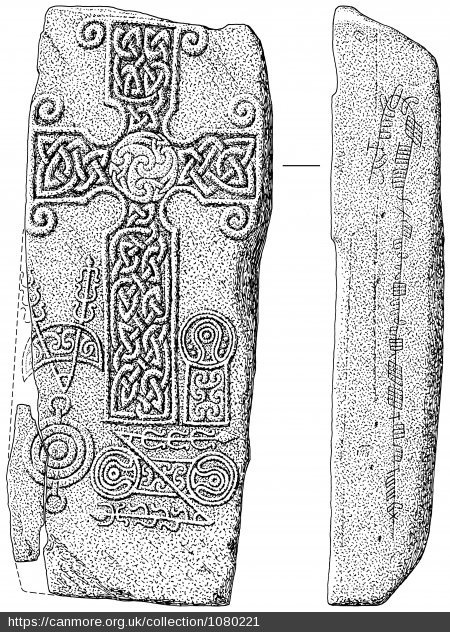
Discovery: The slab was first noted by John Stuart in 1822 who published it as an illustration for Archaeologia Scotia volume II (Stuart 1822, 314). It likewise seems to be recorded in the Old Statistical Account volume III from 1792 (Wilson 1792, 131-132). When Stuart first saw the slab it had been ‘placed in the wall surrounding the Churchyard’ (1856, 5). Consequently, the ogham inscription on the obscured right face of the slab went unnoticed. The ogham inscription was first noticed in August 1997 when the slab was removed for conservation prior to reinstallation in a display on-site (Forsyth 2001, 4). The first record of the inscription is an illustration from 2004 as part of the Records of the Royal Commission on the Ancient and Historical Monuments of Scotland under catalogue number SC 1080221.
Findspot: Dyce, Aberdeenshire, Scotland (National Grid Reference: NJ 8752 1541)
Last recorded location(s): Recorded in St Fergus church on May 17th 2022.
Support
Trove 19466
Object type: Cross-slab
Material: Granite
Dimensions: H 1.4 × W 0.6 m
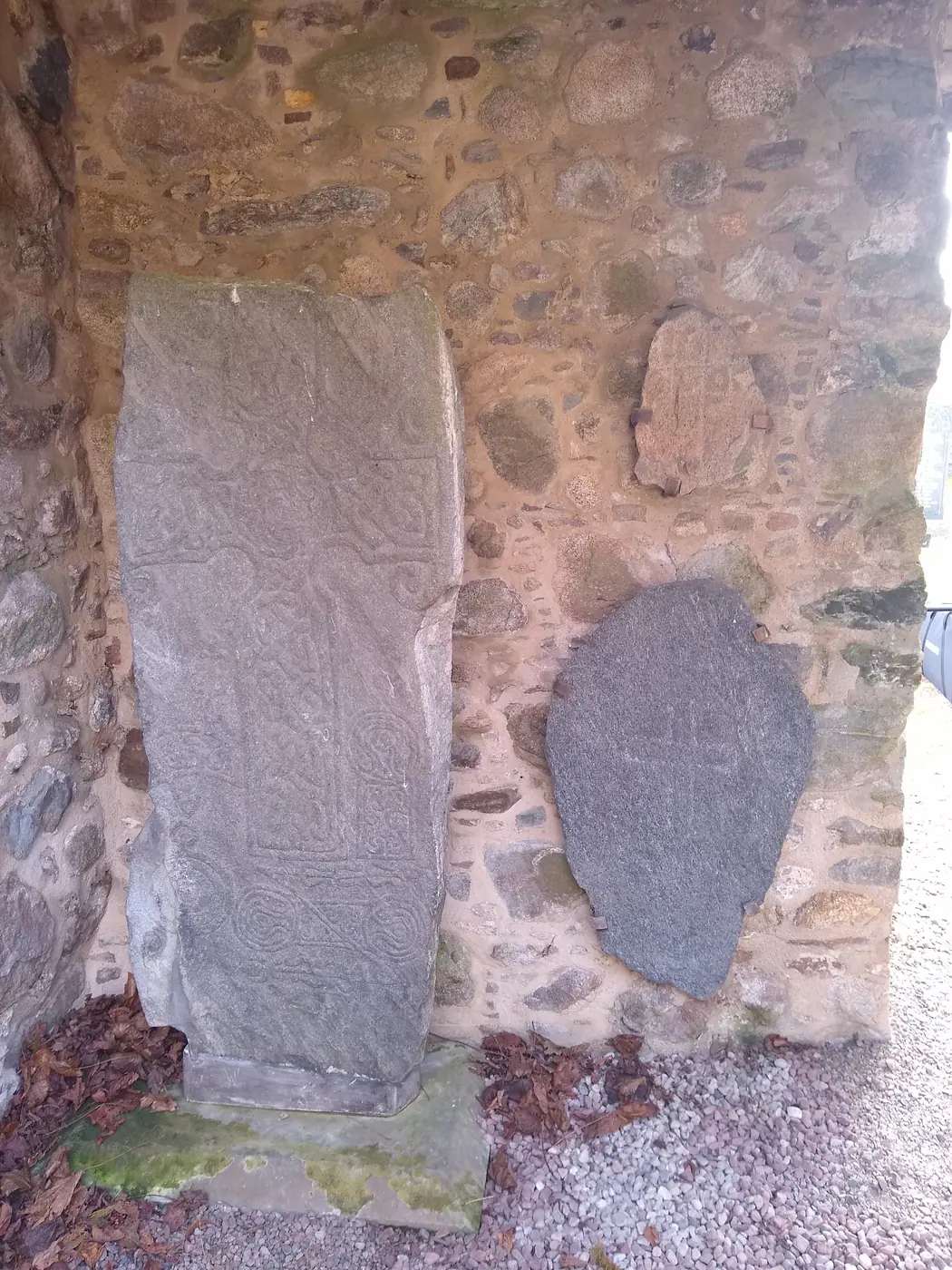
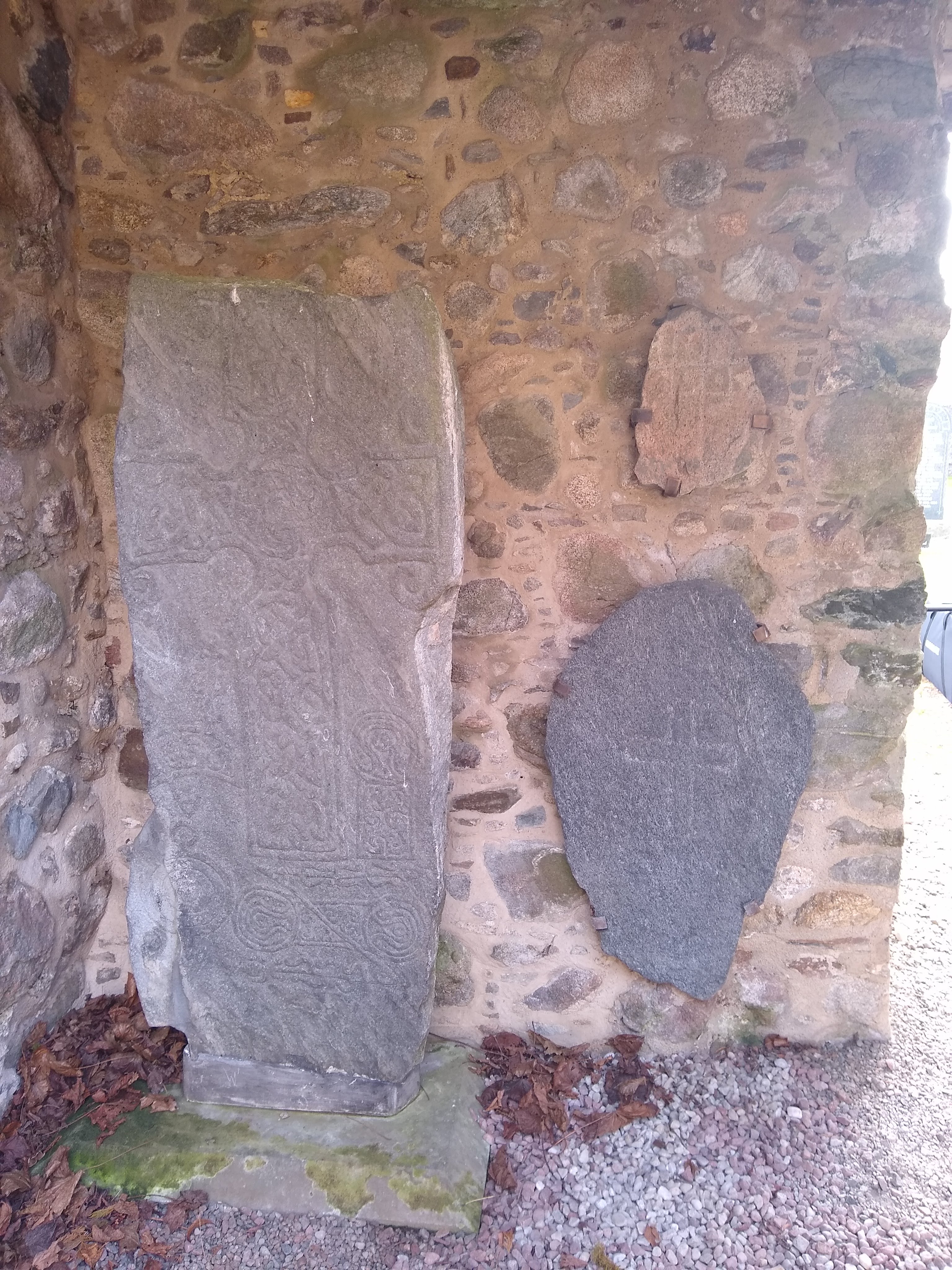
Decoration: The main face of the slab is carved in relief with a cross and four Pictish motifs. The cross has round hollows in the angles between the arms and spiral terminations to the top and two side arms (Allen 1903, 189-190). On the left of the shaft of the cross near the bottom is a crescent and V-shaped rod symbol, and on the right a mirror-case symbol. Below these on the left is a triple-disc, and on the right a double disc and Z-shaped rod symbol Allen 1903, 189-190).
Condition: An upright granite cross-slab of rectangular shape. The faces of the stone have all suffered damage to some degree. The worst affected is the base which has been very roughly trimmed. Some at least of the top has also been trimmed roughly. The whole of the upper part of the right face, and perhaps also the upper part of the left face, are intact, but below the cross arms the front arris of the right side and most of the surface of the left side has been trimmed off. A chunk of the missing portion of the left side survives as a separate piece. The surfaces of the stone are generally rather pitted. The ogham inscription is very clear and is generally very well preserved.
Inscription
Text field: The ogham inscription occupies almost the entire length of the right side of the slab. It is incised, not on an arris, but up the middle of the flat surface on a drawn-in stem. The lettering begins towards the base at a point level with the bottom of the symbols on the main face. At its highest point the inscription is level with the bottom of the top arm of the cross. A certain lack of planning is evident in the need to bend the stem round 180° in order to fit in all the letters. As a result, the inscription is shaped a little like a shepherd’s crook. The stem begins at the mid-point of the first letter and continues in a more-or-less straight line until the beginning of the twenty-fifth letter. At which point it begins to dip down slightly before turning back on itself sharply 1.13m from the beginning. The stem turns a tight bend upwards and to the left at the twenty-eighth and twenty-ninth letters before continuing a short distance back down towards the base from the thirtieth to the thiry-fifth letters, ending level with the point of departure at the twenty-fifth letter. The total inscribed length of the stem is c.1.4m. The Dyce text reads vertically upwards in a continuous line. This leaves the last five letters upside-down relative to the viewer.
Letters: The inscription is well carved, albeit in a rather loose style. The ogham letters are pocked with a small tool, the individual pock marks are clearly visible. The lettering of the Dyce ogham is very clear, with individual characters well spaced and well differentiated. The letters vary slightly in size but h- and b-strokes are typically about 40mm and m-strokes are typically about 70mm. The long vowel-stroke of the eighth letter is 50mm, and the crossstroke 30mm. The judicious spacing of the letters and the consistent use of bind-strokes demonstrate a concern for legibility. The inscription also exhibits two of the supplementary letters or forfeda (X-forfid / ébad ᚕ and OI-forfid / ór ᚖ) and several variant letter forms, such as angled letters, s-shaped A, hammerhead A and rabbit-earred D.
Edition
Ogham text: ᚕ
Transcription: EOTTASSARHETODDEDDOTS MAQQ ROGODDADD
Critical apparatus:
- The inscription is ‘very difficult to interpret, partially because the phonetic value of some of the letters is uncertain’ (Forsyth 2001, 2). However, the presence of the formula word MAQQ indicated the segmentation of the inscription into: (eottassarrhetoddeddots) maqq Rogoddadd
Translation
The latter portion of the inscription means ‘son of Rogoddad’ (Forsyth 2001, 2). The preceding portion of the inscription cannot be interpreted but is likely to have contained several words, including a personal name.
Commentary
Information about the stone and its analysis is limited due to the lack of publications. However, Stevenson (1955, 126) has argued that the Dyce slab was mid- to late-ninth century based on its decoration, but this date range seems too late to Forsyth (1996, 266).
If Rogoddodd were a personal name it would be possible to interpret it in Brittonic (i.e. Pictish) terms. The first element could be Ro- the intensifying prefix, sometimes spelled Ru- (c.f. Modern Welsh rhy, Breton re ‘too’) which is found in such names as the Breton Ro-haoiarn, (Loth 1890, 161). The remainder may be Godd-odd with the first element to be compared with the well-attested Uuod-/Guod-/God- (Loth 1890, 177).
The Dyce ogham is probably the last of the striking cluster of ogham inscriptions in the Don/Urie basin and is the only one to come from an ecclesiastical site.
References
- Allen and Anderson 1903, 189-190
- Forsyth 1996, 266
- Forsyth 2001-02-28, 1-16
- Loth 1890, 177
- Stevenson and Wainwright, 1955, 97-128
- Stuart 1856, 5
- Stuart 1822, 314
- Wilson 1792, 131-132