
Provenance
Discovery: The ogham inscription was recognised by J. Stuart (1856, 12) in 1856. The slab itself was first recorded by Cordiner in 1776 in the graveyard at Golspie, where it had been re-used as a recumbent graveslab sometime before the middle of the eighteenth century, likely in the seventeenth century (Forsyth 1996, 299). In 1868 the slab was taken to Dunrobin Castle Museum (Forsyth 1996, 299).
Findspot: Golspie, Sutherland, Scotland (National Grid Reference: NC 8370 0020)
Current repository: Scotland Dunrobin Castle Museum (inv. no. )
Last recorded location(s): Recorded in Dunrobin Castle Museum on May 22nd 2023.
Support
Trove 6564
Object type: Cross-slab
Material: Sandstone
Dimensions: H 1.83 × W 0.82 × D 0.17 m
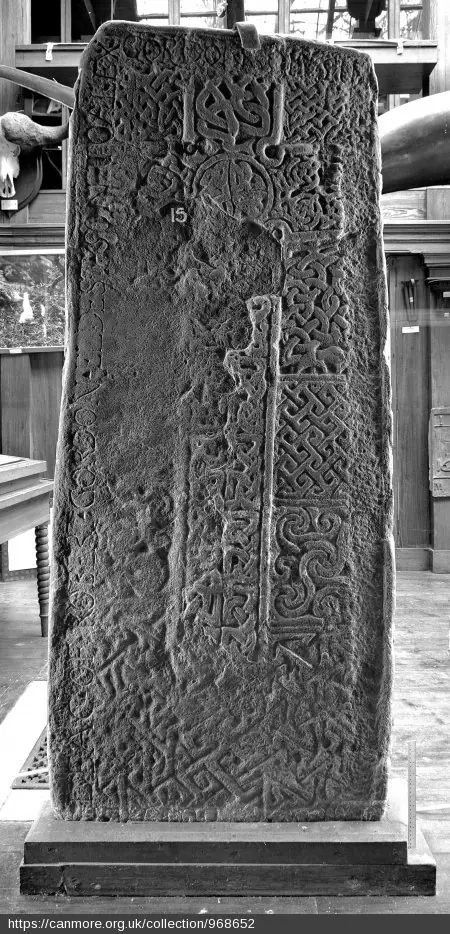
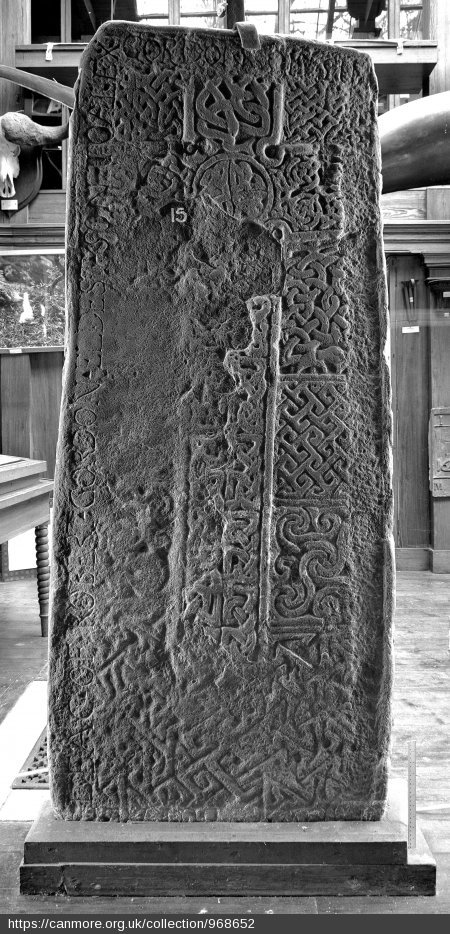
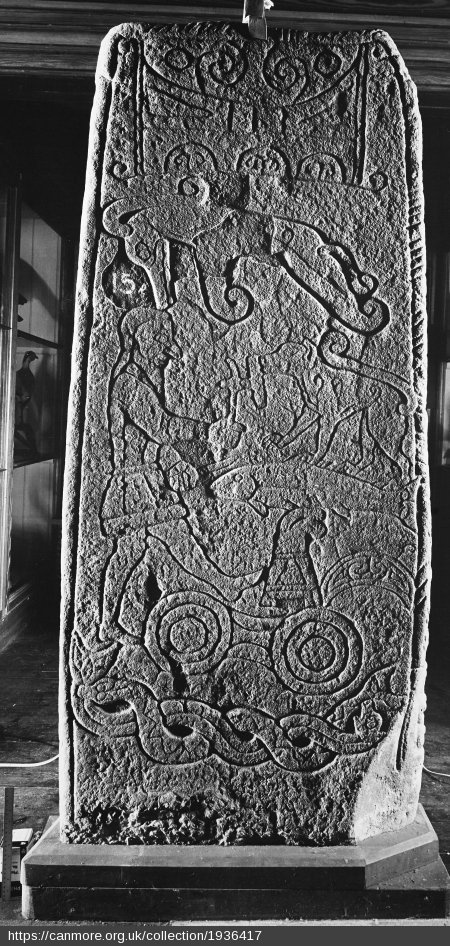
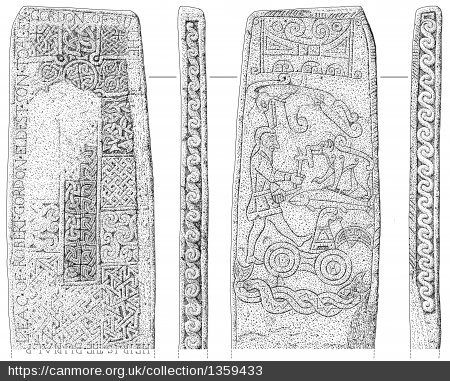
Decoration: This purple (old red) sandstone, rectangular slab is carved on all four sides. The front face is carved in shallow relief with a long-shafted cross with circular armpits, filled with and surrounded by interlace. The reverse is carved with eight Pictish symbols arranged in pairs, including a large decorated rectangle symbol and beast, a man wielding a knife and axe, a wolf, a fish facing left, a flower, a crescent and V-rod symbol, a double-disc and a pair of intertwined serpents. The two narrow sides of the slab are carved with a spiral border pattern composed of one row of double spirals connected by S-shaped curves.
Condition: The front face is defaced by a modern inscription and is badly weathered. In addition to being exposed to the elements, the stone has also been worn smooth by the passage of feet. The reverse is generally in very good condition. The ogham inscription is clear except for two very worn sections.
Inscription
Text field: Unusually, the inscription reads up the long edge on the right-hand of the reverse face, turning at the top corner and continuing across the upper edge. There is no drawn-in stem-line. Instead the strokes are arranged either side of the arris which, though not sharp, is ridged in some places. A deeply-cut line has been incised about 35-40mm from the vertical arris on either side. This has created the impression that the ogham inscription occupies a slightly raised roll-moulding.
Letters: The letters are well-spaced and carved with assurance. The strokes are deep and well-defined, broad at the surface but pointed at their base. The b- and h-consonants are sloped and thus can be accommodated within the band, the M-aicme strokes occupy the middle two-thirds of the band and the vowels are short cross-strokes, perpendicular to the stem. The inscription was likely pocked. The b- and h-consonants are c.4.5-5cm long.
Date: Middle of the eighth century or later
Edition
Ogham text: ᚐᚂᚂᚆᚆᚐ
Transcription: ALLHHALLORREDD M[.]QQ NIA VVH ṚRC[.]ṆṆ →
Critical apparatus:
- The consonants are straightforward sloping strokes, with no special characters. The vowels show more variety. In addition to the simple straight stroke vowels, there is a hammer-head A, an angled A, an X forfid, and, if, as seems likely, it is a separate character, the > < forfid. 2. The inscription seems to follow the ‘X MAQQ Y’ formula and likely contains personal names (Forsyth 1996, 317). The presence of MAQQ or MEQQ gives a clear indication as to preliminary word division. However, the sections both before and after the MAQQ or MEQQ are rather long and may require further word division. Although, most authorities are agreed in taking ALLHHALLORREDD as a separate word.
Translation
An exact interpretation of the text has not been determined, but possible interpretations include: the monument of Alored son of the nephew of Fercar or the monument of Alored, MacNia, and Fercar.
Commentary
The final two syllables of ALLHHALLORREDD, -orredd (-ored), may be compared with the common Brittonic male personal element -gwared (guored, uoret), meaning ‘protection, bulwark, defense’ attested in Welsh, Cornish, and Breton. The first syllable, ALL, might be meant to be read as the Irish word ail, meaning ‘rock, boulder, grave-stone, monument’. Within this context, the following word would be a personal name in the genitive.
MAQQ OR MEQQ is interpreted as an attempt to render the genitive maicc, meaning ‘son’. NIA, nia, which is also Irish has two possible meanings, ‘warrior, champion’ and ‘sister’s son’.
The final section of the text VARRC[.]RR, might be transliterated as FARRCARR which may be a form of the Irish male personal name Ferchar, a compound of the elements fer ‘man’ and cha(i)r ‘loving’, meaning ‘friendly’.
The three names at Golspie could be three individuals commemorated equally, or the name of the patron (secular), patron (ecclesiastical), and craftsman, as is found on later Irish crosses such as the Cross of the Scriptures at Clonmacnoise (Macalister 1949, 70-71) or the Market Cross at Tuam (Maclister 1949, 2-3).
One of the most interesting features of the Golspie ogham is that it is written without drawn-in stem-line on the arris of the stone. While this is the norm on otherwise undressed and uncarved pillars, it is unique on a highly decorated cross-slab. Since Golspie cannot be as early as the seventh century and is probably no earlier than the middle of the eighth, this is an important reminder that the lack of a stem-line is not necessarily indicative of an early date (Forsyth 1996, 312).
References
- Allen and Anderson 1903, 48-50
- Fraser 2008, 98
- Forsyth 1996, 299-320
- Macalister 1949, 2-3, 70-71
- Stuart 1856, 12