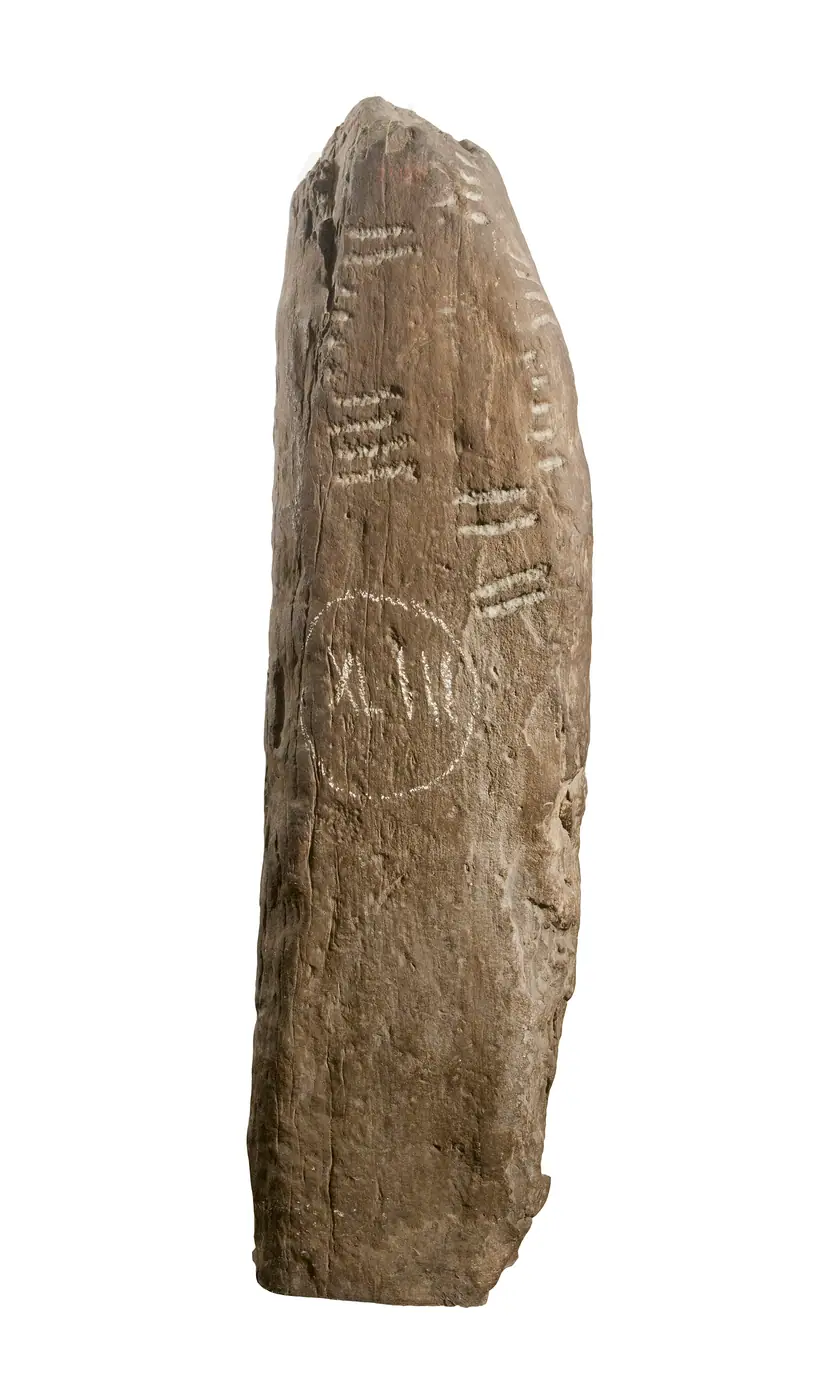
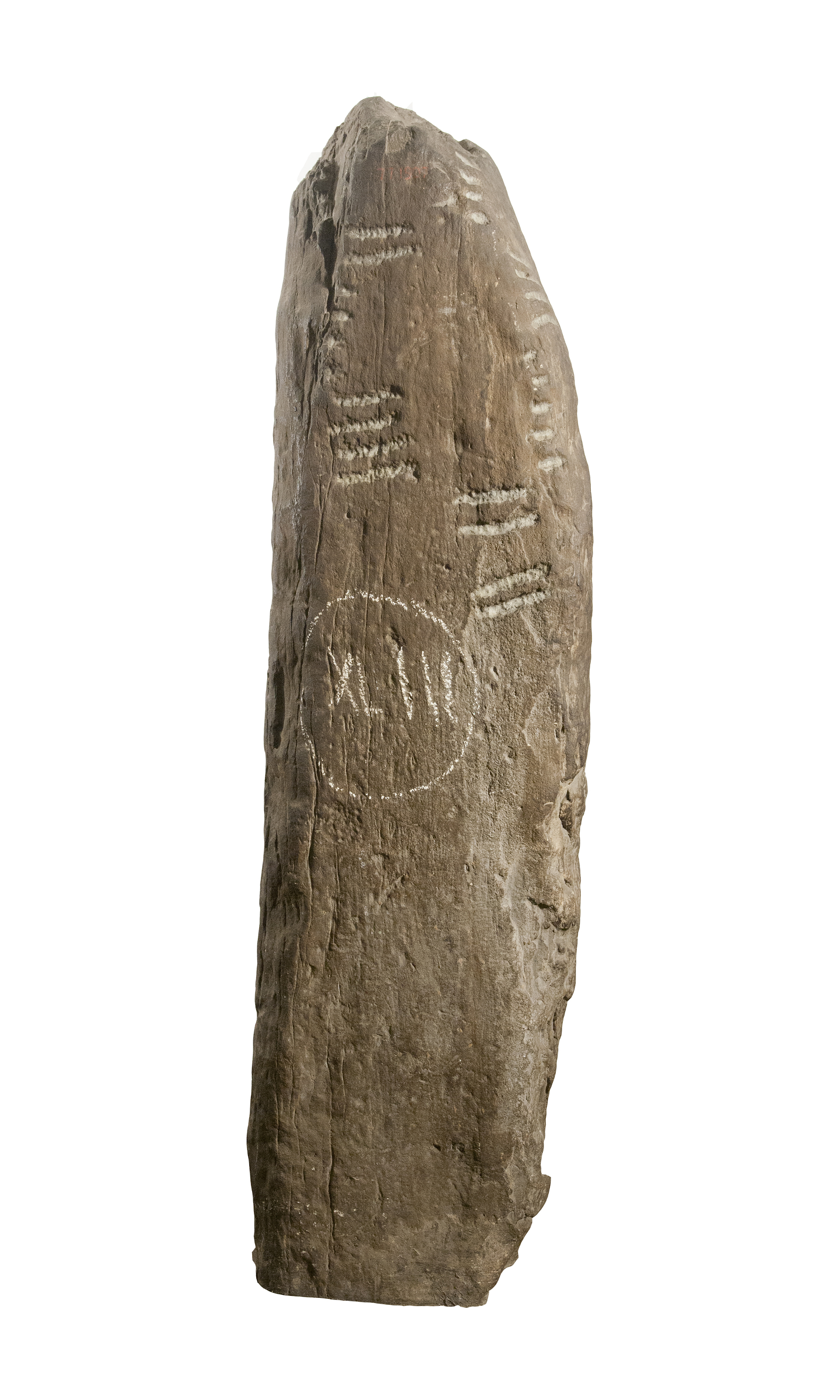
Provenance
Discovery: Discovered by Sergeant Lyons of Ballyhaunis ‘in the ground course of the old church wall’ at Kilmannin (Cill Mhainín ‘church of Mannín?’) , marked as ‘children’s burial ground’ on Ordnance Survey historic 1.64m (25in.) and 0.15m (6in.) maps (Rhys 1907, 61). The site is only a little over 2km to the east of the Island ogham stone (I-MAY-001).
Findspot: Kilmannin (Cill Mhainín ‘Mainín’s church’?), Co. Mayo, Ireland (ITM Coordinates: 549559, 780647)
Current repository: Ireland National Museum of Ireland (inv. no. 1907:77)
Last recorded location(s): National Museum of Ireland (seen and recorded in 3D using structured light scanning in August 2015)
Support
National Monuments Service Record Number: MA093-045003-
Object type: Pillar
Material: Sandstone
Dimensions: H 1.22 × W 0.51 × D 0.30 m
Condition: The stone is damaged in places and also contains small fractures which run along the two inscriptions. In the first inscription, there is ‘a small fracture on the angle following 2G’ while in the second inscription ‘a fracture follows O, large enough to contain two scores or notches, but had they actually been there some trace of them would probably have remained’ (Macalister 1945, 6). Additionally, three letters from the end of the second inscription, ‘S2 and S3 are seen to form a character resembling a 6, broken at the bottom’, which Macalister (1945, 7) suggests looks like the U-forfid, but it could be just damage to the stone.
Inscription
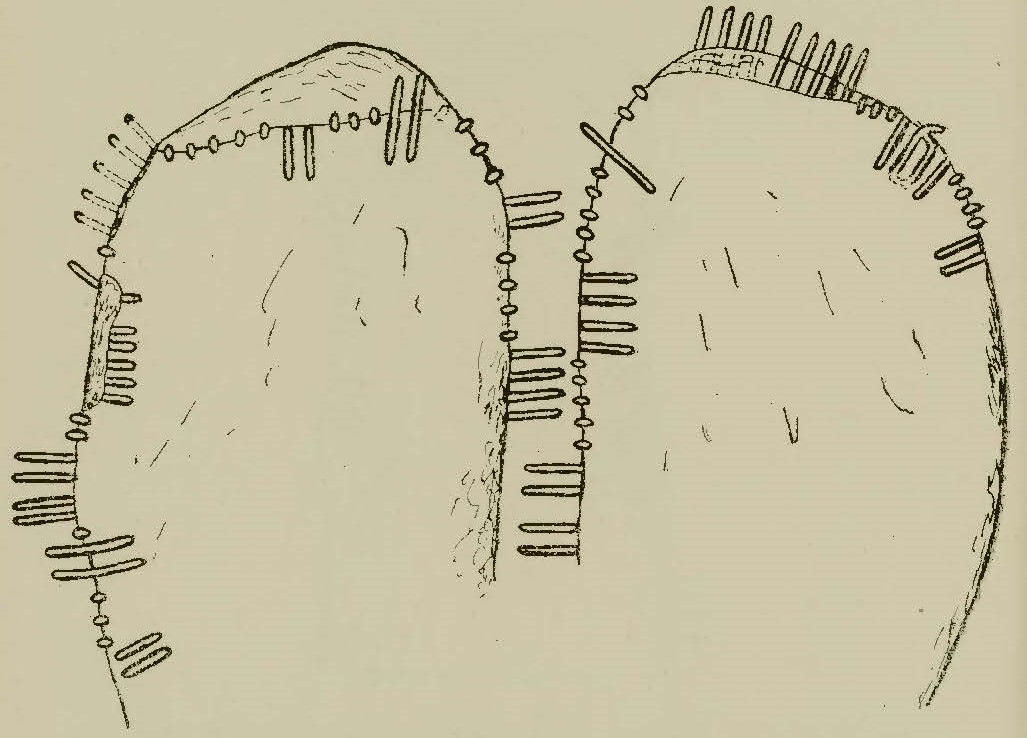
Text field: There is ogham on all four angles with what appears to be two separate inscriptions (one surrounding each face, up-top-down), the second of which is unintelligible.
Letters: The scores and notches are broad and pocked, generally clear and evenly spaced. The initial L- unusually slopes upwards. The Gs and Ms, which we would expect to be diagonal, are rather straight across the angle. Both inscriptions appear to have been carved at the same time using the same technique and, presumably, by the same carver.
Date: mid to late sixth century A.D. (linguistic)
Edition
Ogham text: ᚂᚒᚌᚐᚇᚇᚑᚅ ᚋᚐᚊ̣ᚔ ᚂᚒᚌᚒᚇᚓᚉ ᚇᚇᚔᚄᚔᚋᚑ vac.
Transcription: LUGADDON MAQ̣I LUGUDEC DDISIMO vac. CQUSEL
Critical apparatus:
- The inscription around the second face (2) is clear but incomprehensible.
Translation
1: of Lugáed son of Luguid
Commentary
The onomastic formula consists of the bare minimum of elements, son and father, both of whose names are based on the same etymon, the divine name Lug. Both names are well attested in the Old Irish period; the father’s name is still in use in the Modern Irish form Lughaí.
The first name is also found in the spelling LUGUAEDON in the 6th-century Latinate inscription GAL-011 from Inis an Ghaill (Inchagoill Island, Co. Galway), which preserves the middle u and thus reflects a more archaic state of the language than the ogham version. It is a compound of Lug and *ai̯du- ‘fire’ (cf. the rare OIr. word áed ‘fire’), meaning probably ‘possessing fire of Lug’ or ‘possessing fire like Lug’. The middle u was lost/dropped in LUGADDON (McManus 1991, 117) and the reduction of the diphthong in unstressed position to /ə/? (McManus 1991, 121; Uhlich 1989, 131 n9), but the diphthong was retained or re-introduced in OIr. Lugáed.
The father’s name is popular on Irish ogham stones. It occurs also in LUGUDECAS (I-WAT-002 = CIIC 263, Ardmore, Co. Waterford; LUGUDECA (I-WAT-025 = CIIC 286, Kilgrovan, Co. Waterford), and LUGUDUC (I-COR-057 = CIIC 108, Kilcullen South, Co. Cork). The names reflect consecutive stages of language change from PrimIr. *Lugudiks to OIr. Lugaid, gen. Luigdech under the effects of apocope and stress reduction. The second element of the name is the root *dik- ‘to show, point out’. The name therefore means ‘showing or pointing out Lug’, perhaps in the sense of an intermediary between the god and ordinary people. The popular analysis as Lug + the root *dek- ‘to show respect’ (McManus 1991: 103, 178 n.17) is phonologically difficult to justify (Stifter 2011: 23–24) and is therefore rejected here.
The endings of the names are gone, it therefore postdates apocope. The preserved ending of MAQI is not significant, since formula words are more conservative in spelling (and the -I could even function as a marker of palatalisation). The preserved middle -u- of LUGUDEC (= OIr. Luigdech) could mean that the word had not undergone syncope yet, but an archaism or analogical retention (from the nominative *LUGUD) is also conceivable. On balance, this inscription may date to the late 6th century.
References
- Macalister 1945, 6-7
- McManus 1991, 65, 79, 95, 96, 103, 113, 116, 117, 120, 122, 181
- Rhys 1907, 61-68
- Stifter 2011, 23-24
- Uhlich 1989, 131