Provenance
Discovery: First recorded with sketch 1698, some of the ogham recorded along edge of sketch; first reading of the ogham in 1860
Findspot: Clydau, Pembrokeshire, Wales (National Grid Reference: SN 2508 3546)
Last recorded location(s): Inside the church, clamped to the west wall of the south aisle.
Support
Monument Dyfed Archaeological Trust Historic Environment Record: 1211 Clydau, Clydey; St Clydai’s Church
Object type: Slab
Material: Porphyritic andesite
Dimensions: H 1.46 × W 0.42 × D 0.13 m
Inscription
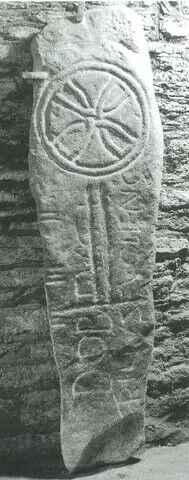
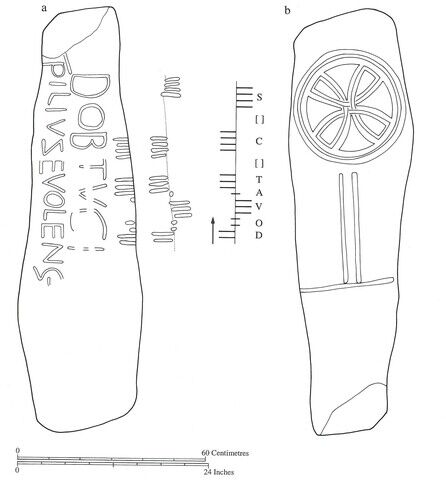
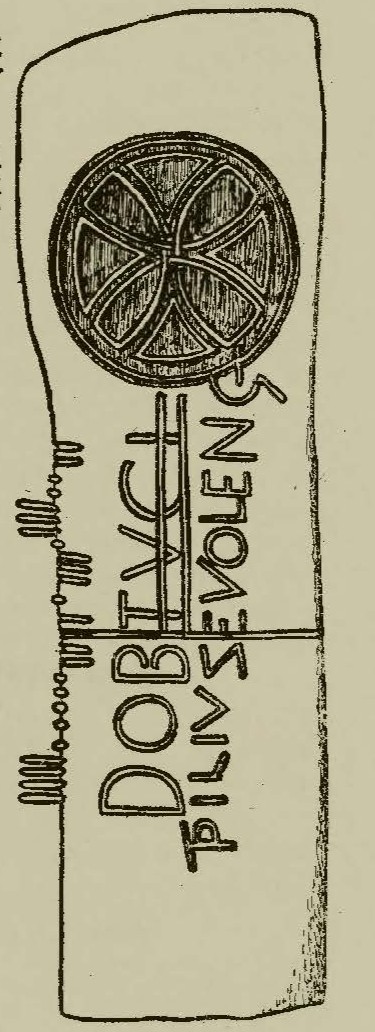
Text field: The ogam inscription is incised ‘on the right angle of the face (A/B), originally reading upwards’ and fills the centre third of the right angle of the stone face (Edwards 2007, 319). The roman-letter, Latin inscription consists of two lines, originally reading vertically downwards. The inscriptions are now ‘upside-down’ as the stone is positioned with the cross ‘the correct way up’ (Edwards 2007, 319).
Letters: The ogham and Latin inscriptions are pocked. The roman-letter inscription was ‘incised using a punch’ and consists of capitals (Edwards 2007, 319).
Date: End of fifth or earlier sixth century A.D. (linguistic)
Edition
Ogham text: ᚇᚑᚃᚐᚈᚒ̣ᚉᚔ̣ᚄ
Transcription: 1 DOVATỤCỊS
Critical apparatus:
- ‘The precise form of the name in ogam is unclear. There is room on the angle of the stone for three vowel-notches between the T and C, thereby suggesting a U, which would tally with the form of the name in the roman. There appear to be traces of four vowel-notches between the C and the S, but room for five, and either an I or an EA seem possible, giving a reading of Dovat[u]c[i]s or Dovat[u]c[ea]s. McManus (1991, 67) has sugested the latter, in the genitive case, is more likely’ (Edwards 2007, 321). 2. The ‘roman-letter, Latin inscription uses the ‘X son of Y’ formula; the names are in the genitive case, while filivs is in the nominative. The reading is clear, apart from the form of the first name, which may be either DOBTVCI or DOBITVCI. There is room for an I, which may have been destroyed by the later carving’ (Edwards 2007, 320-321).
Translation
Ogham: Dovatucis / Dovatuceas
References
- Edwards 2007, 318-321
- Macalister 1945, 411-412
- McManus 1991, 67