Provenance
Discovery: Found in August 1904 by J.R. Allen in the narrow passage which opens off the west wall of the Henllys Chapel (Edwards 2007, 390).
Findspot: Nevern, Pembrokeshire, Wales (National Grid Reference: SN 0833 4002)
Current repository: Wales St. Brynach’s Church (inv. no. )
Last recorded location(s): Inside the church in the Henllys (south) Chapel, built into the sill of the east window in the south wall.
Support
Dyfed Archaeological Trust Historic Environment Record: 1605 Nanhyfer; St Brynach’s Church
Object type: Slab
Material: Dolerite
Dimensions: H 1.59 × W 0.33 × D 0.10 m
Inscription
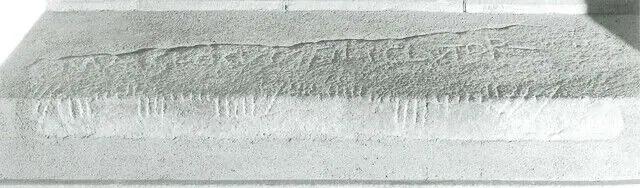
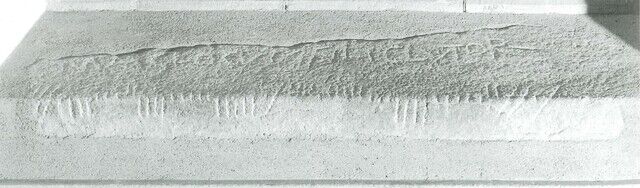
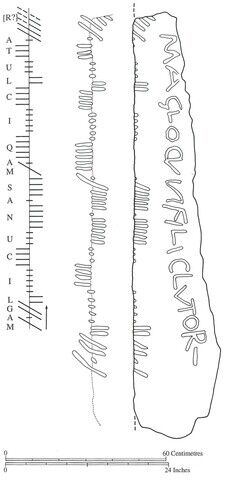
Text field: An ‘incomplete ogam inscription runs up the left angle of the face (A/D) and [one letter runs] partially across the top of the stone (now damaged)’ (Edwards 2007, 390-391). The slab contains a roman-letter, Latin inscription in one line reading vertically downwards.
Letters: There is no evidence to indicate how the ogham inscription might have been carved, so the execution technique remains unknown. The roman-letter inscription is described as being lightly punched and consists of capitals (Edwards 2007, 391).
Date: Second half of the fifth or earlier sixth century A.D. (linguistic)
Edition
Ogham text: ᚋᚐᚌᚂᚔᚉᚒᚅᚐᚄ ᚋᚐᚊᚔ ᚉᚂᚒᚈᚐ ᚏ̣[---
Transcription: 1 MAGLICUNAS MAQI CLUTA Ṛ[---]
Translation
Ogham: of Maglicu son of Clutar
Commentary
‘In the ogam inscription the first name is in the genitive case. The end of the second name is missing but CLUTA at the beginning is clear. The next letter is incomplete. It now consists of four partially visible diagonal strokes and, if it is the same as the roman inscription, there was almost certainly a fifth, thereby identifying it as an R… (Rhys 1910, 328) reconstructed the name as the genitive CLUTA[RI], thereby reflecting the roman inscription… (Jackson 1953, 624) and (McManus 1991, 91) have suggested an alternative genitive CLUTA[RIGAS]… These Celtic names are either British with Irish influence on the spelling or Irish with British influence on the spelling… The first name is either W. Meilyg/Maelgwn, “prince-hound”, or Ir. Máelchú, gen. Máelchon…’ (Edwards 2007, 391-392).
The last letter of the first name in the roman-letter inscription has been alternately identified as either a reversed N or a conjoined VI. If an N, the name reads as MAGLOCVN(i) which reflects the spelling of the ogam inscription. Otherwise, the spelling MAGLOCVVI would be the Latinized genitive of the Irish name Maglocu in the nominative (Edwards 2007, 391-392).
References
- Edwards 2007, 390-392
- McManus 1991, 91
- Jackson 1953, 624
- Rhys 1910, 328