Provenance
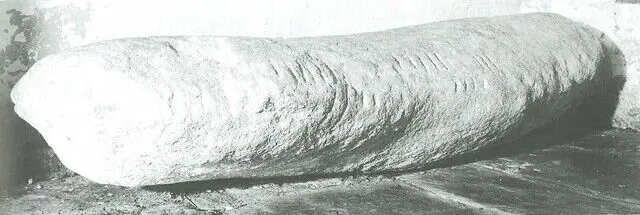
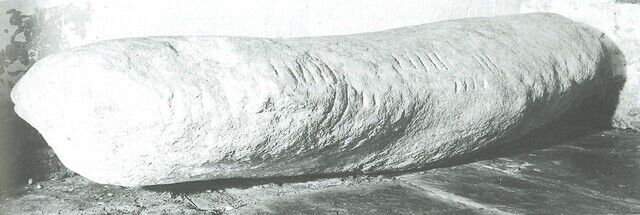
Discovery: The monument was in use as a footbridge when Lhuyd recorded the roman-letter inscription around 1698. However, the ogham inscription was not noted until around 1883 when the monument was rediscovered serving as a footbridge again across the Brawdy Brook on the boundary between Castle Villa Farm and Trewilym Farm. The stone was moved to the roadside near Castle Villa Farm where the roman-letter inscription was noticed in 1895. In 1896 the stone was moved to Brawdy churchyard and by 1922 it was placed in the church porch (Edwards 2007, 286).
Findspot: Brawdy, Pembrokeshire, Wales (National Grid Reference: SM 884 275)
Last recorded location(s): In St David’s Church, Brawdy lying on the east side of the porch.
Support
Monument Dyfed Archaeological Trust Historic Environment Record: 2765 Castle Villa (Castell Villia, Caswilia) Farm
Object type: Pillar
Material: Quartz gabbro
Dimensions: H 2.16 × W 0.585 × D 0.48 m
Condition: The ogham inscription is very worn but clear, whereas the letters of the Latin inscription ‘are now illegible’ (Edwards 2007, 286).
Inscription
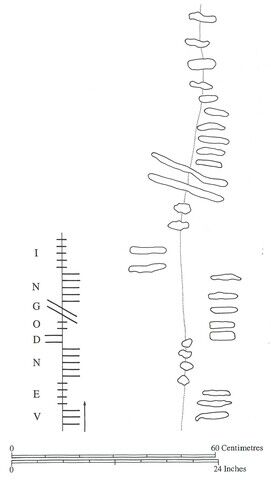
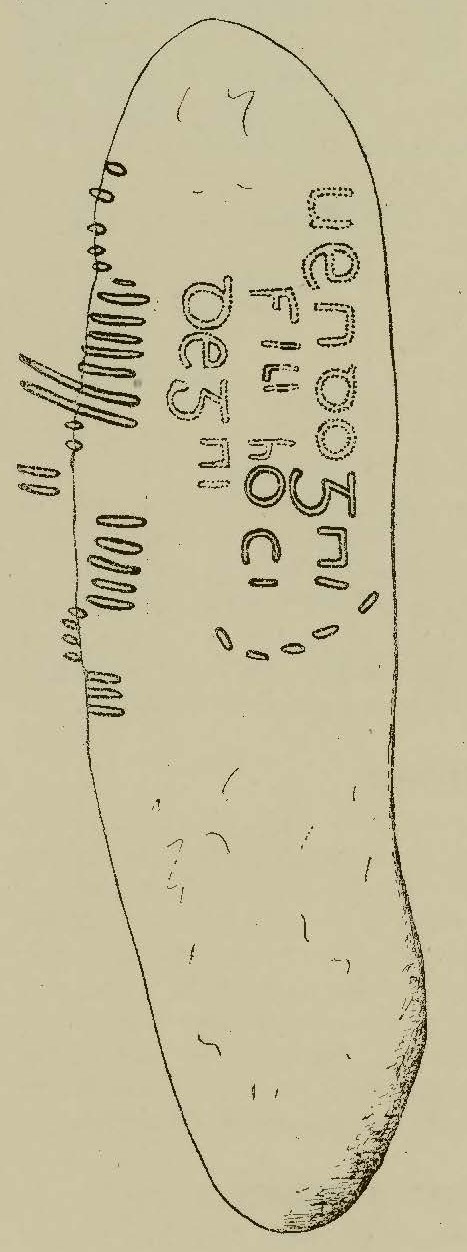
Text field: The ogham inscription is ‘incised on the left angle of the face’ and reads vertically upwards (Edwards 2007, 286). Macalister (1945, 399) highlighted that ‘there is no formal stem-line’ due to the ‘rounded edge’ of the stone. Traces of a roman-letter inscription are present on the stone in two lines, presumably reading vertically downwards.
Letters: Macalister (1945, 399) described the inscriptions as pocked.
Date: Later fifth or sixth century A.D. (linguistic)
Edition
Ogham text: ᚃᚓᚅᚇᚑᚌᚅᚔ
Transcription: VENDOGNI
Critical apparatus:
- Edwards (2007, 286) explains that the Latin inscription Vendagni is ‘a slightly different version of the same name’ given in the ogham inscription, Vendogni. In the roman-letter inscription, ‘the inclusion of fili shows the inscription conformed to the “X son of Y” formula, but the case is unclear. It is most likely to be the genitive fili followed by a name beginning with V, but the nominative filiv[s] would also be possible’ (Edwards 2007, 286). Based on the extant letters it is possible to deduce that ‘the name of the father (like that of the son) could therefore have begun with V and ended with NI’ (Edwards 2007, 286).
Translation
Ogham: Vendogni
Commentary
The ogham inscription is generally considered to be the Irish personal name Vendogni. Edwards (2007, 286) outlines that the ‘spelling of the Celtic element *Windo- (“white”) as VEND- is typical of ogam inscriptions, as is the termination -GNI’. The ogham inscription ‘appears to be an abbreviation of the roman, which also includes the patronymic’ (Edwards 2007, 286-287).
References
- Edwards 2007, 286-287
- Macalister 1945, 399-401