Provenance
Discovery: The stone was recognised in 1954, forming part of a drystone hedge blocking a disused trackway along the south side of the river Usk at Aberhydfer. The stone was subsequently moved into Llywel Church. The first reading of the inscription was published 1975.
Findspot: Llywel, Brecknockshire (Brycheiniog), Wales (National Grid Reference: SN 859 278)
Last recorded location(s): The stone is now fixed against the west wall of the nave in St David’s parish church, Llywel (NE of the findspot).
Support
CPAT Regional Historic Environment Record (PRN): 1510
Object type: Pillar
Material: Sandstone
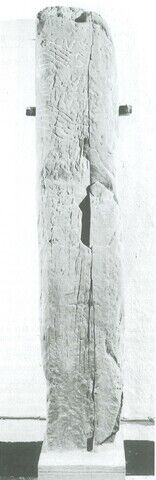
Dimensions: H 1.82 × W 0.33 × D 0.24 m
Condition: Redknap and Lewis (2007, 231) note that ‘there is some damage to the top of the stone, and longitudinal lamination along bedding plane at right angles to the face, so that the stone is in two halves’. The right side shows signs of weathering. The ogham inscription obliterates part of the Latin inscription and as a result, only the right edge of the inscription survives. The Latin inscription was ‘partially removed by the chamfering of both edges of the lower half of the stone’ (Redknap and Lewis 2007, 231).
Inscription
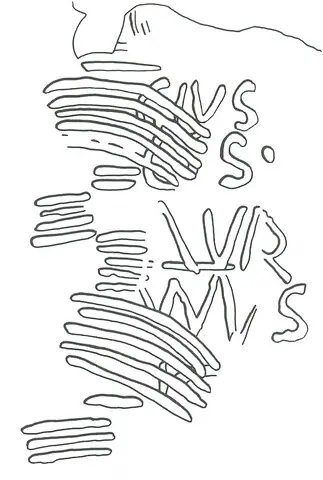
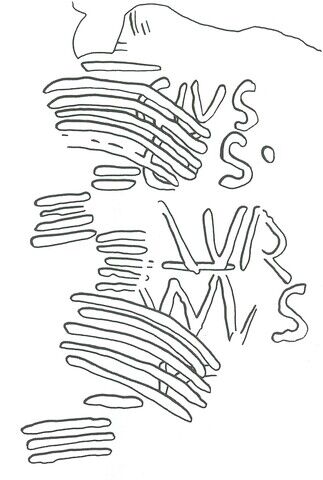
Text field: The ogham inscription is apparently ‘not cut in relation to any precise arris, as for most of its height the edge of a chamfer is not obvious on this side’ (Redknap and Lewis 2007, 231-232). The ogham inscription reads vertically upwards across the chamfer of the upper left edge of the stone, using the inner edge of the chamfer as an arris. The ogham inscription was cut after the roman-letter inscription. The roman-letter inscription is in five lines, reading horizontally across. The third and fourth lines are apparently underscored.
Letters: Both inscriptions appear chiselled.
Date: Mid-sixth century A.D. (textual context)
Edition
Ogham text: ᚈᚐᚏᚔᚉᚑᚏᚑ̣
Transcription: TARICORỌ
Critical apparatus:
- The ogham inscription is remarkable in being the only known example of an ogham inscription overlying a Latin one. It is further notable in that the two inscriptions do not appear to be related.
Translation
Ogham: of Taricoro?
Roman: Lucius [Annius] Taurianus lies here (Tomlin 1975)
Commentary
Sims-Williams (Redknap and Lewis 2007, 231) maintains that TARICORO is obscure but likely Irish. Thomas (1994, 119) compares TARICORO with OI Tairmesc in which Tair- is prepositional. Sims-Williams (Redknap and Lewis 2007, 231) also notes that ‘a possible second element is *kor- “cast, throw” (Old Irish cuir-)’.
It is impossible to confidently restore the first line of the Roman-letter inscription ’[…]CIVS’ as this is a very common name-ending. Sims-Williams (Redknap and Lewis 2007, 231) also notes that there are a number of possible suggestions for the last name, including Maurianus, Taurianus and Laurianus.
References
- Redknap and Lewis 2007, 231-233
- Thomas 1994, 118-119, 128 n.12, 274 n.24,
- Tomlin 1975, 68-72