Provenance
Discovery: Found inside Eglwys Gymun parish church in 1855 during the course of church restoration and excavations in the chancel. Ogham inscription first read by Rhys in 1889.
Findspot: Eglwys Gymyn, Carmarthenshire, Wales (National Grid Reference: SN 2310 1065)
Last recorded location(s): Inside the church, in a wooden chest under the west window of the nave (SN 2308 1065).
Support
Dyfed Archaeological Trust Historic Environment Record: 5056 Church of St Margaret of Scotland
Object type: Pillar
Material: Sandstone
Dimensions: H 0.96 × W 0.32 × D 0.18 m
Inscription
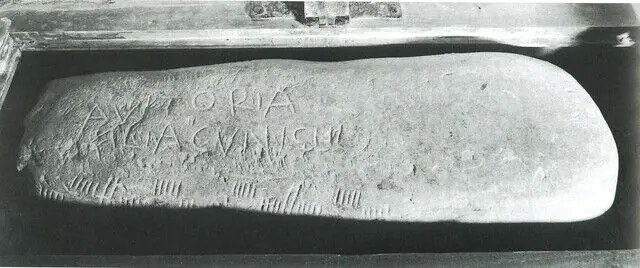
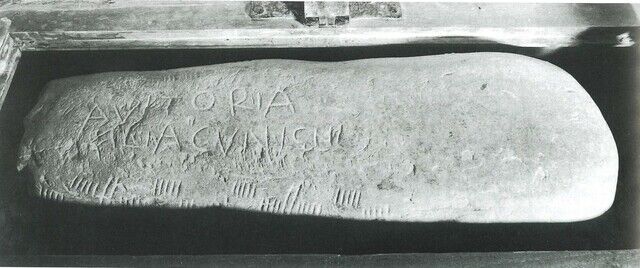
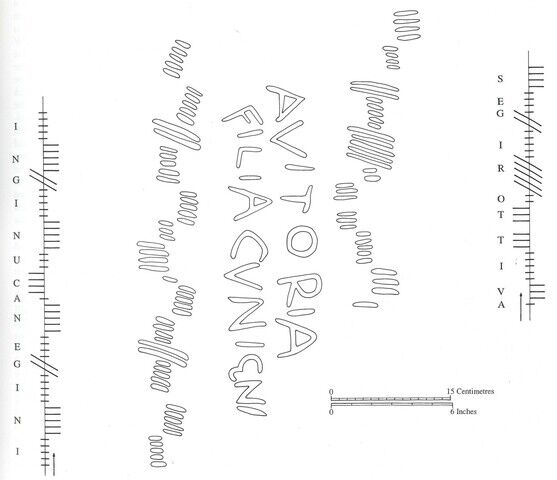
Text field: An ogham inscription is present on both the right and left edges of the stone, beginning around halfway up on the left side and three-quarters up on the right, both terminating at the top corners of the stone. Both ogham inscriptions are read vertically upwards. The stone is also inscribed with a roman-letter inscription in two lines reading vertically downwards.
Letters: The ogham inscription is chiselled and described by Edwards (2007, 214) as ‘deeply incised’. The roman-letter inscription are chisel-cut and pocked and is described as being medium-to-lightly-incised with clearly visible punchmarks (Edwards 2007, 214-215; Macalister 1945, 346).
Date: Later fifth or earlier sixth century A.D. (textual context)
Edition
Ogham text: ᚐᚃᚔᚈᚈᚑᚏᚔᚌᚓᚄ ᚔᚅᚔᚌᚓᚅᚐ ᚉᚒᚅᚔᚌᚅᚔ
Transcription: AVITTORIGES INIGENA CUNIGNI
Translation
Ogham: of Avitoria daughter of Cunignas
Roman: Avitoria daughter of Cunignus
Commentary
‘The inscriptions commemorate a woman. The wording used for both is the female version of the “X son of Y” formula. The Irish word inigena (“daughter”) in ogham is unique. Macalister (1945, 346-347; CIIC: no. 362) suggested that the ogham was changed from inigina to inigena in the course of execution… The name is probably a Celtic feminine name *A(V)ITORIX, comparable with other female names in -rīx… AVITTORIGES/AVITORIA and AVITORI are probably both Irish names cognate with Old British Oedri [from] *Ai(wi)torīg-, “age-king”, and perhaps with Gaulish names such as Aetorius and Aetoria’ (Edwards 2007, 216).
CUNIGNI ‘is probably Irish (Old Irish Co(i)nín)… the papal Taxatio of c.1291 refers to Eglwys Gymyn as Ecclesia de Eglusgluneyn… and if this is a slip for *Eglusguneyn, “Cunein’s church”, note that Cunein is exactly the Welsh form into which Irish *CUNEGNA(S) (nominative of CUNIGNI) would develop’ (Edwards 2007, 216).
‘In the Latin both Avitoria and filia are in the nominative; Cvnigni is in the genitive’ (Edwards 2007, 216).
References
- Edwards 2007, 216
- Macalister 1945, 346-347