Provenance
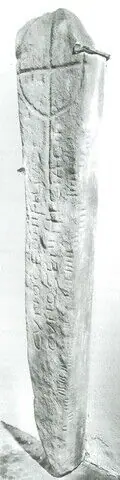
Discovery: The stone was discovered c. 1860 before the rebuilding of St David’s Church in 1861. Previously used as ‘a jambstone in one of the windows’ (Macalister 1945, 328) and as ‘a footstool by the bell-ringer’ (Redknap and Lewis 2007, 242), the stone was moved to its present position before 1909. A reading of the ogham inscription was first published in 1862 by Jones.
Findspot: Trallwng, Brecknockshire (Brycheiniog), Wales (National Grid Reference: SN 96 29)
Last recorded location(s): The stone is inside the church, fixed to the north wall of the nave, to the right of the porch.
Support
National Monuments Record of Wales (NPRN): 151259
Object type: Cross-carved pillar
Material: Sandstone
Dimensions: H 1.77 × W 0.36 × D 0.15 m
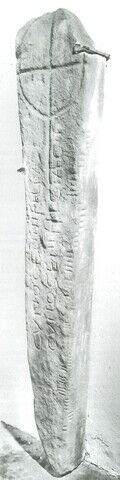
Decoration: The stone was later inverted and reused for a cross-carving (Redknap and Lewis 2007, 242-244). Nash-Williams (1950, 81) described the cross as a linear Latin ringed cross with a prolonged stem.
Condition: One end of the stone has broken off. The ogham and roman-letter inscriptions are worn but are in generally good condition. The cross carving on the new head, partly overrides the tip of two of the end-letters in line 2 of the roman-letter inscription.
Inscription
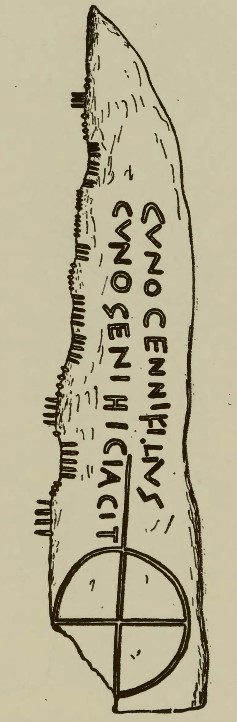
Text field: The stone is inscribed with an ogham inscription running vertically along the left edge of the stone, reading upwards. The stone also has a roman-letter inscription in two lines, reading vertically downwards. The inscriptions are inverted in current display (Redknap and Lewis 2007, 242-244).
Letters: The ogham and roman-letter inscriptions were pocked and rubbed. Macalister (1945, 329) notes that the ogham scores ‘become smaller as the writing proceeds’.
Date: First half of the sixth century A.D. (textual context)
Edition
Ogham text: ᚉᚒᚅᚐᚉᚓᚅᚅᚔ̣ᚐ̣ᚃ[.. ? ..
Transcription: CUNACENNỊ ẠV[.. ? ..] ILVVETO
Critical apparatus:
- The same person is commemorated in both the ogham and roman-letter inscriptions, but by different formulae. The interpretation of the ogham inscription has been subject to much comment. According the Redknap and Lewis (2007, 242), ‘a rubbing suggests the presence of a single stroke (B?) between the V and the beginning of “Ilvveto”’. 2. Macalister (1945, 329) read: CVNACENNIVI ILVVETO
Translation
Ogham: Cunacennus, descendant of Ilvvetus
Roman: of Cunocennus. The son of Cunogenus lies here
Commentary
Sims-Williams (Redknap and Lewis 2007, 242) notes that [A]V[I] in the ogham inscription means either ‘grandson’ or ‘descendant’ in Irish. The use of the word AVI and the ogham script suggests that the name and patronymic are Irish, but they could very well be Old Welsh Concen, MW Cyngen, and Congen, MW *Cynien. Similarly, ILVVETO ‘looks Irish’ but ‘it may be related to the Continental Celtic tribal name Elvetii, Helvetii’(Redknap and Lewis 2007, 244). Macalister (1945, 329) notes that Ilvetto is a ‘territorial designation, indicating the owner of the stone as belonging to a place called Elmet, Elfed, or Elvet, as it is variously spelt’. Sims-Williams (Redknap and Lewis 2007, 242) also highlights that other ‘etymologies connect it with *wed- as in Welsh dy-wed-yd, “to say”, hence “much-speaking, eloquent” or “much-spoken-of, famous” or with OI Féth, gen. Fétho, “?calm, polished”’.
Sims-Williams (Redknap and Lewis 2007, 242) notes the composition vowel A in the ogham script, which suits Irish, ‘while the O in the Roman letters suits Britonnic, so there has been an attempt to translate the name from one language into the other’. Sims-Williams (Redknap and Lewis 2007, 244) suggests that the ogham inscription may belong to the fifth to early sixth centuries.
References
- Redknap and Lewis 2007, 242-244
- Macalister 1945, 328-329, no. 342
- Nash-Williams 1950, 81-82, no. 70