Provenance
Discovery: The ogham was first mentioned in 1859 (Edwards 2007, 290).
Findspot: Bridell, Pembrokeshire, Wales (National Grid Reference: SN 1766 4206)
Last recorded location(s): Standing in the churchyard, south of the church and possibly in situ (Edwards 2007, 290).
Support
Monument Dyfed Archaeological Trust Historic Environment Record 1174St David’s Church
Object type: Pillar
Material: Dolerite
Dimensions: H 2.225 × W 0.635 × D 0.20 m
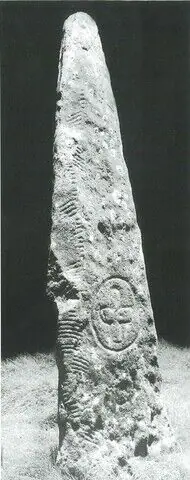
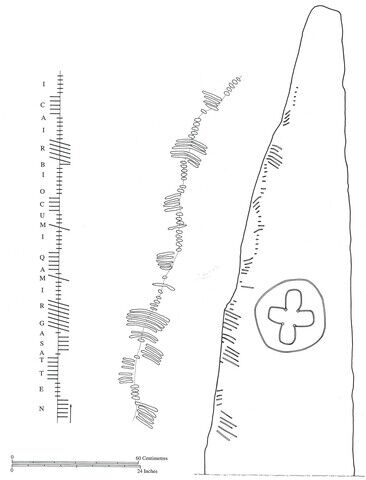
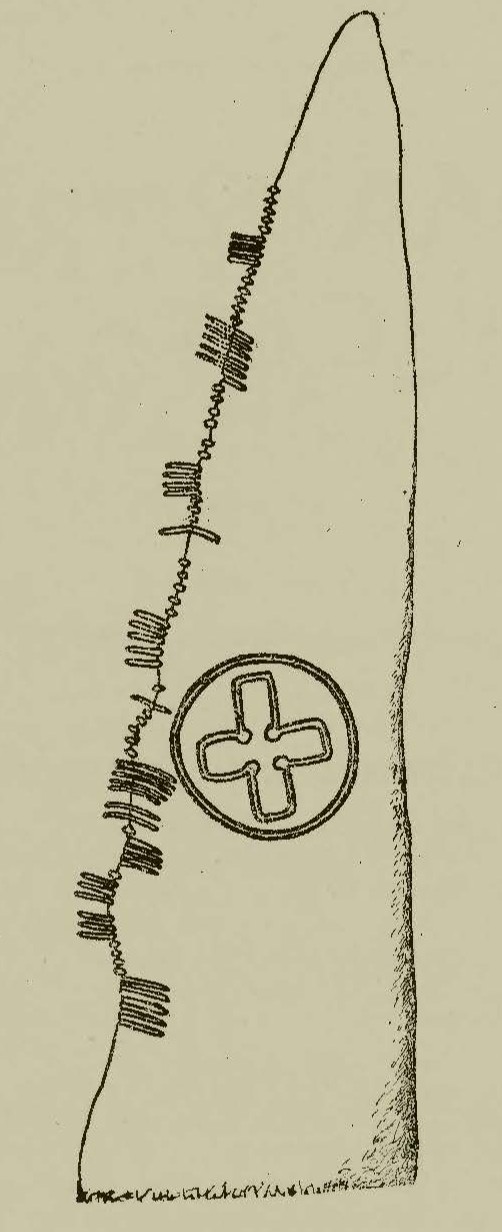
Decoration: There is an equal-armed cross within an circle low down on the side of the stone. According to Edwards (2007, 290), the cross was ‘incised using a broad line’, has ‘rounded, slightly sunken armpits and curved cross-arm terminals’, and was added after the ogham inscription.
Condition: The stone is in good condition but the inscription is extremely worn (Edwards 2007, 290). Macalister (1945, 403) notes that some ‘of the scores are injured by chipping’ or ‘clogged with lichen’. The cross is ‘weathered but clear’ (Edwards 2007, 290).
Inscription
Text field: The ogham inscription consists of one line, reading vertically upwards, and spans almost the entire length of the ‘left, north-east angle of the stone’ (Edwards 2007, 290). Furthermore, parts of the inscribed angle are very uneven (Macalister 1945, 404).
Letters: The inscription has been described by Macalister (1945, 403) as pocked and by Edwards (2007, 290) as ‘medium-incised with broad strokes’. Edwards (2007, 293) notes that the initial stroke of the first letter is ‘extremely worn’ and ‘the strokes of the final word are very weathered’. Edwards (2007, 293) also noted that the ‘cross-strokes of the G and R are unusually long’.
Date: Fifth century A.D. (linguistic)
Edition
Ogham text: ᚅᚓᚈᚈᚐᚄᚐᚌᚏᚔ̣ ᚋᚐᚊᚔ ᚋᚒᚉᚑᚔ̣ ᚁᚏᚔ̣ᚐ̣ᚉᚔ
Transcription: NETTASAGRỊ MAQI MUCOỊ BRỊẠCI
Critical apparatus:
- Edwards (2007, 291-293) notes that the ‘first stroke of the N is extremely worn, but the rest of the first name is clear, apart from the last letter’ which has previously been interpreted as a U or an I. There are three clearly visible vowel-notches ‘which might at first glance suggest a U, but there is certainly room for five, and slight traces of two further notches can be tentatively made out, making the identification of an I more likely’ (Edwards 2007, 293). MAQI is clear as is the majority of MUCOI except for the final letter, ‘where again the vowel-notches are placed at an uneven point on the angle of the stone’ (Edwards 2007, 293). For the final word the first two letters BR ‘can be detected with some confidence’ and the ending is clearly CI (Edwards 2007, 293).
Translation
of Nettasagri son of the kindred of Briaci
Commentary
Edwards (2007, 293) explains that ‘NETTASAGRI is an Irish compound name in the genitive case, *Neta(s)-Sagri, OI Nad Sáir’, meaning ‘champion of a leader’. Furthermore, the ‘personal name embodied in the kindred name was read by Macalister as BRIACI’, however, but *BRIGACI for OI Brígach would be expected in ogham (Edwards 2007, 290).
McManus (1991, 67, 111, 180, n. 56) interpreted the final name as BRECI or SLECI, proposing that ‘MUCOI BRECI may be identical with the Brecraige, a subject people of the Uí Néill in Co. Meath’.
According to Edwards (2007, 290-293), this ‘is the only ogam-inscribed monument from Wales which certainly uses the maqi mucoi (“son of the kindred of”) formula, which is much more common in Ireland’.
References
- Edwards 2007, 290-293
- Macalister 1945, 403-405
- McManus 1991, 67-180