Provenance
Discovery: The ogham was first mentioned in 1880 by Westwood (Edwards 2007, 503).
Findspot: Steynton, Pembrokeshire, Wales (National Grid Reference: SM 9180 0780)
Last recorded location(s): Inside the church, standing against the west face of the most westerly pillar in the north arcade of the nave.
Support
Monument Dyfed Archaeological Trust Historic Environment Record 3369 Church of St Peter and St Cewydd
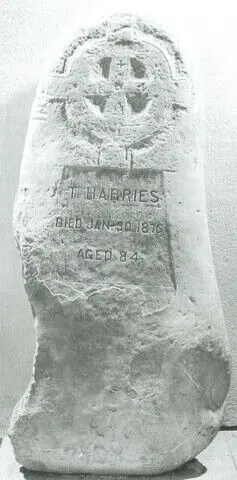
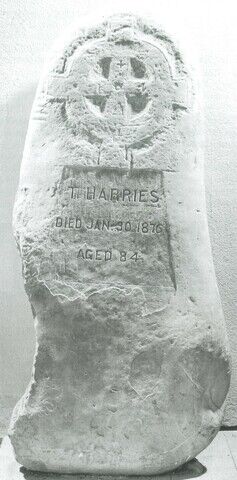
Object type: Boulder
Material: Sandstone
Dimensions: H 1.26 × W 0.51 × D 0.265 m
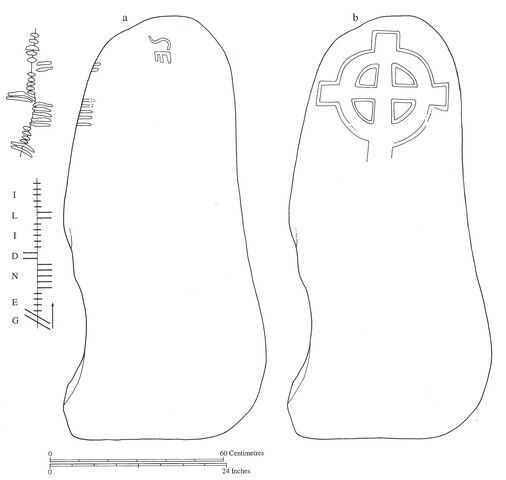
Decoration: In the ninth century an incomplete outline of a Latin ring-cross was added to the face of the stone.
Condition: The end of the left cross-arm cuts the final stroke of the N of the ogham inscription. The majority of the roman-letter inscription was destroyed as a result of the c. ninth century addition of the ring-cross, and the lower cross arm of the Latin ring-cross was subsequently disrupted as a result of the stone being repurposed in 1876 as a gravestone (Edwards 2007, 503).
Inscription
Text field: The ogham inscription is present on the left angle (A/D) of the stone face, reading vertically upwards. It begins in the top quarter of the stone and teminates at the crest of the stone. ‘A fragmentary roman-letter inscription is incised vertically down the centre of the face within the upper cross arm’ of the Latin ring-cross (Edwards 2007, 503).
Letters: The ogham inscription is chiselled and described as ‘deeply incised’ (Edwards 2007, 503).
Date: Fifth of sixth century A.D. (linguistic)
Edition
Ogham text: ᚌᚓᚅᚇᚔᚂᚔ
Transcription: 1 GENDILI
Translation
Ogham: of Gendilus
Commentary
‘GENDILI is a genitive of one or other of the attested Latin names Gentilius, Gentilis or Gentillus, with Ir. /nd/ substituted for the /nt/ that was lacking in Primitive Irish. A related borrowing in Welsh can be seen at Patrishow 1 (B43) in GENILLIN = MW Gen(n)illyn, -in and perhaps in the place name Tref Ginhall (var. Gynnhill, Gynhil) in the Book of Llandaf…’ (Edwards 2007, 504).
‘Although the roman inscription is fragmentary, enough survives to suggest that it mirrored the ogam inscription, being simply a personal name in the genitive case, though the former existence of a longer one-line inscription is also possible’ (Edwards 2007, 504).
References
- Edwards 2007, 503-505
- Macalister 1945, 432-433