Provenance
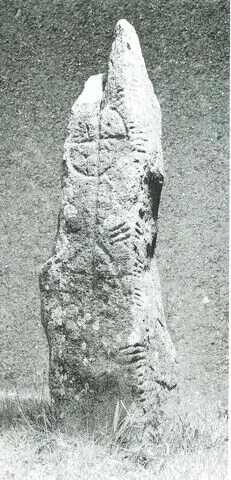
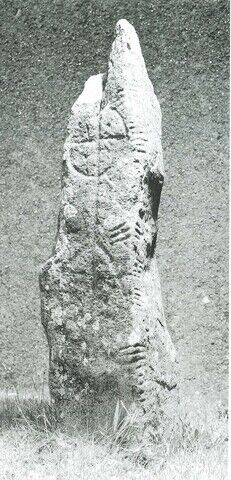
Discovery: First located on Mynydd Stamber, Iet-wen Farm, in the same place that crochanau (pots) and burning were also reported. Removed to Trehowel Farm where it was used as a gatepost before the oghams were first noticed in 1908 (Edwards 2007, 341).
Findspot: Llanfyrnach, Pembrokeshire, Wales (National Grid Reference: SN 174 292)
Last recorded location(s): Standing in the yard of Glandŵr Baptist Chapel, north-west of the entrance.
Support
Monument Dyfed Archaeological Trust Historic Environment Record: 1109 Iet-wen Farm
Object type: Pillar
Material: Dolerite
Dimensions: H 1.40 × W 0.305 × D 0.36 m
Inscription
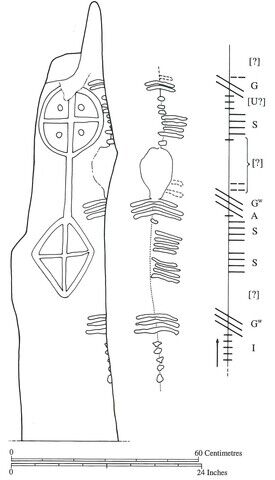
Text field: On the right angle is an ogham inscription, which reads upwards in one line, running the length of the exposed stone (Edwards 2007, 342-343).
Letters: Macalister (1945, 418) described the ogham inscription as pocked.
Date: Fifth or early sixth century A.D. (linguistic)
Edition
Ogham text: ᚔᚍᚓ̣ᚄᚄᚐ̣ ᚍ[---
Transcription: IGʷẸSSẠ Gʷ[---]ASỤGṆ---
Translation
the prayer of Gusugnas
Commentary
‘Gʷ was a rare sound, and the only obvious possibility is something like *[D]IGʷESSA (“prayer”, “petition”?, cf. OI dígde), perhaps followed by a name in the genitive case. The name in question may be one of the many ogham names in -GNI… the nearest are CIIC: nos 287 NISIGNI (cf. OI Nessán) and 236 LOSAGNI (cf. OI Loissín) (Macalister 1945, 229-231, 282-283). If the first letter is definitely Gʷ it is difficult to reconstruct a suitable name, as stems with this initial sound were rare. If the Gʷ were hypercorrected for G, however (cf. frequent hypercorrect Q for C), a possibility is *GʷUSUGNI or *GʷUSOGNI (cf. OI Gussán), a derivative of *gussu-, “valor” (ogham -GUSU)’ (Edwards 2007, 343).
References
- Edwards 2007, 341-344
- Macalister 1945, 417-420