Provenance
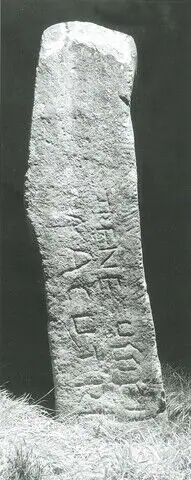
Discovery: The ogham inscription was first mentioned by Lhuyd in a letter to Bishop Humphreys of Bangor in 1698; in 1855 it was standing in its present location and was excavated to reveal the ogham inscription (Edwards 2007, 311).
Findspot: Cilgerran, Pembrokeshire, Wales (National Grid Reference: SN 1906 4305)
Last recorded location(s): Standing in the churchyard south of the church.
Support
Monument Dyfed Archaeological Trust Historic Environment Record: 1179 St Llawddog’s Church
Object type: Pillar
Material: Dolerite
Dimensions: H 2.44 × W .38 × D 0.405 m
Decoration: According to Macalister (1945, 409), there ‘is a plain cross, which might have been made at any time, roughly scratched upon the side of the stone, to the right of the inscribed face’.
Condition: The lower half of the monument is buried, covering the end of the ogham inscription. The visible ogham letters are worn and parts of the angle of the stone are damaged. The visible part of the roman inscription is worn but clear (Edwards 2007, 311-313).
Inscription
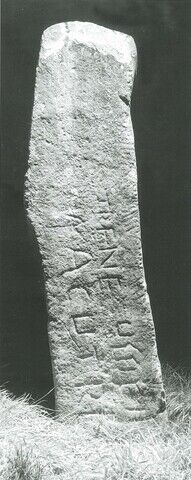
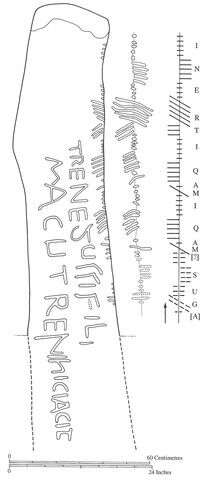
Text field: The ogham inscription is present on the right angle of the face of the stone, ‘on the right angle to the roman,’ and runs vertically upwards, spanning almost the entire length of the exposed surface. A ‘roman-letter, Latin inscription is incised in two lines, running vertically downwards’ (Edwards 2007, 311-313).
Letters: Both the ogham and Latin inscriptions appear to have been pocked (Macalister 1945, 409).
Date: Second half of the sixth century A.D. (linguistic)
Edition
Ogham text: ᚈᚏᚓᚅᚐ̣ᚌᚒᚄ.. ? ..
Transcription: TRENẠGUS.. ? .. MAQI MAQITRENI
Translation
Ogham: Of Trenagus .. ? .. son of Macus-Treni
Commentary
‘The naming pattern of father and son is best paralleled within Insular Celtic inscriptions by BARRIVENDI FILIVS VENDVBARI on Llandawke 1 (CM15) and BIVADI AVI BODIBEVE on Llanwinio 1 (CM34). Irish MACUTRENI and its archaizing ogam equivalent MAQITRENI have been discussed under Brawdy 1 (P1), where the same name appears. The Q of MAQI is probably also archaizing/conservative… Here the -E- for the composition vowel may reflect British influence… and the genitive in -I is either British or more likely Latin. The ogam seems to have the normal Irish composition vowel A, and while it may have had the expected Irish genitive in -O, it may equally well have read TRENAGUS[I] (as Macalister conjectured), copying the Roman TRENEGUSSI’ (Edwards 2007, 311-313).
References
- Edwards 2007, 311-313
- Macalister 1945, 409