Provenance
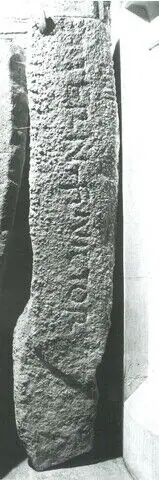
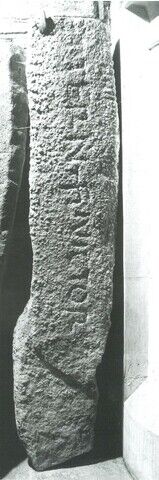
Discovery: The stone was first mentioned in 1859. The stone was either built into or standing close to the north wall of the churchyard and had been adapted for use as a sundial. The first mention of the ogham inscription was in 1879 (Edwards 2007, 316).
Findspot: Clydau, Pembrokeshire, Wales (National Grid Reference: SN 2508 3549)
Last recorded location(s): Inside the church, set against the west wall of the south aisle.
Support
Monument Dyfed Archaeological Trust Historic Environment Record: 1066 Clydau, Clydey; St Clydai’s Church
Object type: Pillar
Material: Dolerite
Dimensions: H 1.78 × W 0.255 × D 0.255 m
Condition: The top of the stone has been cut away which has ‘destroyed the middle of the ogam inscription and the first letter of the roman inscription has been damaged’ (Edwards 2007, 316).
Inscription
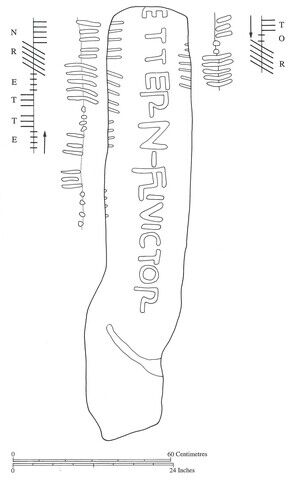
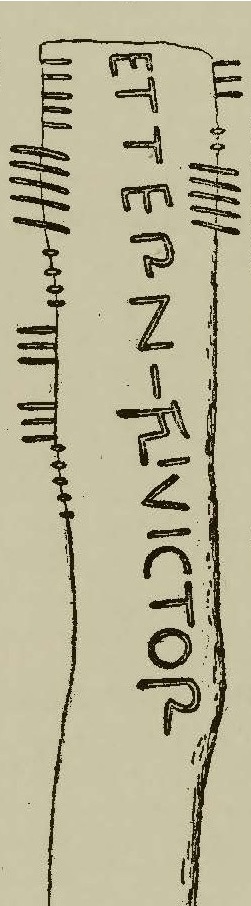
Text field: An ‘incomplete ogam inscription is incised up the left (A/D) and down the right angle (A/B) of the face’ (Edwards 2007, 316-317). The left-angle inscription begins around halfway up the stone and terminates at the top corner. The right-angle inscription begins at the top right corner of the face and terminates around one fifth of the way down the stone face. The Latin inscription consists of one line reading vertically downwards and is centred on the face of the stone, and fills the top three quarters of the stone (Edwards 2007, 316).
Letters: The ogham and Latin inscriptions are pocked. The Latin inscription is ‘incised, using a broad punched line’ (Edwards 2007, 316).
Date: Late fifth or first half of the sixth century A.D. (linguistic)
Edition
Ogham text: ᚓᚈᚈᚓᚏᚅ[---
Transcription: 1 ETTERN[---…]TOR
Critical apparatus:
- ‘Enough survives of the ogam inscription to suggest that it should be reconstructed to read Ettern[i maqi Vic]tor (“of Etternus son of Victor”), thus echoing the Latin. The “X son of Y” formula would therefore be used for both’ (Edwards 2007, 317-318).
Translation
Ogham: of Etternus son of Victor
Commentary
‘In the Latin Etterni and fili are in the genitive case; Victor may be in the nominative. The names are both Latin, which is unusual on monuments with bilingual inscriptions… though both were naturalized in Welsh (Nash-Williams 1950, nos. 97, 271). (A)eternus gave Welsh Edyrn (beside Edern… Victor instead of genitive Victoris is not necessarily an indication of post-apocope date, as it may be an example of nominative for genitive’ (Edwards 2007, 317-318).
References
- Edwards 2007, 316-318
- Nash-Williams 1950, nos. 97, 271