Provenance
Discovery: The ogham inscription was not noticed until Rhys provided a reading of the ogham in 1874. According to the Welsh Corpus, the Roman inscription was recorded in 1695 by Lhuyd, next reported by AJK In 1838 (Edwards 2007, 232). The stone type (‘Fine, well-sorted, pinkish-grey sandstone with quartz content’) is local bedrock (Edwards 2007, 232).
Findspot: Llandawke, Carmarthenshire, Wales (National Grid Reference: SN 2827 1121)
Last recorded location(s): Inside church, mounted horizontally against the east wall of the nave south of the chancel arch.
Support
Dyfed Archaeological Trust Historic Environment Record: 3906 Church of St Oudoceus (Euddogwy)
Object type: Slab
Material: Sandstone
Dimensions: H 1.38 × W 0.30 × D 0.10 m
Condition: Edwards (2007, 232-233) describes the inscriptions as worn.
Inscription
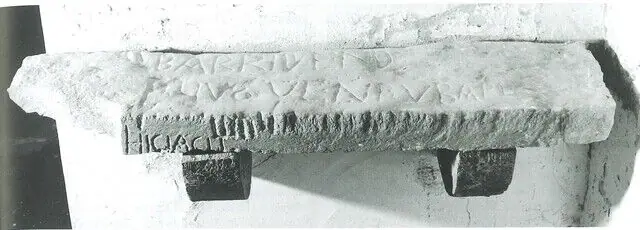
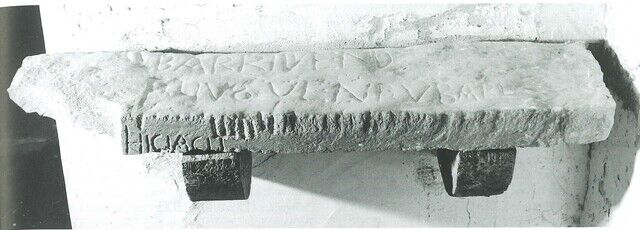
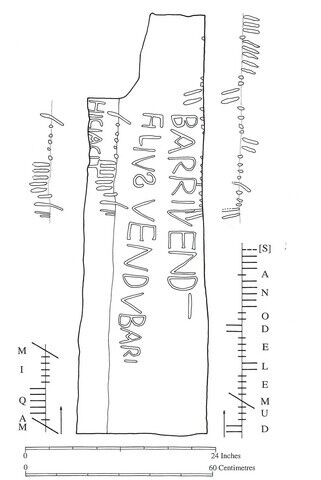
Text field: The ogham inscription is independent of the roman-letter inscription and is present in two lines, both reading vertically upwards. Line 2 begins around halfway up the right-hand edge of the stone (A/B) and terminates at the top right-hand corner; line 1 is present on the left-hand corner of the stone (A/D) but the extent of the inscription is unclear due to significant damage on this side of the stone. The roman-letter inscription is in three lines reading vertically downwards. Lines 1 and 2 are present on the face of the stone (A); line 3 is on its left-side face (D) behind line 1 of the ogham inscription.
Letters: The inscriptions are pocked and described as being incised with visible ‘punchmarks’ (Edwards 2007, 232-233). On the ogham inscription, ‘the V in line 1 of the roman inscription incorporates the second diagonal bar of the ogam D… and the second R overlies the diagonal stroke of the M… The T in line 3 of the roman inscription… cuts through the last three strokes of the ogam Q’ (Edwards 2007, 232-234). In top right-hand corner, the fourth stroke of the final S is missing due to the fracture of the stone. Of the roman-letter inscription, ‘Line 1 is very evenly set out but the letters at the end of line 2 and those in line 3 are significantly smaller than the rest.’ (Edwards 2007, 233).
Date: Fifth century or first half of the sixth century A.D. (linguistic)
Edition
Transcription: [---]MAQI M[---] DUMELEDONAṢ
Translation
Ogham: son of… of Dumel(a)edu.
Commentary
‘It is usual for ogham inscriptions to read up the left angle and then down the right. Here the inscription reads up both angles… Because the ogham inscription is incomplete, the reading is unclear. MAQI is clear. The second M- might be the beginning of MUCOI (“of the kindred of”)… Only the first three strokes of the S of DUMELEDONA[S] are visible, but this is the only reading which would make sense… It is a personal name, Dunmel(a)edu, in the genitive case. The ogham inscription might be translated as “of X son of the kindred of Dumel(a)edu” (as suggested by Macalister (1945, 351-352), CIIC: no 368). The first element of the genitive DUMELEDONAS [from] *Dumel-aidonas, “(possessing) bitter fire”, is the same as in DVMELVS, “not sweet, bitter” on Llandewibrefi 1 (CD8) and cognates cited there. The second element is the oblique stem *Aeðon- of the popular Irish name Áed, “fire” (from which the rare Welsh name Aeddon may be borrowed)’ (Edwards 2007, 234).
‘The roman-letter inscription uses the “X son of Y” formula, with the names in the genitive and filivs in the nominative case. This is followed by the Christian formula hic iacit… The naming pattern of father and son in BARRIVENDI FILIVS VENDVBARI is best paralleled by the Irish names on Llanwinio 1 (W-CMN-002), BIVADI AVI BODIBEVE, and on Cilgerran 1 (W-PEM-004), TRENEGUSSI FILI MACUTRENI. Both elements (“head” and “white”) occur in names in both branches of Insular Celtic, but it may be significant that while the combinations Bairrfhind and Finnbarr are both known Irish names, only Berrwyn occurs in Welsh, and not *Gwynfar. There are no strong grounds for choosing between Irish or Welsh, however’ (Edwards 2007, 234).
References
- Edwards 2007, 232-234
- Macalister 1945, 351-352