Provenance
Discovery: First noted by Camden in 1594; John Lloyd recorded it and the ogham (‘strokes on edges’), and sent mention to Edward Lhuyd in 1693. Published in 1848. Rhys publishes a reading in 1874. The Welsh Corpus comments that ‘the monument was originally located on open moorland just above the 350m (1,150ft) contour…on the north side of the summit was a mound (one of two) [wrongfully] interpreted by John Lloyd as an artificial mound or barrow (Lhuyd 1695, 685-686)…’(Edwards 2013, 317).
Findspot: Clocaenog, Denbighshire, Wales (National Grid Reference: SJ 0525 5324)
Current repository: Wales National Museum Wales (inv. no. acc no NMW 36.473)
Last recorded location(s): National Museum Cardiff.
Support
National Monuments Record of Wales (NPRN): 306621 (Bedd Emlyn)
Object type: Block
Material: Sandstone
Dimensions: H 1.95 × W 0.60 × D 0.55 m
Inscription
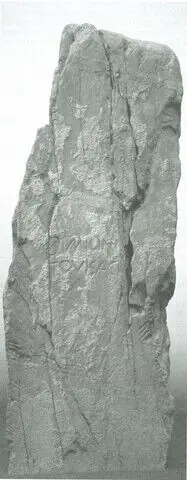
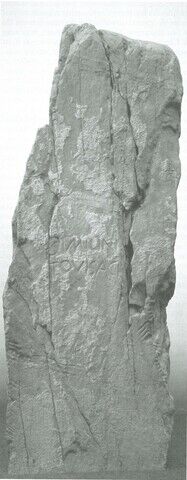
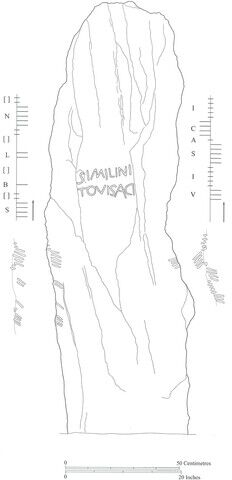
Text field: The stone is inscribed with an ogham inscription on the left and right edge of the roman-letter inscribed face. The placement of the ogham inscription, running up both to the right and left of the main face, is unusual but paralleled elsewhere in Wales such as Eglwys Gymyn 1 (W-CMN-004) and Llanwinio 1 (W-CMN-002). Both ogham inscriptions read vertically upwards and are presumed to read in the order left then right (Edwards 2013, 316-317). The Latin inscription is in two lines, reading horizontally, approximately half-way down the stone. The combination of a horizontal roman-letter inscription with an ogham inscription is unusual but not unprecedented. Welsh parallels include Dolbenmaen 2 (W-CAE-001), Castell Dwyran 1 (W-CMN-005) and Nevern 2 (W-PEM-008) (Edwards 2013, 317).
Letters: Both the ogham and Latin inscription are ‘cut, not pocked’. According to Macalister (1945, 376), the ogham scores are chiselled and ‘look like knife cuts, sloped at an angle to the stem-line’. The roman letters are described as ‘small neat capitals’ (Edwards 2013, 317).
Date: Later fifth or early sixth century A.D> (linguistic)
Edition
Ogham text: ᚄᚒ̣ᚁᚔ̣ᚂᚔ̣ᚅ[---
Transcription: SỤBỊLỊN[---] [---]VISACI
Translation
Ogham: of Sibilin(i)us Tovisacos
Roman: of Similin(i)us Tovisacos
Commentary
The ogham inscription has various interpretations due to the vowel-notches between the consonants in the left line being either partially or fully worn (Edwards 2013, 317). The reading S[i]b[i]l[i]n[i] is based on the length of space between consonants and on the reading of the roman-letter inscription (Edwards 2013, 317-319). The Welsh Corpus (Edwards 2013, 319) comments that ‘the name SIMILINI suggests a Romanized context, but that does not rule out an Irish identity for him as Latin names appear in the ogam inscriptions even in Ireland’. The change of B instead of M in the ogham version of SIMLINI may be due to an error or due to denasalization in Welsh which the Welsh Corpus (Edwards 2013, 319) notes would be early but may also indicate that ‘the inscriber was familiar with the name Similinus in Welsh speech’. The stone’s location and the wording of the inscription may have indicated a claim to the surrounding land and it might be a reused prehistoric standing stood (Edwards 2013, 317).
The interpretation of the initial letter of the roman inscription is debatable but the Welsh Corpus (Edwards 2013, 317) asserts that ‘SIMILINVS … consists of a personal name’. The Welsh Corpus (Edwards 2013, 317-9) comments that the second word of the inscription, ‘TOVISACI/[TO]VISACI is the ancestor…of Welsh tywysog and Irish taoiseach “leader”, used here either as a title or as a second name or patronymic. It is difficult to decide which language it belongs to in the inscription - perhaps to both simultaneously’.
References
- Edwards 2013, 316-319
- Lhuyd and Camden 1695, 685-686