Provenance
Discovery: The stone was first recorded by Skinner in 1802 at Penseri Farm (Penseri Bach, Penseiri Bach) where it was reused as a window lintel in a barn, though it was reported to have been taken from a field nearby. The stone was reported lost for a time but rediscovered in exactly the space spot in 1945. The stone was moved to its current location in 2001 when the barn was demolished. The ogham was first noticed here by Nancy Edwards in August 2007 (Edwards 2013, 162). The stone type (coarse-grained pebbly sandstone) is relatively local in origin (1.5km to NW).
Findspot: Llanfaelog, Anglesey (Ynys Môn), Wales (National Grid Reference: SH 3334 7227)
Last recorded location(s): Set in the concrete in an outbuilding north of the farmhouse at Trecastell, Llanfaelog (Edwards 2013, 162).
Support
National Monuments Record of Wales (NPRN): 407619
Object type: Pillar
Material: Sandstone
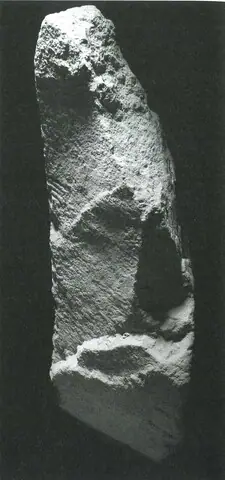
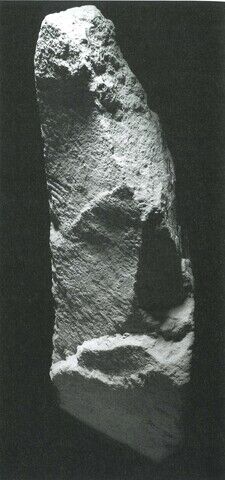
Dimensions: H 1.60 × W 0.45 × D 0.35 m
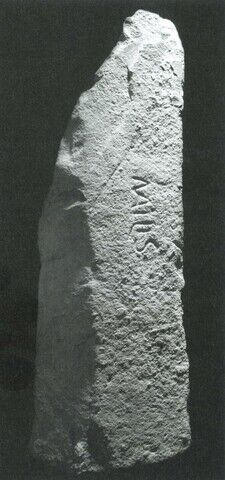
Condition: The ogham and roman-letter inscriptions are in good condition and are clearly legible.
Inscription
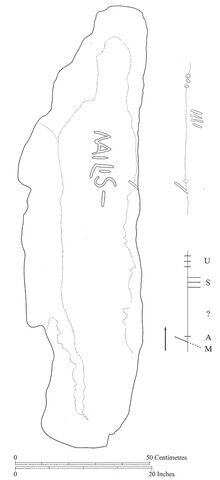
Text field: The stone is inscribed with an ogham inscription which consists of one line and reads vertically upwards. The ogham inscription occupies the right-hand edge of the stone’s largest smooth face. In the centre of this face just beneath a diagonal fault line is a roman-letter inscription. The roman-letter inscription is in one line reading vertically downwards (Edwards 2013, 163).
Letters: Both inscriptions are chiselled. Regarding the ogham inscription, Edwards (2013, 165) notes that the position of the oghams, on the right angle rather than on the left, is less usual, ‘but their closeness to the roman-letter inscription was presumably to indicate that one was the translation of the other’. The characters in the roman-letter inscription are standard capitals (Tedeschi 2005, 198).
Date: Early to mid-sixth century A.D. (linguistic)
Edition
Ogham text: ᚋᚐ[ᚔᚂᚔ]ᚄᚒ
Transcription: MA[ILI]SU
Critical apparatus:
- The fragmentary ogham inscription has been reconstructed with the assumption that it corresponds to the roman-letter inscription, which is supported by the space available between the surviving characters. Regarding the final U, Sims-Williams (Edwards 2013, 164-165) notes that since only three strokes are evident, ‘it should be read, as expected in Irish, as MA[ILI]SU (nominative)’.
Translation
Ogham: Mael Ísu
Roman: of Mailisus
Commentary
The ogham and roman-letter inscription commemorate a person named Mailisi and consist solely of this name. Sims-Williams (Edwards 2013, 165) notes that ‘in theory, MAILISI could be formed from Welsh’. However, the occurrence of ogham on the stone and the fact that the other name from Llanfaelog (CVNOGVSI on Llanfaelog 1 (AN12)) is Irish make it much more likely that MAILISI is Irish, presumably with the element mael meaning ‘bald/tonsured one’ and is common in ecclesiastical names. It seems that MAILISI must be a brutal Latinization of Máel Ísu (‘bald one of Jesus’), with the ubiquitous Latin ‘epigraphic -I’ genitive having been added inappropriately to an Irish name, as also in Llanfaelog 1 and elsewhere in Britain.
Sims-Williams (Edwards 2013, 165) also commented that ‘if there is a connection between MAILISI and the name Llanfaelog, one must assume that the Irish name Máel Ísu was assimilated to the well-known Welsh name Maelog; the latter may have been employed here as a hypocoristic form of Máel Ísu’.
References
- Edwards 2013, 162-165
- Nash-Williams 1950, 55, no.10
- Tedeschi 2005, 198