Provenance
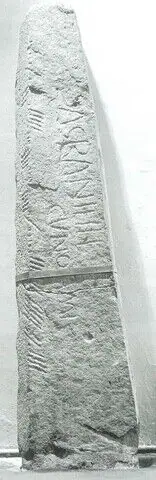
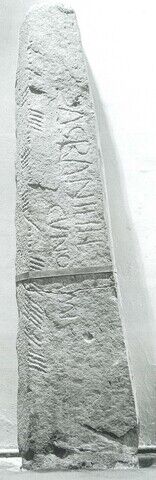
Discovery: The stone was first mentioned by William Gambold 1693 in a letter to Lluyd, when it stood in the ruins of the abbey. The stone was formerly used as a gatepost and as a footbridge across a stream but in 1858 it was built into a wall adjacent to the vicarage. Jones (1860) states that some of the ogham is recorded in a sketch by Lhwyd. The stone was moved to its present position before 1917 (Edwards 2007, 460).
Findspot: St Dogmaels, Pembrokeshire, Wales (National Grid Reference: SN 164 458)
Last recorded location(s): In St Thomas’s parish church (SN 1639 4589) standing against the west wall of the nave (Edwards 2007, 460).
Support
Monument Dyfed Archaeological Trust Historic Environment Record: 1215 Llandudoch; St Dogmael’s Abbey
Object type: Slab
Material: Dolerite
Dimensions: H 2.10 × W 0.495 × D 0.20 m
Condition: The stone was broken in two ‘when it was removed from the wall in 1858 and mended with an iron clamp’ which resulted in both the ogham and Latin inscription to be slightly obscured (Edwards 2007, 460). Despite two fractures running through the ogham inscription, Macalister (1945, 426) noted that ‘both inscriptions are in good condition’ and Edwards (2007, 462) remarked that the ogham inscription was ‘unusually clear’.
Inscription
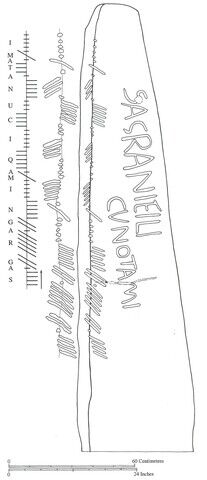
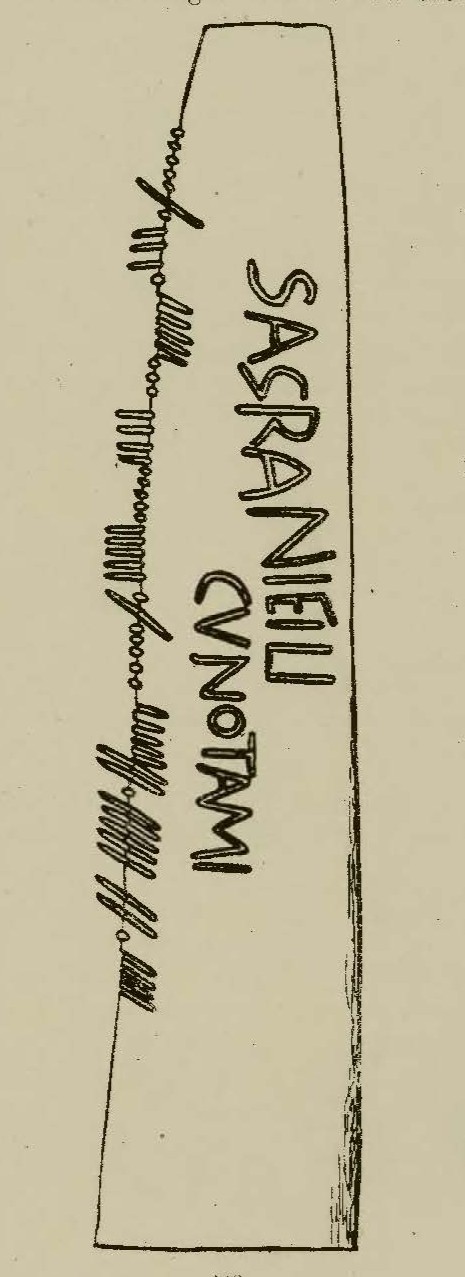
Text field: The ogham inscription is on the left angle of the stone and reads vertically upwards. ‘On the upper part of the stone is a roman-letter, Latin inscription in two lines, reading vertically downwards’ (Edwards 2007, 460-462).
Letters: Both the ogham and Latin inscriptions were ‘incised with a punch’ or pocked (Edwards 2007, 462; Macalister 1945, 426). The Lain inscription also used broad lines. The G and A of the ogham inscription are obscured due to the previously mentioned factures (Macalister 1945, 426; Edwards 2007, 460). The roman-letters consists of capitals.
Date: Fifth or early sixth century A.D. (linguistic)
Edition
Ogham text: ᚄᚐᚌᚏᚐᚌᚅᚔ ᚋᚐᚊᚔ ᚉᚒᚅᚐᚈᚐᚋᚔ
Transcription: SAGRANI MAQI CUNATAMI
Critical apparatus:
- The stone was ‘known, rather grandiloquently, as the “the ogham Rosetta stone”’ because it was ‘one of the first of the bilateral inscriptions to be discovered’ (Macalister 1945, 426). 2. Both the ogham and Latin inscriptions use the ‘X son of Y’ formula in the genitive case.
Translation
Ogham: of Sagragnus son of Cunatamus
Commentary
In regards to the first element of the ogham inscription, Edwards (2007, 462) states that while ‘the patronymic is typically Welsh, SAGRA(G)NI is presumably OI Sárán, not a hypothetical Welsh *Haeron’. Edwards (2007, 462) points out that the ogham spelling ‘SAGRAGNI is more conservative than the roman SAGRANI’ and how it is ‘odd that G is still shown in the first syllable but in Ireland CIIC: no. 317 MAGLANI is comparable’ (see Macalister 1945, 305-306). ‘Further evidence for the Irish name in Britain is provided by SAGRANVI on the reverse of the ogam stone from Fardel, Devon (Macalister 1945, 468-469; Okasha 1993, 13), perhaps a hybrid of Irish SAGRAN- with the well-known Brittonic termination -wy’ (Edwards 2007, 462). The first personal name SAGRAGNI is followed by MAQI for mac ‘son’.
The second name in both inscriptions inscribed as CVNOTAMI in the roman-letter inscription ‘is typically British, OW Condaf, MW Cyndaf, and means something like ‘most hound-like’.’ (Edwards 2007, 462). Edwards (2007, 462) suggests that the ‘T rather than D in CUNATAMI may be copied from the roman-letter form’.
References
- Edwards 2007, 460-462
- Macalister 1945, 425-426
- Okasha 1993, 13