Provenance
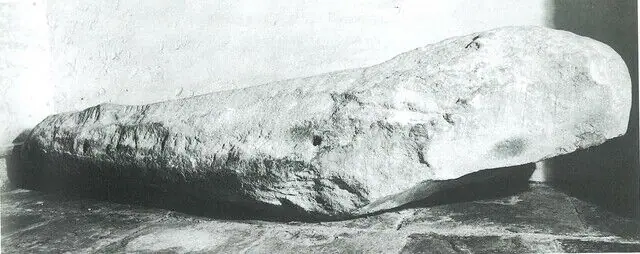
Discovery: The ogham was first noticed in 1883 when the stone was in use as a gatepost at the entrance to the yard of Castle Villa farm. It was moved to Brawdy churchyard in 1896-1897 and was placed in the church porch by 1922 (Macalister 1922, 31). According to Edwards (2007, 284), ‘the shape and large size of the monument might suggest it is a reused prehistoric standing stone’.
Findspot: Brawdy, Pembrokeshire, Wales (National Grid Reference: SM 882 276)
Last recorded location(s): In St David’s Church, Brawdy, lying on the west side of the porch.
Support
Monument Dyfed Archaeological Trust Historic Environment Record 2764 Castle Villa (Castell Villia, Caswilia) Farm
Object type: Pillar
Material: Dolerite
Dimensions: H 2.85 × W 0.56 × D 0.46 m
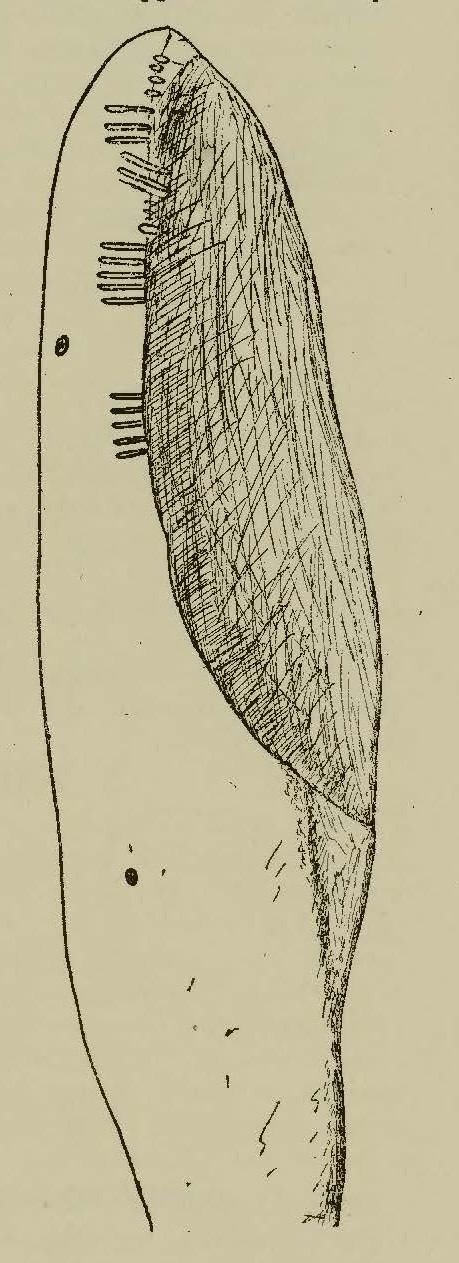
Condition: The ogham-bearing stone has two gate-hanger holes on its back face. The ogham inscription is fragmentary.
Inscription
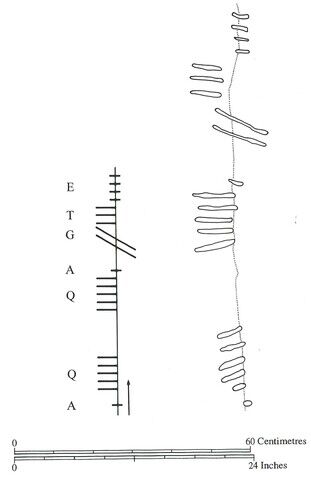
Text field: The fragmentary inscription consists of one line, reading vertically upwards, and survives on the left angle of the stone (Edwards 2007, 284).
Letters: The ogham letters were described by Edwards (2007, 284) as ‘medium-incised’ and appear to have been chiselled.
Date: Fifth or early sixth century A.D. (linguistic)
Edition
Transcription: [---]AQ vac. QA vac. GTE[---]
Critical apparatus:
- The first legible letter is an A and the following Q is certain. Then, as Edwards (2007, 284) notes, there is ‘a gap with no visible carving, though there would have been room for the five notches of an I’. 2. According to Macalister (1945, 401), after the second Q there is one vowel-notch, followed by a space ‘in which nothing can be found but three little nicks’. However, Macalister (1945, 401) concludes that these marks ‘are hardly to be taken with the genuine notch to make E’. 3. Rhys (1985, 185-186) read an M and A before the first Q, but Macalister (1945, 401) maintains that these marks are illusory as they ‘are not nearly so definite as the Q’.
Translation
son of Cacht
Commentary
As Edwards (2007, 284) explains, although ‘AQ is clear, there is no sign of the five vowel-marks for I, which makes [M]AQ a slightly more likely restoration than [M]AQ[I]’. The first element of the inscription is likely MAQ for mac ‘son’. Similarly, while it is certain that the first two letters of the name are QA ‘other vowels could have been intended, in view of the space before the GTE. The combination of GT is puzzling, and there is something to be said for Rhys’s (1895, 185-186) suggestion that GT represents the OI cht’ (Edwards 2007, 284). The name could, therefore, be read as Cacht which is mentioned in the Irish geneaologies as ‘the name of the legendary daughter of Cathmand, a king of Britain’ (Edwards 2007, 284). It also occurs as a male name, ‘presumably based on the OI cacht’, meaning ‘servant, slave’, and ‘arguably a Celtic cognate or derivative of Latin captus, capta. If this name is meant, the ogam Q must be a false archaism or hypercorrection for C’ (Edwards 2007, 284).
References
- Edwards 2007, 284-285
- Macalister 1922, 29-32
- Macalister 1945, 400-401
- Rhys 1895, 180-190