Provenance
Discovery: First recorded in 1698 by Lhuyd and his assistants standing at the east end of St Teilo’s Church, Llandeilo. It is unclear if the ogham was identified at that time. According to Collier and Allen, the ogham was ‘discovered’ by Collier in 1889. By 1914, the stone was standing outside the entrance to the churchyard, right of the gate. The stone was moved to its present location in 1959 (Edwards 2007, 329).
Findspot: Llandeilo Llwydarth, Pembrokeshire, Wales (National Grid Reference: SN 0996 2691)
Last recorded location(s): In St Mary’s church, Maenclochog, set against the south wall at the west end.
Support
Monument Dyfed Archaeological Trust Historic Environment Record: 1311 St Teilo’s Church
Object type: Pillar
Material: Dolerite
Dimensions: H 1.75 × W 0.46 × D 0.23 m
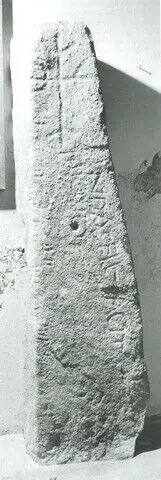
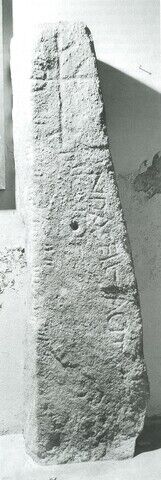
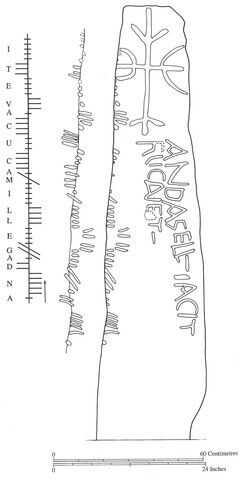
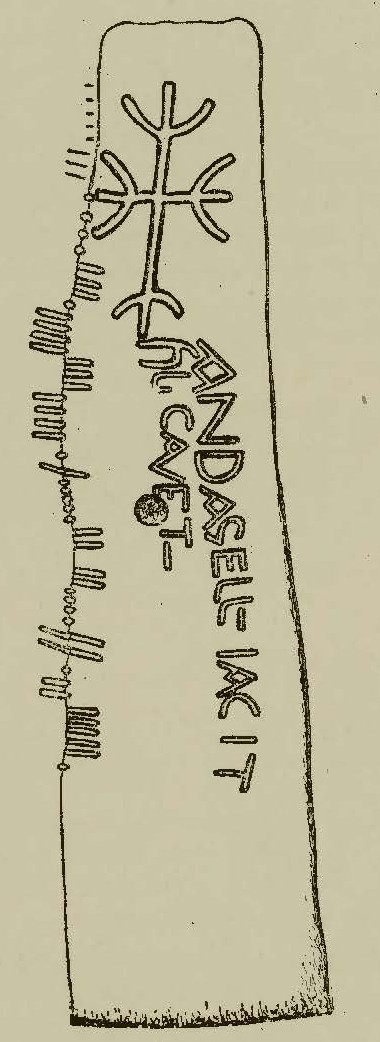
Decoration: The top of the stone is decorated with a linear Latin cross which is deeply incised using a broad line. Edwards (2007, 331) described the cross-arms as having ‘trifid terminals’ and ‘the outer terminals of the horizontal cross-arms are curved’.
Condition: The stone had fallen sometime before 1908 and was re-erected. The cross obscures the last two letters of the ogham inscription. The Latin and ogham inscriptions are ‘very worn, the cross less so’ (Edwards 2007, 329). Macalister (1945, 413) remarked that the inscriptions are ‘clogged with lichen, which renders them difficult to decipher’.
Inscription
Text field: The ogham inscription is on the left angle and reads upwards.The roman-letter inscription reads vertically downwards in two lines and takes up much of the right central third of the stone face (Edwards 2007, 331).There is a ‘gate-hanger hole’ in the centre of the inscribed surface which cuts through the second line of the roman inscription.
Letters: Both the ogham and Latin inscriptions are pocked (Macalister 1945, 413). The roman-letter is more lightly incised than the ogham inscription. According to Edwards (2007, 329), the left horizontal cross-arm runs into the last notch of the T in the ogham, while the upper part of the curved bar overlies the third notch of the I in the ogham. The Latin inscription consists of capitals. (Edwards 2007, 331).
Date: Early to mid sixth century A.D. (linguistic)
Edition
Ogham text: ᚐᚅᚇᚐᚌᚓᚂᚂᚔ ᚋᚐᚉᚒ ᚉᚐᚃᚓᚈᚔ
Transcription: 1 ANDAGELLI MACU CAVETI
Critical apparatus:
- The roman-letter inscription ‘consists of the “X son of Y” formula in the genitive case with the addition of iacit. The incorporation of the abbreviated hic iacit formula indicates that the inscription is Christian’ (Edwards 2007, 331). The ogham inscription ‘mirrors the Latin but without iacit. MACU is written instead of the usual maqi’ (Edwards 2007, 331).
Translation
Ogham: of Andagellus son of Cavetus
Commentary
Edwards (2007, 331) explains that the name ANDAGELLI ‘is probably not British but a preform of the poorly attested OI Indgall, ‘very yellow’. The initial A- has been regarded as British or British-influenced, but could be an archaic Irish feature, since OI Ind- developed from *Ande-’. The name can alternatively be segmented AN-DAG-ELLI, ‘little bad one’ (Edwards 2007, 331).
The first personal name ANDAGELLI is followed by MACU for mac ‘son’ which is followed by the second personal name CAVETI.
References
- Edwards 2007, 329-331
- Macalister 1945, 413-414