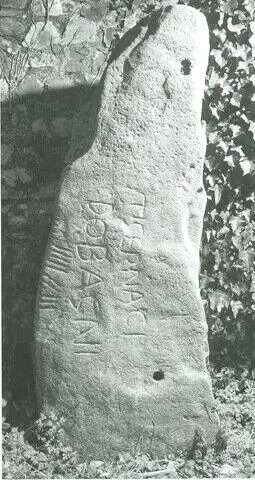
Provenance
Discovery: First mentioned in 1896 built into a wall near Llangwarren House, where it had formerly been used as a gatepost. The ogham was published in 1897 (Edwards 2007, 325).
Findspot: Jordanston, Pembrokeshire, Wales (National Grid Reference: SM 929 313)
Last recorded location(s): In the garden north-east of Llangwarren House.
Support
Monument Dyfed Archaeological Trust Historic Environment Record: 2582 Llangwarren (Llangwarran) House
Object type: Pillar
Material: Dolerite
Dimensions: H 1.55 × W 0.62 × D 0.27 m
Inscription
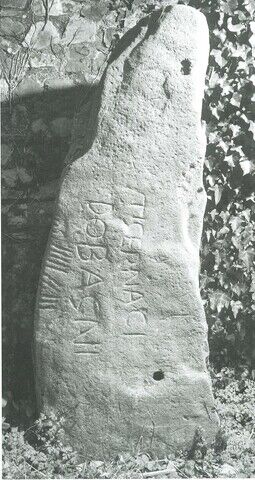
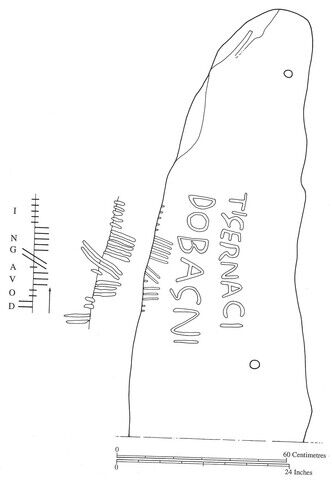
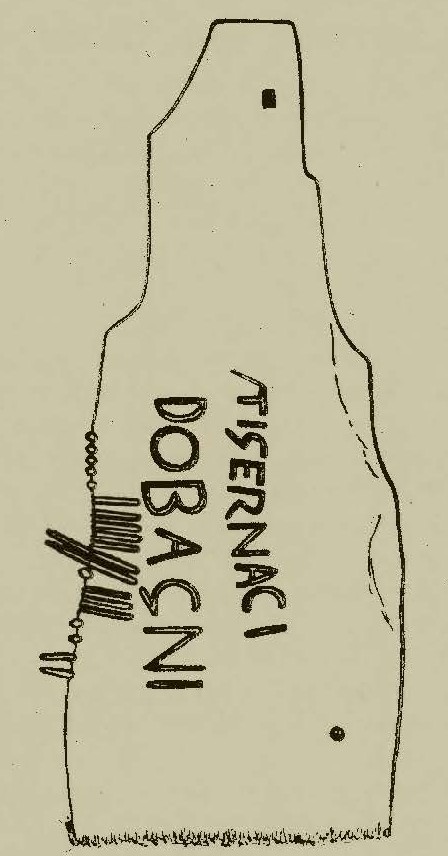
Text field: The ogam inscription is on the left angle (A/D), reading upwards (Edwards 2007, 325). The roman-letter inscription is in two lines, reading vertically downwards.
Letters: The ogham and Latin inscriptions are both pocked. According to Edwards (2007, 325), the ogham inscription is ‘medium incised’ and the Latin inscription is also ‘medium incised, using a broad, punched line’. The letters of the roman-letter inscription are in capitals (Edwards 2007, 325).
Date: Fifth or early sixth century A.D. (linguistic)
Edition
Ogham text: ᚇᚑᚃᚐᚌᚅᚔ
Transcription: 1 DOVAGNI
Translation
Ogham: of Dovagnus
Commentary
‘The ogam inscription consists of a personal name DOVAGNI in the genitive case… DOVAGNI/DOBAGNI is OI Dubán…“black”. Possible evidence of the Irish name in Wales is the place-name Merthyr Dyfan (Dovan) in Glamorgan’ (Edwards 2007 , 326-327).
‘DOVAGNI and DOBAGNI are clearly the same person, and the roman and ogam inscriptions have been placed side by side which draws attention to this… The ogam inscription may commemorate the father while the roman inscription commemorates his son, with the name and patronym only, rather than the Latin “X son of Y” formula. Secondly, the same person may be commemorated in both the roman and ogam inscriptions, but TIGERNACI has been placed above DOBAGNI, rather than below, in order to show the relationship of the latter to the ogam letters’ (Edwards 2007, 326-327).
References
- Edwards 2007, 325-327