Provenance
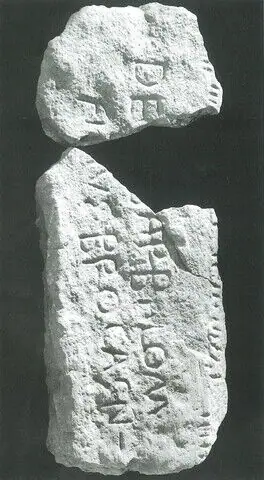
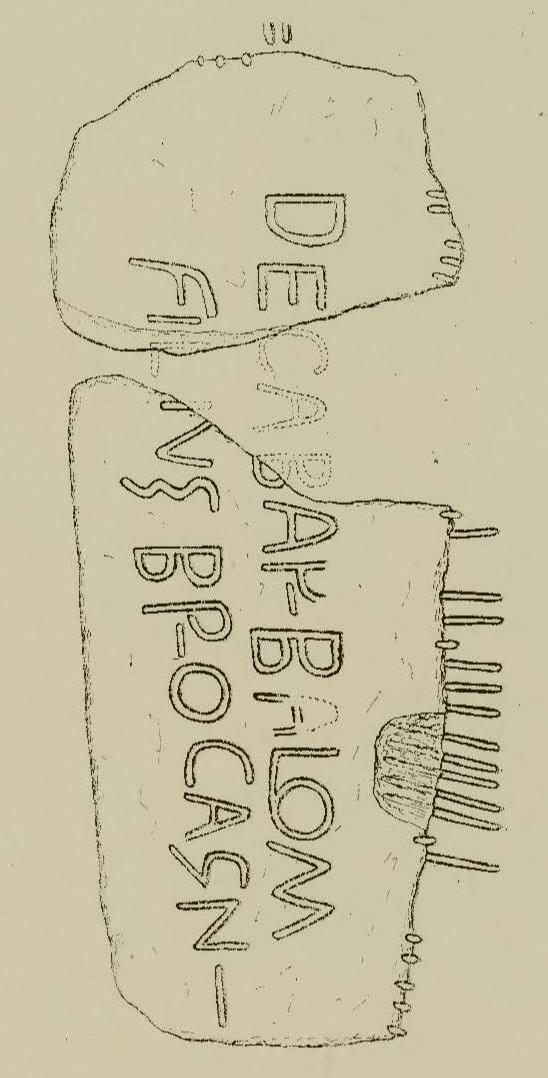
Discovery: First noted 1828 near the ruin of old Capel Mair and drawn by the then vicar Reverend David Morgan sometime before 1855 (according to Rhys 1907). The first reading of the ogham was given by Rhys in 1875. The monument was broken up before 1855 and lost. Two small fragments were rediscovered in 1900 during the demolition and rebuilding of a cow-house at Tan-y-Capel (Dancapel) Farm (Edwards 2007, 251). The smaller of these fragments was lost again by 1907, but was rediscovered again by 1938. A substantial fragment constituting the head of the stone was found serving as a drain-cover at Tan-y-Capel farm in 1936. The three fragments were moved to their present location before 1938.
Findspot: Llangeler, Carmarthenshire, Wales (National Grid Reference: SN 403 380)
Last recorded location(s): In Capel Mair, at the west end in a glass case.
Support
Dyfed Archaeological Trust Historic Environment Record: 1778 Capel Mair
Object type: Slab
Material: Sandstone
Dimensions: H 0.44 × W 0.18 × D 0.395 m
Condition: Originally a slab, the monument was broken up and is now incomplete, consisting of three fragments. According to Edwards (2007, 251), ‘the fragments may also have been split lengthways’. Consequently, parts of the roman and much of the ogham inscriptions have been lost (Edwards 2007, 251). The extant letters of the roman inscription are in good condition with Macalister (1945, 355) noting that the ‘last A of the first line is worn; this is the only injured letter in the surviving part of the inscription’.
Inscription
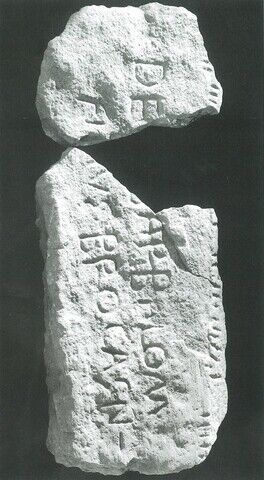
Text field: The fragmentary ogham inscription is deeply incised up the right angle of the face. There may also be traces of possible ogham strokes on the top left corner of the fragment of the top of the slab. The surviving parts of the ogham inscription are placed to the right of the roman inscription, rather than to the left, as is more usual, and possibly continued round the top of the monument. The Latin inscription is deeply incised in two lines and reads vertically downwards.
Letters: Macalister (1945, 354) described both the ogham and roman-letter inscriptions as pocked. The ogham inscription is fragmentary, ‘the beginning is still missing’ (Macalister 1945, 355). Where the larger and smaller fragments join, the ends of two ogham strokes are visible but this area is too damaged to determine for sure. The only ogham letters that can be read with any certainty are found at the bottom of the more substantially sized fragment. There may be a further one or two strokes at the top of the smaller fragment. The fragment comprising the top of the slab has ‘slight notches on the top-left corner’ which might be ogham but this is unclear, though the ends of strokes are visible in the lower-right corner of the fragment (Edwards 2007, 252). ‘The Latin inscription is in capitals, with a space between the two words in line 2’ (Edward 2007, 251-252).
Date: Early to mid sixth century A.D. (linguistic)
Edition
Transcription: [---]IBA[---]
Critical apparatus:
- The missing and fragmentary letters of the ogham inscription were reconstructed from Morgan’s drawing (Illus. CM25.2; Edwards 2007, 251). Edwards (2007, 252) cautions that ‘although Morgan’s drawing of the roman-letter inscription appears accurate, his record of the ogam inscription seems unreliable’. Edwards (2007, 252) notes that the monument was probably already damaged at the time of drawing and, more importantly, that ‘ogam inscriptions were not understood at this time’ (Edwards 2007, 251-252). 2. According to Edwards (2007, 252), ‘it is difficult to tell the relationship of some of the surviving ogham strokes to the centre line, and this, and the fact that many are fragmentary, makes their reading very difficult’. Edwards (2007, 252) read only three ogham letters with certainty but maintained that the five strokes before could been an R or an N and the three strokes afterwards could be a V. -IBA- 3. Based on Morgan’s drawing and his own field notes, Macalister (1936, 152-153) reconstructed the ogham inscription as: [DECCA]IBARVALB(I) [MAQI B]RO[CAG]NI
Translation
Roman: of Decabarbalom son of Brocagnus
Commentary
Sims-Williams (Edwards 2007, 253-254) notes that while ‘the last two letters of IBA on fragment c. are easily equated with the start of roman BARBALOM, the I cannot be connected with DE[CA] unless it is a completely artificial genitive ending, but could perhaps be the remains of the presumed nominative preform of Daig, namely *Degwi(s). An ogam spelling DEGWGWI ABARVALOB would fit Morgan’s drawing up to a point, which begins with DE, followed by two three- or four-stroke consonants, and then six vowel notches. BROCAGNI rather than *BROCANN is likely to be a conservative or archaic spelling in this very well-known name’.
The roman-letter inscription consists of the Latin ‘x son of y’ formula, with filivs in the nominative and Brocagni in the genitive (Edwards 2007, 252). However, as Edwards (2007, 252) highlights, the ‘form of the first name is problematic and depends partly on Morgan’s drawing’. The last name is legible and, as Sims-Williams (Edwards 2007, 253) confirms, ‘BROCAGNI is definitely Irish, the ancestor of Old Irish Broccán’. According to Sims-Williams (Edwards 2007, 253) ‘BROCAGNI has a genitive ending, whereas DE[CAB]ARBALOM seems to be uninflected’ and ‘BARBALOM (allegedly BARVALB in the ogam) may be an Irish name or epithet *Barrobalvos, “Dumbhead”, with the British -LOM (with M as spirant /v/) being an attempt to spell the Irish svarabhakti in OI balb, “dumb”’. Alternatively, Sims-Williams (Edwards 2007, 253) suggests another possibility, ‘to divide DEC ABAR-BALOM, with DEC as a form of nominative Daig and ABAR- as the Old Irish intensive abar-, hence “very dumb”’.
References
- Edwards 2007, 251-254
- Rhys 1907, 66-102
- Rhys 1875, 359-371
- Macalister 1936, 152-153
- Macalister 1945, 354-356