Provenance
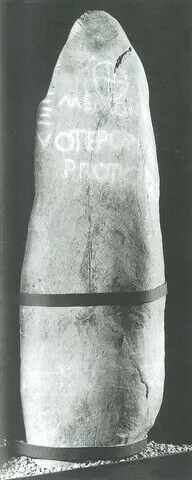
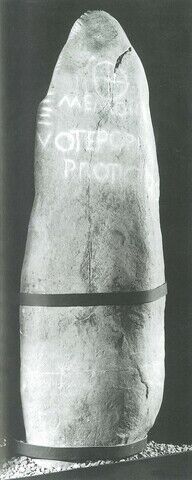
Discovery: Ogham inscription read by Rhys in 1895. Stone first noted in August 1895 standing in a field in front of Gwarmacwydd House, Llanfallteg (SN 161 208); it had been brought there from 1880 from Castell Dwyrann church (Edwards 2007, 202).
Findspot: Castell Dwyran, Carmarthenshire, Wales (National Grid Reference: SN 1440 1819)
Current repository: Wales Carmarthen Museum, Abergwili (inv. no. acc no A76.3537)
Last recorded location(s): Carmarthen Museum.
Support
Dyfed Archaeological Trust Historic Environment Record: 3731 St Teilo’s Church
Object type: Pillar
Material: Tuff
Dimensions: H 2.11 × W 0.71 × D 0.28 m
Inscription
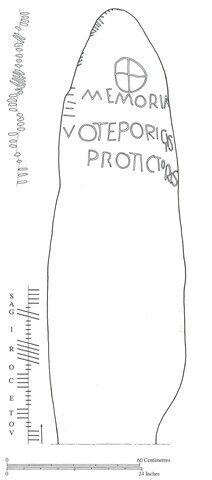
Text field: The ogham inscription begins in the top quarter of the left edge of the stone, and continues vertically along the edge, terminating at the stone’s highest point. A corresponding roman-letter inscription occurs in three somewhat uneven, horizontal lines.
Letters: The ogham inscription is ‘medium-to-lightly-incised’ and the strokes are ‘small and short’ (Edwards 2007, 204-205). The Latin inscription is described as being lightly incised and the letters are in capitals (Edwards 2007, 204-205).
Date: Late fifth or earlier sixth century A.D. (linguistic)
Edition
Ogham text: ᚃᚑᚈᚓᚉᚑᚏᚔᚌᚐᚄ
Transcription: VOTECORIGAS
Translation
Ogham: of Votecorix
Roman: The memorial tomb/tomb of Voteporix the Protector
Commentary
The ogham inscription denotes only the name of the person commemorated, in the genitive case. The name VOTECORIGAS derives from the genitive Celtic *Votekworīgos>, ‘refuge-king’, and shares the element *tekwo-> with the Silchester ogham TEBICATOS, and the prefix *wo- with the Old Welsh name Guotepauc. ‘It is not clear whether the Irish form translates the Welsh or vice versa: while the ogham O may copy the Brittonic composition vowel, it could be an independent Irish development due to the rounding influence of *Q > C. The preservation of -S despite the destabilization of *Q may betray archaization in the ogham’ (Edwards 2007, 205-206).
The Latin inscription includes the term protectoris which originally referred to a member of the Roman imperial bodyguard and could be a hereditary title. The title might ultimately go back to the period of the Roman occupation (Alcock 1971, 122-123). This inscription ‘is the only example of the use of the Latin memoria in Wales’ (Edwards 2007, 205).
References
- Alcock 1971, 122-123
- Edwards 2007, 203-206