Provenance
Discovery: The stone was found in the churchyard in 1846 while digging foundations for the new church, close to the west wall of the previous building. At some point the inscribed stone was inverted and reused as a cross-carved stone. It was moved to Middleton Hall c. 1852 and donated to the Carmarthenshire Antiquarian Society in 1919. The first reading of the ogham inscription was published by G G Francis in 1867.
Findspot: Llanwinio, Carmarthenshire, Wales (National Grid Reference: SN 2610 2646)
Current repository: Wales Carmarthen Museum, Abergwili (inv. no. acc no A76.35.34)
Last recorded location(s): Now in the Carmarthen Museum, Abergwili (acc no A76.35.34).
Support
Monument Dyfed Archaeological Trust Historic Environment Record: 3943 St Gwinio’s Church
Object type: Pillar
Material: Gabbro
Dimensions: H 1.14 × W 0.38 × D 0.305 m
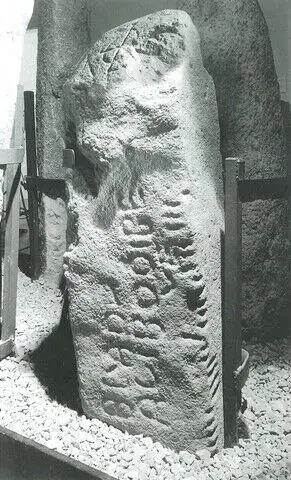
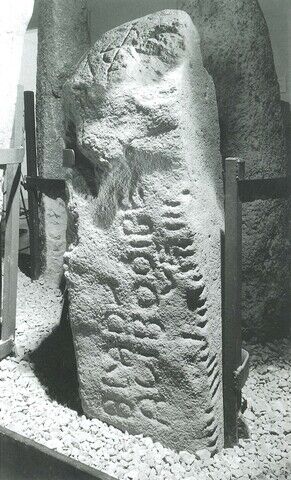
Decoration: There is a ‘very lightly scratched, uneven’ linear ring cross centred near the top of the vertical face (Edwards 2007, 265).
Condition: Macalister (1945, 359) notes that ‘the top of the stone is broken, carrying off some’ of the ogham letters, and that ‘there must have been a third line of ogham on a back angle, which has been split off and lost’. Edwards (2007, 264), however, explains that the ‘original top (now the bottom) is concealed’ rather than broken. According to Edwards (2007, 264), both ogham inscriptions are incomplete and the surviving letters are ‘very worn’. The ogham inscription on the right angle of the stone is ‘very fragmentary’ (Edwards 2007, 266). The roman-letter inscription is equally ‘very worn but clear’ (Edwards 2007, 264). Additionally, the ‘present top of the stone is damaged and part of the right side of the ring-cross is missing’ (Edwards 2007, 264).
Inscription
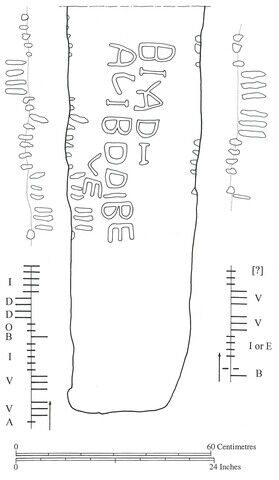
Text field: The two incomplete ogham inscriptions are along ‘the original right (A/B) and left (A/D) angles of the face, both reading upwards from the original base’ (Edwards 2007, 267). Edwards (2007, 265) notes that the ogham inscriptions are ‘positioned so that the corresponding words are near their roman equivalents’. Additionally, Edwards (2007, 267) points out that ‘the short central stroke of the second V on the left side suggests that the ogham inscription was cut after and shortened so as to avoid line 3 of the roman inscription’. The roman-letter inscription consists of ‘three lines reading vertically downwards (from the original top of the monument)’ (Edwards 2007, 264).
Letters: The two ogham inscriptions are pocked or as Edwards (2007, 265) describes ‘deeply incised, using broad strokes’. According to Edwards (2007, 264), the roman-letter inscription is ‘incised, using very broad lines’ or as Macalister (1945, 359) noted ‘pocked and rubbed smooth’. The roman-letter inscription consists of capitals (Edwards 2007, 264-265).
Date: First half of sixth century A.D. (linguistic)
Edition
Ogham text: ᚁ[ᚔ]ᚃᚃ[---
Transcription: B[I]VV[---] AVVI BODDI[---]
Critical apparatus:
- Regarding the ogham inscription on the right angle, Edwards (2007, 266) notes ‘B[. ]VV[. ]- is reasonably secure. Four notches of the second letter are clearly visible, suggesting an E, but a gap follows, with a possible fifth notch making an I also possible. At the end of the inscription three vowel-notches are clearly visible, but the angle beyond these is damaged. On linguistic grounds this may read A followed by a second vowel, now incomplete, perhaps I’. 2. For the ogham inscription on the left angle, Edwards (2007, 266) confirms that ‘AVVIBODDI- is clear’, however, Macalister (1945, 359) ‘then shows a B followed by a vowel notch’ (BA) which ‘cannot be verified since they are not at present visible’. 3. The ogham inscription is a variant of the ‘X son of Y’ formula. Despite its fragmentary state, enough survives to demonstrate that the ogham inscriptions are ‘broadly the same as the roman, but the forms of the names are slightly different and avi is spelt avvi’ (Edwards 2007, 267).
Translation
Ogham: Bivv… grandson (or descendant) of Boddi…
Commentary
Sims-Williams (Edwards 2007, 267) confirms that both Llanwinio names are Irish and contain the popular Insular Celtic name-element ‘living’ (Old Irish béo, Welsh byw). According to Sims-Williams (Edwards 2007, 267), if ‘the restoration BIVVA[IDONA(S)] is correct it is OI Béoáed, “living fire”’. However, Sims-Williams (Edwards 2007, 267) contends that it is most likely a ‘preform of the attested Old Irish masculine o-stem name Búaidbéo, “victory-living”, in which case -E represents the Irish or Latin genitive -I’. Sims-Williams (Edwards 2007, 264-267) also cautions that linguistically ‘it is not possible to choose between -BEV- and -BIV- wherever the readings are unclear, since both are possible’.
The roman-letter inscription uses the same variant of the ‘X son of Y’ formula in the genitive case ‘with avi rather than fili’ (Edwards 2007, 266). Sims-Williams (Edwards 2007, 266) notes that Avi means ‘grandson’ or ‘descendant’, and ‘is a straight transliteration of the primitive Irish found in the ogham avvi, rather than a Latin translation’.
References
- Charles-Edwards 1993, 149
- Edwards 2007, 264-267
- Jackson 1953, 180-181
- Macalister 1945, 359-360