Provenance
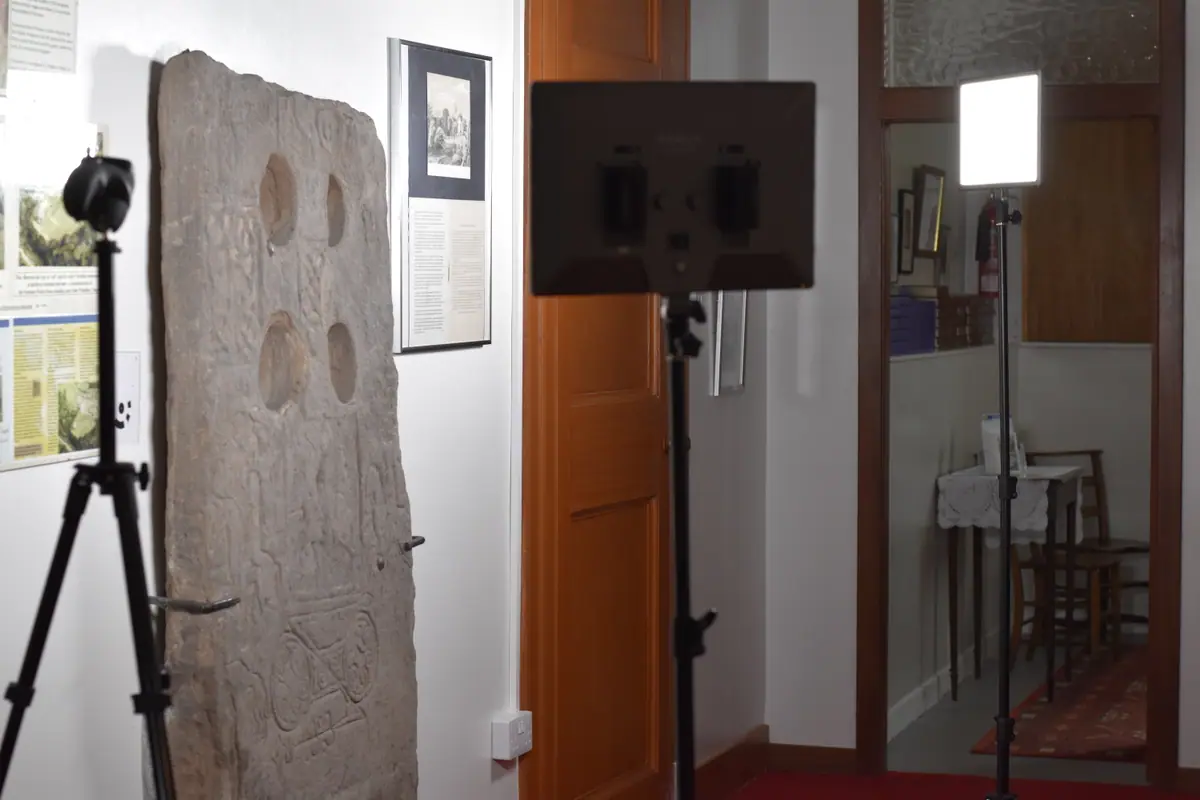
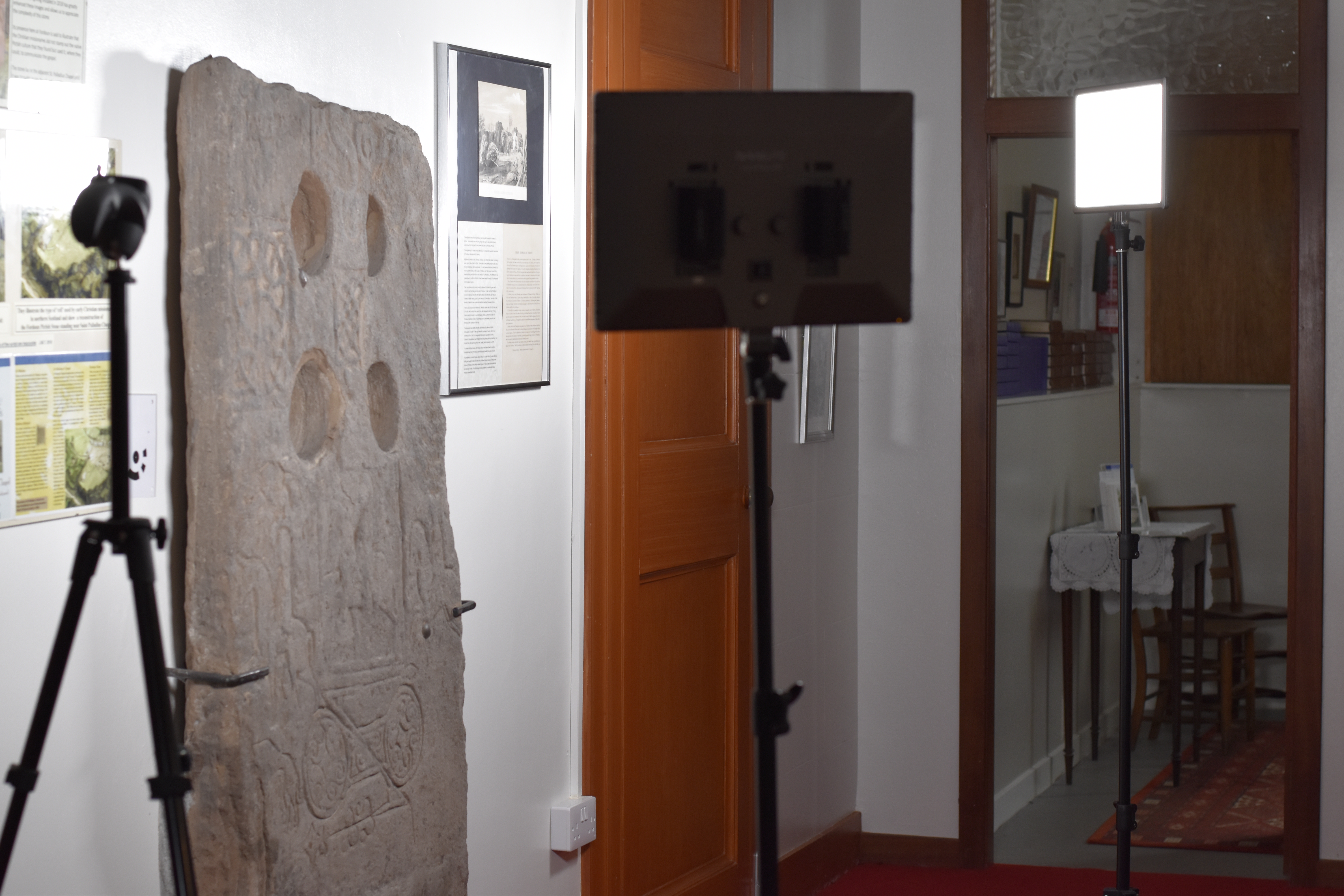
Discovery: The ogham inscription was first noticed in the late twentieth century. Rhys (1898, 380) is the first to mention an ogham inscription in connection with the slab in 1898, but indicates the transliteration of the second inscription instead, casting some doubt on the recognition. The stone was found in the late eighteenth century, re-used horizontally as the base for the pulpit in the old parish church, and was subsequently placed in St Palladius Chapel, in the churchyard of Fourdon (Stuart 1856, 20). An illustration of the stone is provided by John Stuart (1822, 314) in 1822, missing the top and with the right-hand portion having flaked away. The missing surface was restored in concrete sometime before 1848, and the slab was fixed to the wall inside St Palladius Chapel probably in 1872 when the chapel itself was restored. In 1966 it was moved into the adjacent parish church (Canmore)
Findspot: Fordoun, Kincardineshire, Scotland (National Grid Reference: NO 7261 7841)
Last recorded location(s): Recorded in Auchenblae church on May 16th 2022.
Support
Trove 36458
Object type: Cross-slab
Material: Sandstone
Dimensions: H 1.5 × W 0.84 × D 0.09 m
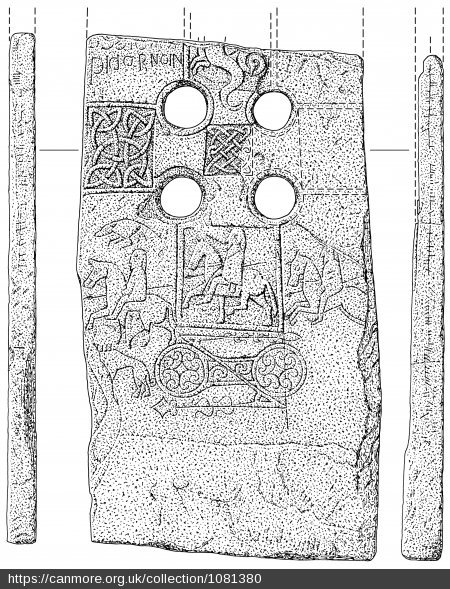
Decoration: The front is decorated with a cross. Its centre is decorated with interlace, the top arm of the cross includes the lower part of a sea monster, the left arm is decorated with Stafford knots, the right arm may have also been carved but is now defaced, and the bottom arm contains a horseman carrying a spear. Surrounding the bottom arm of the cross are the remainders of a hunting scene, consisting of two more horsemen carrying spears and accompanied by hounds, as well as a double-disc and Z-shaped rod symbol.
Condition: The cross-slab is weathered and incomplete. The upper portion and top part of the right-hand side is missing. Rhys (1898, 348) remarked that the traces of ogham scores ‘are so far gone’ that nothing could be made of them, while Macalister (1940, 198) described them as ‘frayed and weathered’. Regarding the roman-letter inscription, Rhys (1898, 347) noted that ‘only just the lower ends of the letters in the upper line are visible, and that not to the extent of enabling one to make them out’. Okasha (1985, 52) was pessimistic of reading the lower line but it is quite legible.
Inscription
Text field: The remains which have been identified as an ogham inscription run up the two narrow faces of the slab. Macalister (1940, 198) remarked that there is ‘no traceable stem-line’. The top left corner of the slab includes the remnants of an inscription in Insular minuscules which consisted originally of at least two lines (Rhys 1898, 347).
Letters: The inscription was likely knife-scored. Macalister (1940, 198) described the ogham as ‘cut in very small scores’.
Edition
Transcription: [---]ỌVV[---]QM[---]C[---]
Critical apparatus:
- Macalister (1940, 200) read: Ogham: VUN[I]MSETTOR BRE[---EN]N; Roman: RURTES [I] P IDARNOIN
Translation
An exact translation of the inscription cannot be readily determined.
Commentary
Although Macalister (1940, 198) supplied a suggested segmented reading of the inscription, he did not offer any interpretation, noting that the ogham is ‘very difficult and requires prolonged study’. John Borland of the HES prepared a drawing of the supposed ogham but did not offer a reading (see Trove). The OG(H)AM project visited the stone in 2022 and could not discern a convincing ogham.
Regarding the roman text, however, Macalister (1940, 198) linked IDARNOIN with the EDDARRNONN of the Scoonie stone (S-FIF-001) and IP to the IPE on the Drosten Stone from St Vigeans.
References
- Allen and Anderson 1903, 201-203
- Macalister and Ryan 1940, 184-226
- Okasha 1985, 43-69
- Rhys 1898, 380
- Stuart 1822, 314-316
- Stuart 1856, 20