Provenance
Discovery: Discovered in 1885 by Edmond Barry in pasture, on the east side of a townland boundary fence between Ballyrobert and Rathcobane. According to Barry (1879-1888, 485), the stone was removed from its socket in 1885 and ‘two or three fragments of “crockery”, each two or three inches square’ were found at its base. The second inscription does not appear to have been on the stone when it was first recorded by Barry. Therefore, it was presumably added sometime between 1885 and 1945.
Findspot: Rathcobane (Ráth Ghobáin), Co. Cork, Ireland (ITM Coordinates: 582705, 584120)
Last recorded location(s): In 1986, subsequent to a survey visit, the stone was moved to the grounds of Scoil an Easpaig O Briain, Bartlemy (SMR no. CO044-111----). The stone was examined and recorded at the school by the Ogham in 3D project in 2017.
Support
National Monuments Service SMR ID: CO054-067----
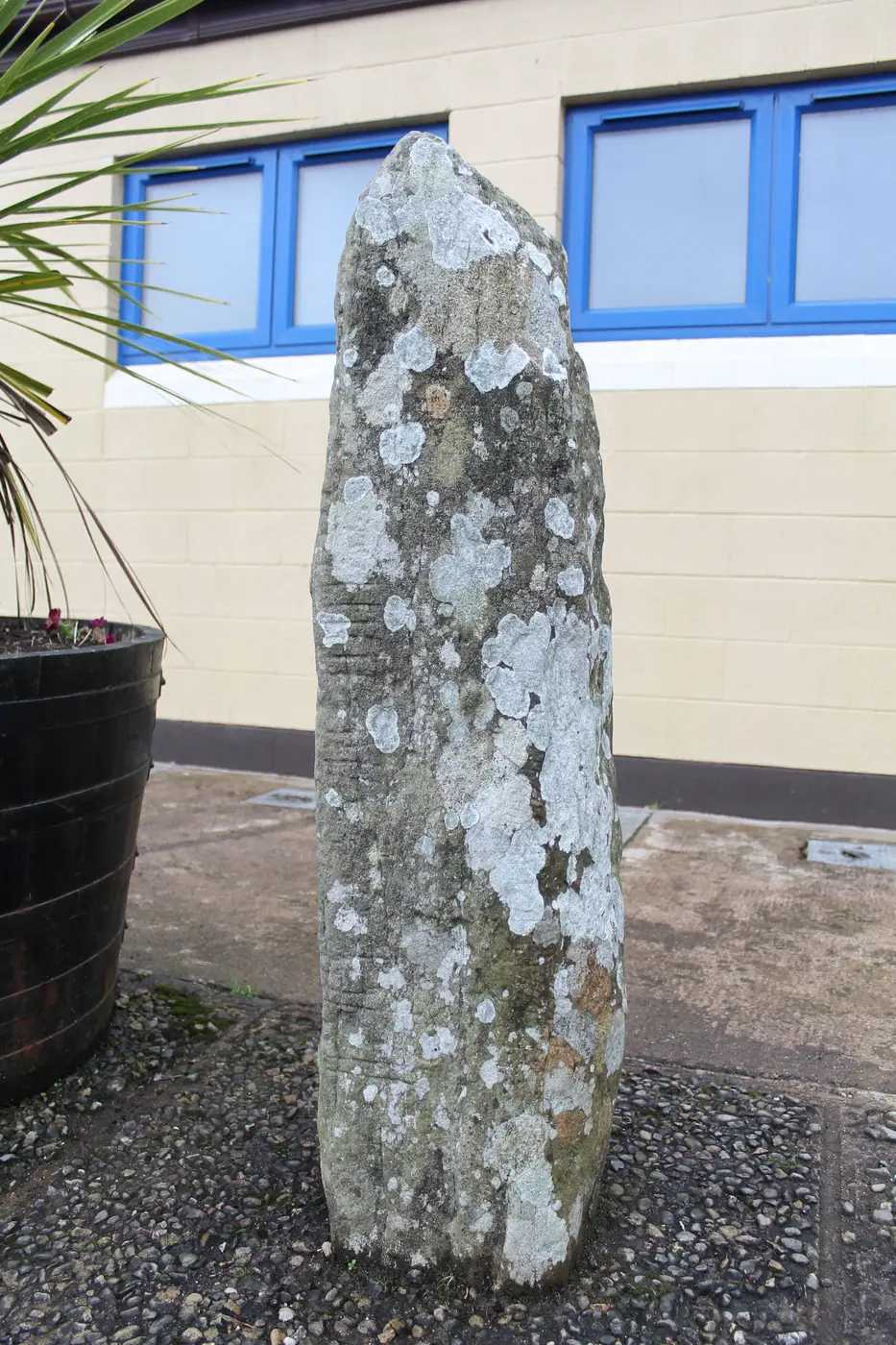
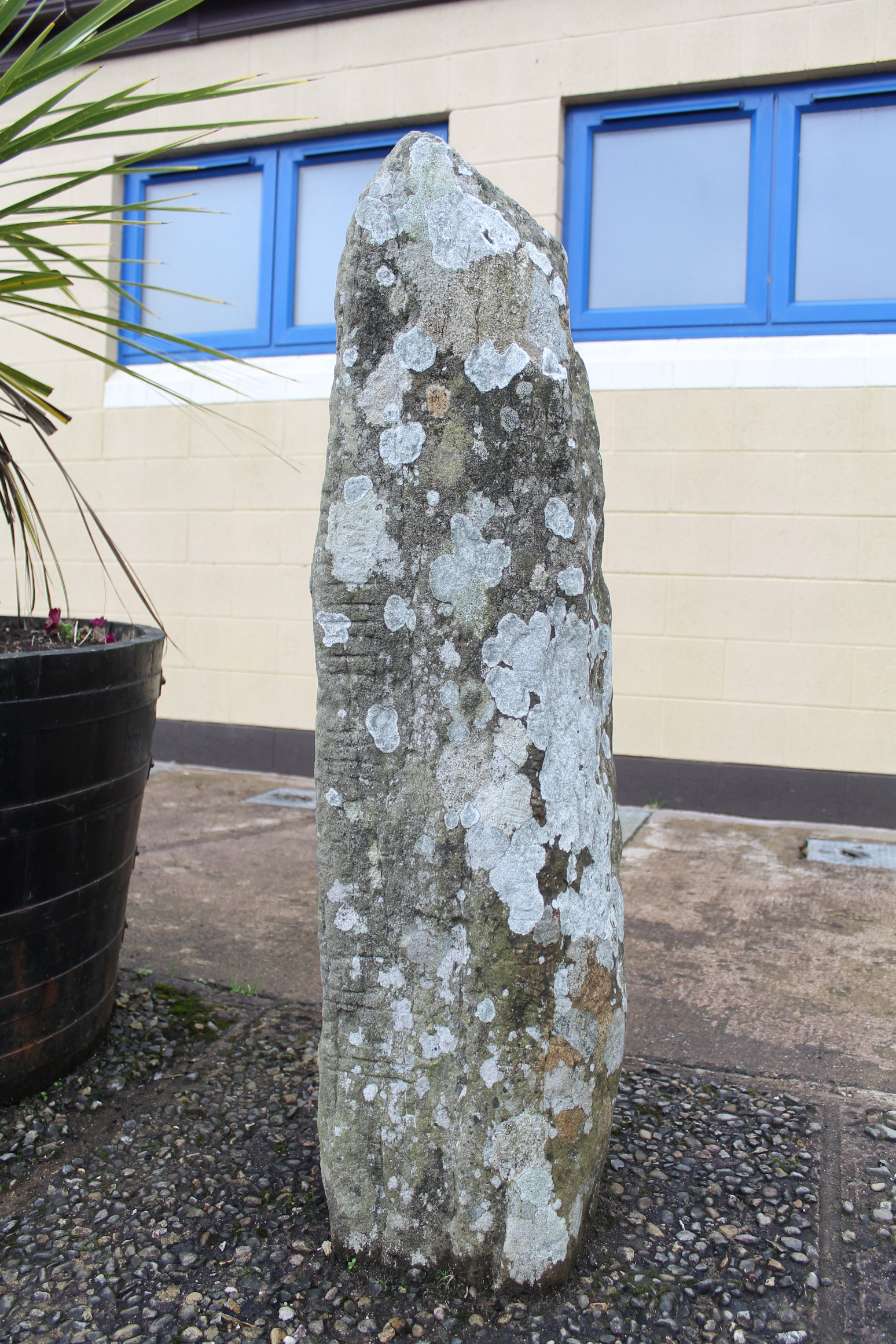
Object type: Pillar
Material: Stone type unknown
Dimensions: H 1.20 × W 0.33 × D 0.26 m
Condition: As recorded by Macalister (1945, 70), the inscription is in good condition, except that the H-half of the G has been flaked away. He recorded the height as 1.30m (4ft. 3.18in.) but in its current position it measures 1.20m (3ft. 11in.) above ground level.
Inscription
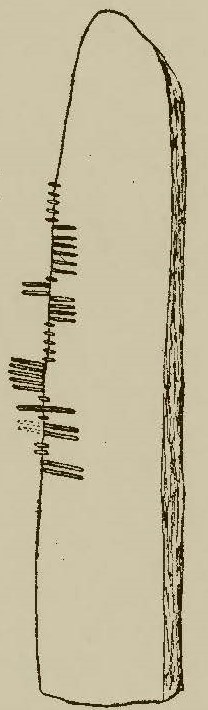
Text field: The earlier inscription is found on the dexter edge (reading upwards) of one of the narrower faces of the stone. Macalister (1945, 70) also noted that one James Ward has written his name in ogham and in Irish on the other edge of the same face (reading downwards).
Letters: The two inscriptions are chiselled and scratched. Macalister (1945, 70) described the earlier inscription as chiselled. The strokes are narrow and long (up to 10cm on the B-aicme) and the M-aicme strokes are straight, rather than slanted, making them difficult to distinguish, especially where they are damaged. The vowel strokes are generally shorter but not consistent in length. The second inscription on the opposite side of the same face is finely scratched and much fainter. The vowel strokes are the same length as the consonant strokes and the stemline is uncertain.
Edition
Ogham text: ᚂᚑᚌ̣ᚐ ᚋ̣ᚐᚊᚔ ᚄᚓᚒᚋᚐᚄ ᚒ̣ᚐ̣ ᚁᚐᚔᚏᚇ
Transcription: LOG̣A ṂAQI SDAṆḄI SEUMAS ỤẠ BAIRD
Critical apparatus:
- Of the earlier inscription (1), Macalister (1945, 70) noted that the H-half of the G has been ‘flaked away’. The M is partly damaged on this side and only a couple of partial Q strokes can be made out.
Translation
1: of Lug? son of ?
2: James Ward?
Commentary
It is unclear how the NB should be read as there is no clear distinction between these 6 strokes, all from the same aicme. It is also difficult to interpret as SD is not a usual combination in Irish. Perhaps it is related to the word for tin, which is stán.
The reading of the later inscription is also uncertain, partly due to the faintness of the strokes and the use of long vowel strokes, which are difficult to distinguish from consonant strokes, especially as the stemline seems to be following an irregular ridge on this side of the stone. It does appear, as suggested by Macalister (1945, 70), to be the name James Ward in Irish. However, we would rather expect something like: Séamus Mac an Bhaird.
References
- Barry 1879-1888, 485-489
- Macalister 1945, 69-70, no. 65