Millions of people have played Assassin’s Creed Valhalla. A smaller number have stopped mid-raid to read the ogham stones scattered across its version of Viking-Age England and Ireland. Fewer still know that some of those inscriptions aren’t decoration. They’re grammatically correct Primitive Irish, checked by an actual Celticist before Ubisoft shipped the game.
That’s unusual. Most games that reach for ogham treat it the way they’d treat any vaguely ancient-looking squiggle: atmospheric noise. Valhalla did something different, and it’s worth pulling apart what the game actually got right, what it fudged for the sake of a good quest, and how its stones compare to a real one.
A tattoo, a stone circle, and a proper Celticist
Valhalla’s Irish and British ogham didn’t come from a stock font. Ubisoft brought in Gregory Darwin, a Celtic Studies lecturer at Uppsala University, to handle its Gaelic content, including a reconstructed Old Ulster dialect for characters in the game’s northern regions. Antoine Henry, one of the game’s associate directors, has said he has background in Old Irish and primitive Irish specifically, and he’s credited with hiding several of the game’s ogham inscriptions himself.
The clearest payoff of that effort is a stone the player finds inside a stone circle early on, beside a mysterious figure named Brendan. Read from bottom to top, it says:
BRENAIN MAQI FINLUGI MUCOI ALTI
“Brendán, son of Finnlug, of the Alt(raige) tribe.” That’s not a random string. It’s the same X MAQI Y MUCOI Z formula, name, “son of,” father’s name, “kin of,” clan name, that shows up on hundreds of real ogham stones across Ireland and Wales. Our breakdown of the MAQI formula covers how common this exact structure is. The stone is also a clue: the Brendan the player meets turns out to be Brendan of Clonfert, a real sixth-century Irish saint who founded a monastery at Clonfert and became known in later legend as “the Voyager.”
What a real MAQI…MUCOI stone looks like
For comparison, here’s an actual stone carrying the same formula pattern.
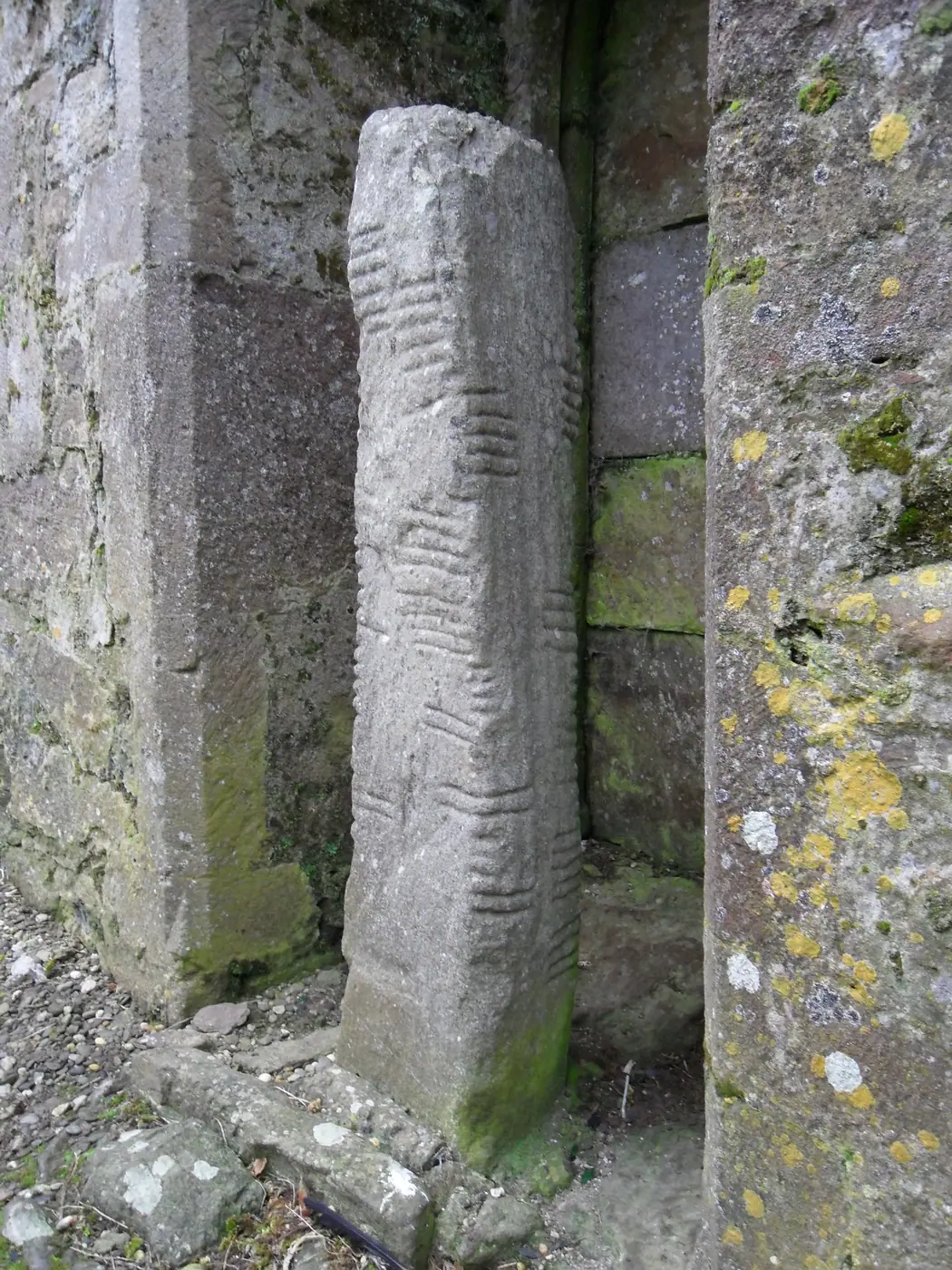 The Ardmore 1 stone, Co. Waterford, reads LUGUDECCAS MAQI [---] MUCOI NETASEGAMONAS: “of Luguid, son of […], from the kin of Nad-Segamon.” The father’s name has been lost to damage, but the formula is intact.
Line the two up and the game’s invented inscription is doing exactly what the real one does: name, son-of, kin group. That’s a level of care most ogham-in-games moments never bother with.
Where the game breaks from history: Arthur and Excalibur
Not every stone in Valhalla holds up the same way. Deeper in the game, inside a chamber beneath Stonehenge, a second inscription introduces Arthur, son of Uther Pendragon, ahead of a quest to pull Excalibur from its resting place:
ARTUR MAQI UTERI QENNDRAGON
Grammatically, it’s the same MAQI formula again. Historically, it’s pure fantasy. There’s no ogham tradition connecting Arthurian legend to inscribed stones, and the game isn’t pretending otherwise. It’s borrowing the script’s credibility to dress up a myth, which is a different thing from getting the myth right.
The physical mistake: carved on the wrong face
The more telling inaccuracy isn’t linguistic, it’s physical. Both the Brendan and Arthur stones in the game are inscribed on the flat face of the pillar. Our own piece on how ogham stones were actually carved covers this in detail: real ogham almost always runs along a stone’s edge, the arris, using the corner itself as the stemline the letters are cut across. A face-carved inscription like the game’s is the exception in the real corpus, not the rule.
The letterforms give away when the game’s inscriptions are “from,” too. The spaced-out lettering used in Valhalla is closer to the style that became common from the ninth century onward, well after the game’s setting. It’s a reasonable choice if the stones are meant to be freshly carved within the game’s own timeline, but not if they’re meant to be ancient when the player finds them.
Ogham shows up in more games than you’d think
Valhalla isn’t the only place this happens, just the most visible. Total War: Warhammer built an “Ogham Stones” landmark into its Albion campaign map, complete with a public-order bonus, an odd but not entirely wrong nod to the way real stones likely marked territory and status. Its sequel replaced that with a glowing “Ogham Shard” quest that leans so hard into Stonehenge-style mysticism that any actual inscription gets lost under the special effects.
The 2008 point-and-click game Rhiannon: Curse of the Four Branches goes further than either: an ogham stone in the game is central to a puzzle that has the player take a rubbing and run it through a researcher’s “translation software,” a small, oddly earnest tribute to how ogham scholarship actually works. And the alternate-reality game built around Heartbound hid a genuine cryptographic puzzle in ogham, continuing a use of the script for coded messages that goes back to real medieval sources like In Lebor Ogaim, the subject of our piece on ogham as a cipher.
Why any of this matters
None of these games are trying to be textbooks, and they shouldn’t be judged like one. What’s interesting is the gap between them: some treat ogham as a genuine language system worth getting right, others treat it as set dressing that only needs to look the part. Valhalla mostly falls in the first camp, which is rare enough to be worth noting, even with an edge-versus-face mistake and one fictional king thrown in.
If a glowing stone in a video game is what gets someone curious about the real thing, that’s a fair trade. The genuine inscriptions are stranger and better documented than anything a game could invent: hundreds of them, carved by real people to record real names, still standing (or built into real walls) across Ireland, Wales, and beyond. Our guide to reading ogham walks through the letterforms and formulas these stones actually use, and our stone map lets you browse the real inscriptions county by county.
Further Reading
- Clara Scholz, “The use of Ogham in Assassin’s Creed: Valhalla,” OG(H)AM Project Blog, University of Glasgow (2022)
- Dr Megan Kasten, “‘Selective Authenticity’: Ogham in Video Games and Tabletop RPGs,” OG(H)AM Project Blog, University of Glasgow (2022)
- Damian McManus, A Guide to Ogam (An Sagart, 1991)
- Ogham in 3D, the Discovery Programme’s 3D survey of Irish ogham stones