Ogham stones on the Isle of Man number only nine, but few places pack so much of ogham’s story into so small a space. The island sits in the middle of the Irish Sea, and its stones run from fifth-century Irish memorials to a twelfth-century priest who carved the ogham alphabet next to Norse runes. One of them even names the ancestor of a Manx family who still lived on the same land a thousand years later.
An Irish script on a Manx island
Manx Gaelic is a close cousin of Irish, and in the early medieval period the island belonged firmly to the Gaelic world. Ogham came with it. The oldest Manx stones use the same formulas found in Munster, which is why they read so much like the pillars of Kerry and Cork. If you are new to where the script came from, our guide to ogham’s history and origins sets the scene.
Most of the stones are now in the Manx Museum in Douglas. Others stay in the churches where they were found. You can see all of them on our stone map.
The early memorials
Two stones from Ballaqueeney, near Port St Mary in the south of the island, turned up in the 1870s while the railway was being built. One of them, Ballaqueeney 2, reads BIVAIDONAS MAQI MUCOI CUNAVA[LI], “of Béoáed, son of the kindred of Conall(?).” The name means something like “living fire,” and the full MAQI MUCOI formula marks it as early, probably fifth century. Our piece on the MAQI formula explains how that “son of” pattern works.
The most famous Manx stone is from Knoc y Doonee in Kirk Andreas, found in the early 1900s just west of an old chapel site. It is bilingual. The ogham reads AMBICATOS MAQI ROCATOS, and the Latin says AMMECATI FILIUS ROCATI HIC IACIT, “Ammecatus, son of Rocatus, lies here.” The ogham scores are so faint that the scholar R.A.S. Macalister called them “as fine as pin-scrapes,” while the Latin letters are deeply cut. A Viking boat burial was later dug up on the same hill, so the site served as a resting place for two very different peoples.
A stone called “son of stone”
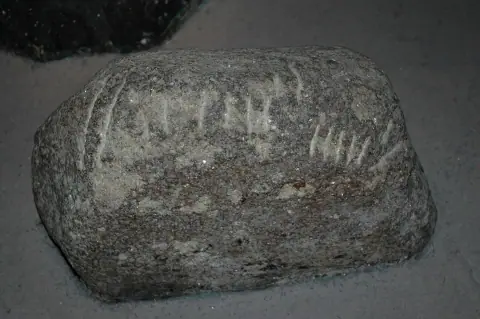
The hero image above shows Bimaken Friary 2, a rounded granite boulder from Kirk Arbory. All that survives of its text is MAQ LEOG, the name Mac-Liäc, “son of stone.” Lía is the Old Irish word for a standing stone, often an ogham pillar.
The short form MAQ, without the old ending, shows this is a later inscription, likely seventh century. The name is the remarkable part. Mac-Liäc became the Manx surname Clague, and a branch of the Clague family gave its name to Ballaclague, the farm next to where this stone was found. They are recorded there from at least the sixteenth century, which means the boulder seems to commemorate the family’s namesake around a thousand years earlier.
Pilgrims’ graffiti at Ballavarkish
Not every Manx ogham inscription is a formal memorial. At Ballavarkish in the parish of Bride, excavators in 1912 found a broken slate panel, probably the front of an altar, carved with a cross and ring. Visitors later scratched their names into the soft stone, mostly in Roman letters, but one of them used ogham.
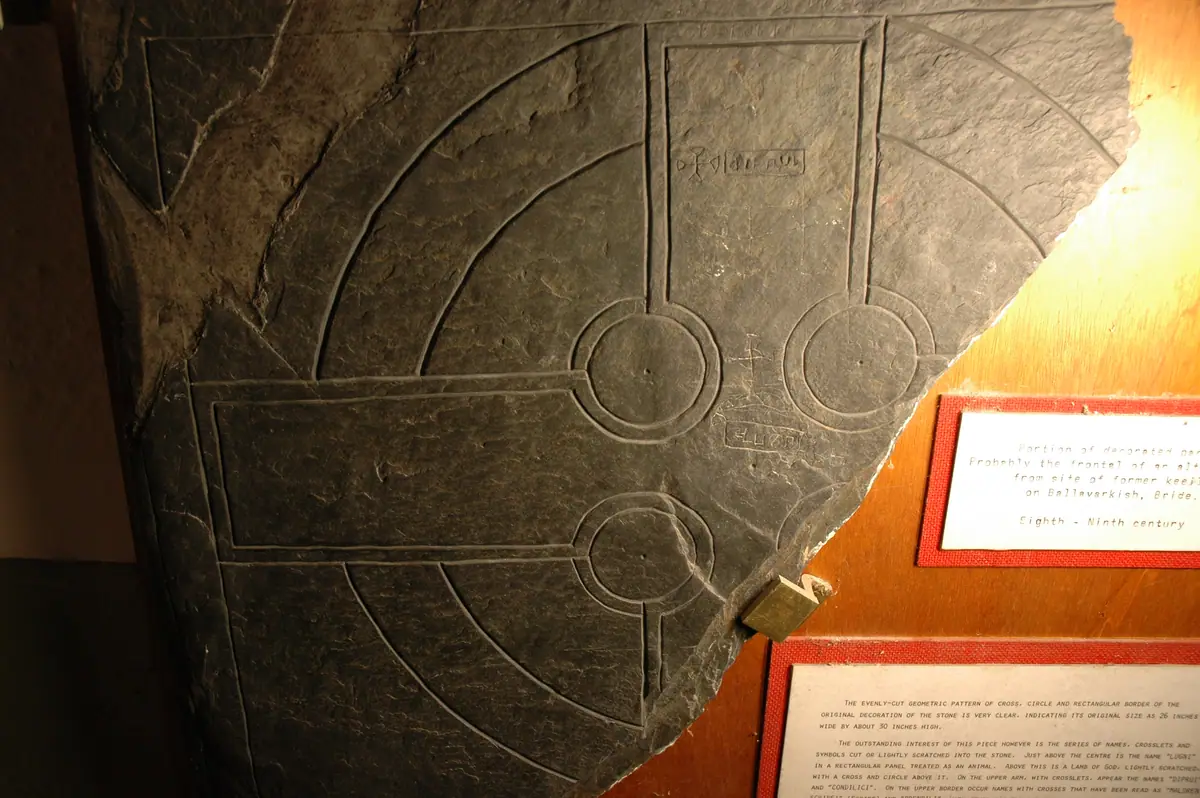
The ogham is knife-scored and hard to read, and no one agrees on what it says. What it does prove is that someone in the north of the island could still write ogham in the eighth or ninth century, at a time when the formal stone tradition in Ireland was fading.
When the Vikings arrived
From the ninth century the island came under Norse rule, and Manx carving changed with it. The island is famous for its Norse crosses, and two of them also carry ogham. We touched on these in our post on when Vikings wrote in ogham.
The Kirk Michael cross-slab has a long runic text naming Mael Lomchon, who raised the cross for his foster mother Malmura. It also has a proverb in runes: “Better is it to leave a good foster-son than a bad son.” Below the cross shaft, someone carved the full ogham alphabet, and a second, faint ogham line near the top has never been convincingly read.
At Maughold, a broken slate slab in the cross house carries the runes IUAN BRIST RAISTI THISIR RUNUR, “John the priest cut these runes,” followed by the runic alphabet. Underneath sit the first two groups of the ogham alphabet, starting with a feather-mark. Scholars disagree on whether the two alphabets were cut at the same time, but the slab is dated to around the middle of the twelfth century. This is a priest showing off two writing systems side by side, a neat picture of Gaelic and Norse culture on one island.
The newest find
The most recent Manx ogham stone was found in 2006 during a Time Team excavation at Speke Farm keeill in Santon, beside a grave in the burial ground of a small early chapel. It is broken and damaged, and readings differ, but one interpretation finds the old kindred word MUCOI again. Dated to the tenth or eleventh century, it shows that people kept writing ogham on the island long after the Norse arrived.
What the Manx stones tell us
Nine stones is a small group, but they cover the whole life of the script. The Ballaqueeney and Knoc y Doonee memorials belong to the classic early ogham of Ireland. Bimaken shows the language changing. Ballavarkish and Speke show ogham carrying on in church settings, and Kirk Michael and Maughold show it surviving as a learned alphabet beside Norse runes. Few places let you trace that whole arc within a short drive.
If you want to try reading one, start with our guide on how to read ogham, then pick a Manx stone from the map.
Further Reading
- Damian McManus, A Guide to Ogam (An Sagart, 1991)
- R.A.S. Macalister, Corpus Inscriptionum Insularum Celticarum, vol. 1 (1945), nos. 500 to 504
- P.M.C. Kermode, Manx Crosses (1907)
- The Ogham Stones of the Isle of Man, BabelStone Blog
- Knock y Doonee Ogham Stone, Wikipedia
- Stone records in our database, which draw on the OG(H)AM project’s 2024 recording work on the island