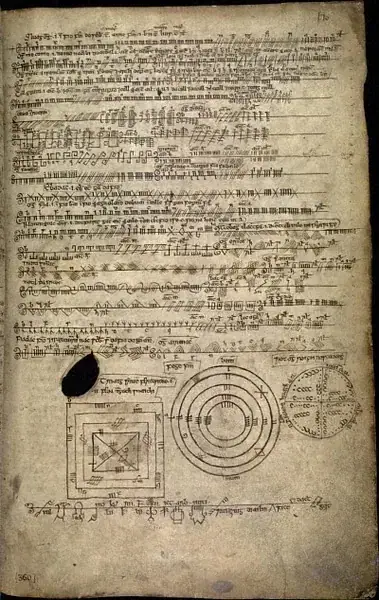
Ogham doesn’t look like anything else. It isn’t a cousin of the Latin alphabet, and it isn’t descended from the runic alphabets it gets compared to so often. Someone, somewhere, in roughly the fourth century AD, built a writing system out of straight strokes cut across a line, and then Irish speakers started carving it onto standing stones. Nobody recorded why. That gap has produced three serious competing theories, and a fourth one that scholars have mostly abandoned but that’s too strange not to mention.
Theory one: a cipher built to keep Rome out
The linguists James Carney and Eoin MacNeill argued that ogham was designed from the start as a cryptic alphabet, something Irish speakers could use that Romans or Romanised Britons wouldn’t be able to read. On this view, the threat (or memory) of Roman contact across the Irish Sea gave the Irish a reason to want a code of their own, not a borrowed one.
It’s an appealing story, but it has an obvious hole. Several ogham stones in Wales carry the same text twice, once in ogham and once in Latin letters, for exactly the audience a code is supposed to exclude. If ogham was meant to stay secret, it didn’t stay secret for long, assuming it ever was.
Theory two: an alphabet built for a new church
The linguist Damian McManus, in A Guide to Ogam (1991), makes a different case: ogham was invented within Ireland’s first Christian communities, not against Rome but alongside it. His argument is practical rather than political. Primitive Irish had sounds the Latin alphabet wasn’t built to represent cleanly, so a literate Christian community with a reason to write things down, land grants, boundary markers, memorials, built an alphabet suited to its own language instead of forcing Latin letters to do an awkward job. McManus points to the early Irish church reaching an organised state by around 400 AD, not long after Palladius’s mission in 431, as a plausible setting.
Theory three: Ireland’s answer to the Roman epigraphic habit
The theory with the most archaeological weight behind it doesn’t treat ogham as a reaction against Rome at all. It treats ogham as imitation.
For about three centuries, inscribing stone monuments to commemorate the dead, a Roman name, their father’s name, their rank, was standard practice everywhere the empire touched, including Roman Britain, just across the water from Ireland. Ireland was never conquered, but it wasn’t cut off either. Trade, raiding, and the Irish settlements that took root in post-Roman Wales put Irish speakers in regular contact with people who used stone inscriptions as a matter of course.
The formula itself is the strongest piece of evidence. Ogham’s standard inscription, X MAQI Y, “X, son of Y,” sometimes extended with MUCOI, “of the kin of,” is structurally close to Roman commemorative formulas naming a person and their father. Our piece on the MAQI formula goes through how consistently that pattern shows up across the roughly 400 surviving stones. Even the word KOI, “here is” or “here lies,” reads like a Primitive Irish stand-in for the Latin hic iacit that opens so many Roman epitaphs. None of that proves direct copying, but it’s a striking amount of structural overlap for two traditions to land on independently.
The physical evidence: three finds from the right century
Three 4th-century objects tie this theory to the ground rather than just the formula.
The Silchester stone is the most direct. It was pulled out of a well inside Calleva Atrebatum, a working Roman town in Hampshire, in 1893. Whoever carved it was literate in ogham while living inside Roman Britain itself, not somewhere on its margins. Our guide to ogham in England covers the rest of that story.
In Ireland, a small bronze votive plaque dug up at Newgrange carries an ogham inscription running along a stemline close to its edge, the same way the script runs along the edge of a standing stone. It turned up alongside Roman coins and jewellery, in a find the excavators compared directly to votive offerings left at Roman shrines in Britain. The Newgrange plaque is one of the only ogham objects found in a context that can be dated, on independent archaeological grounds, to roughly the same century the script is believed to have emerged.
Taken together, a Roman well in Hampshire and a Roman-style votive object at Newgrange make a case that doesn’t rely on linguistics alone: ogham and Roman material culture were turning up in the same places, at the same time, from the very start.
The theory everyone’s abandoned, but is too good to skip
R.A.S. Macalister, whose catalogue is still the standard reference for ogham stones (we’ve written about the flaws in that catalogue separately), believed ogham was invented six centuries earlier than any of this, around 600 BC, by Gaulish druids, as a secret hand-signal system derived from the Greek alphabet. Almost no one holds this view today. There’s no archaeological or linguistic evidence placing ogham anywhere near Iron Age Gaul, and the gap between 600 BC and the earliest actual inscriptions is enormous. It survives mostly as a reminder that even a meticulous cataloguer can build an entire origin story on far too little.
Why it still isn’t settled
None of these theories fully explains the others away. A cipher could still have been adopted by a Christian community, which then adapted its use toward commemoration in a style borrowed from Rome. The honest answer is that ogham’s invention left no documentary trace, only letterforms and a handful of fourth-century objects, and scholars are reconstructing motive from very thin evidence.
What’s not in dispute is what came after: an alphabet that started, for whatever reason, as a strange experiment ended up carved onto hundreds of stones across Ireland, Wales, and beyond, and outlived the empire it may or may not have been reacting to. Our guide to ogham’s history and origins walks through the cipher and Christian-invention theories in more depth, and our stone map lets you browse the surviving inscriptions these theories are built on, county by county.
Further Reading
- Damian McManus, A Guide to Ogam (An Sagart, 1991)
- Karen Murad, “Oghams and the Roman Epigraphic Habit in Late Iron Age and Early Medieval Ireland,” OG(H)AM Project Blog, University of Glasgow (2023)
- R.A.C. Carson and Claire O’Kelly, “A Catalogue of the Roman Coins from Newgrange, Co. Meath and Notes on the Coins and Related Finds,” Proceedings of the Royal Irish Academy 77 (1977)
- Ogham, Wikipedia, for a summary of the competing origin theories and their proponents