Look up almost any ogham stone and you’ll see a short code attached to it: CIIC 263, CIIC 145, CIIC 9. That number isn’t a modern database ID. It comes from a catalogue compiled in the 1940s by one man, and it’s still how archaeologists and epigraphers refer to ogham inscriptions today, even when they think he got the reading wrong.
From Gezer to the Hill of Tara
Robert Alexander Stewart Macalister was born in Dublin in 1870, the son of a professor of anatomy, and educated at St John’s College, Cambridge. His first serious archaeological work wasn’t in Ireland at all. Between 1902 and 1909 he directed excavations at Gezer in Ottoman Palestine for the Palestine Exploration Fund, uncovering the Gezer calendar and a mound stratified with millennia of occupation. It was only in 1909 that he returned home to take up the chair of Celtic Archaeology at University College Dublin, a post he held until 1943. In that role he excavated at the Hill of Tara, served as president of the Royal Irish Academy, and set about doing for ogham what he had already done for Gezer: giving a scattered, undocumented body of inscriptions a single, systematic record.
Building the Corpus
That record became the Corpus Inscriptionum Insularum Celticarum, published in two volumes in 1945 and 1949. It gathered every ogham inscription then known across Ireland and Britain, transcribed and numbered from 1 to roughly 510, along with the Latin and runic inscriptions found alongside some of them. Macalister didn’t just catalogue the stones. He coined much of the vocabulary still used to describe them, including “feather-mark” for the arrow-like brackets sometimes added around a transliterated text, and “arris” for the stone edge that carries the inscription’s stemline. The CIIC numbers he assigned became the standard reference system almost immediately, and they remain so: every stone in our own ogham stone map carries one.
Where the Corpus Got It Wrong
Macalister worked without 3D scanning, raking light photography, or any of the imaging tools that let today’s researchers pick out a worn letter from a shadow. He also brought some assumptions to the material that didn’t hold up. The linguist Damian McManus, in A Guide to Ogam (1991), credits Macalister’s eye and persistence while pointing out that his readings were sometimes weakened by a reluctance to draw on contemporary philology, and by a theory that non-Christian, archaic-looking inscriptions pointed to a druidic origin for the script, a claim McManus calls spurious.
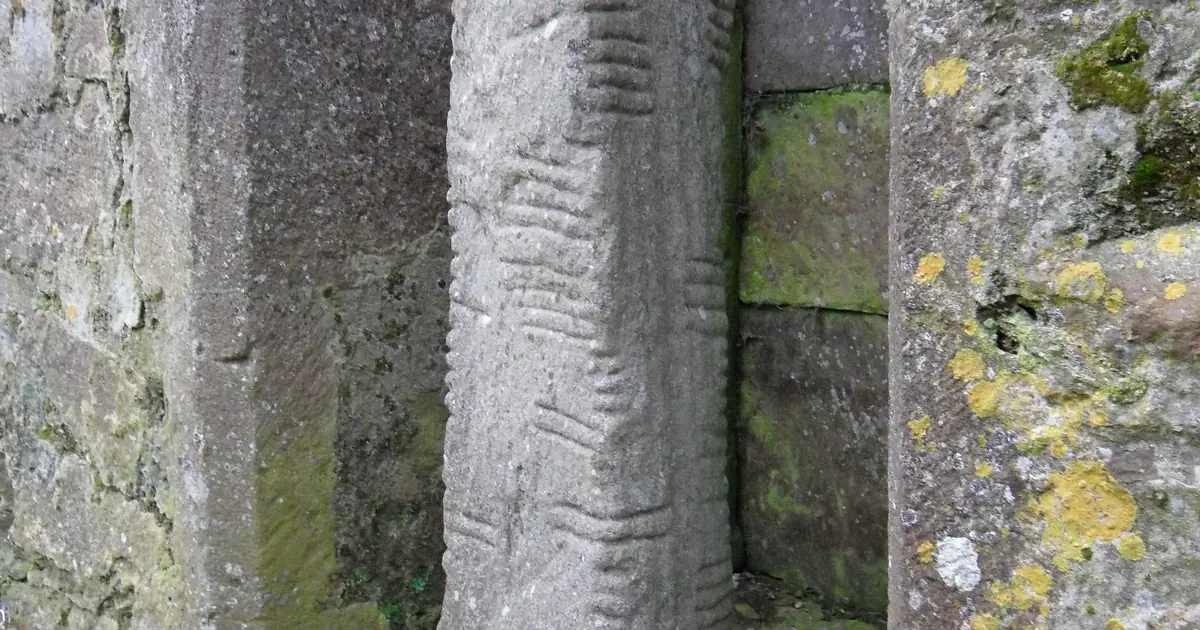 Ardmore 1 (CIIC 263), Co. Waterford. Macalister catalogued this pillar in 1945, and later scholars have since revised part of his reading.
The Ardmore 1 stone in Co. Waterford, shown above, is a good example of both sides of that legacy. Macalister read it as carrying two separate inscriptions, an early pagan formula naming a man from “the kin of Nad-Segamon,” and a later, distinct Christian text he transcribed as reading uici episcopus, “rural bishop.” McManus calls that second reading “extremely doubtful,” and the stylistic evidence, consistent carving technique across all three angles of the pillar, points to a single inscription rather than two.
The stone at Arraglen on Mount Brandon shows the same pattern. Macalister took its ending to describe a Christian “signature” rather than a standard pagan-style memorial, reasoning that its grammar looked like a nominative rather than a genitive. McManus showed the ending was genitive after all, just an unusual-looking one, which undercut the entire basis for Macalister’s Christianisation claim.
Why We Still Use His Numbers
None of this has dislodged the Corpus from its place at the center of ogham studies. Partly that’s inertia: renumbering hundreds of stones cited across a century of scholarship would cause more confusion than it solved. Mostly it’s because the numbering and the reading are two different jobs. Macalister’s CIIC gave the field a shared way to refer to a stone regardless of what any given transcription says about it, and that framework has outlasted the individual conclusions built on top of it. Projects like Ogham in 3D have spent the last decade re-scanning stones Macalister could only examine by eye and torchlight, correcting readings letter by letter while leaving his numbers untouched. He died in Cambridge in 1950, seventy-nine years old, having given the field both its most-used reference book and a long list of corrections for the scholars who came after him. For the bigger picture of how the script developed before Macalister ever got near it, see our guide to ogham’s history and origins.
Further Reading
- Damian McManus, A Guide to Ogam (Maynooth Monographs, 1991)
- R.A.S. Macalister, Corpus Inscriptionum Insularum Celticarum, Vol. I (Dublin, 1945) and Vol. II (1949)
- “Macalister, Robert Alexander Stewart,” Dictionary of Irish Biography
- Katherine Forsyth, “R. A. S. Macalister – A Life,” OG(H)AM project blog, University of Glasgow, 2023