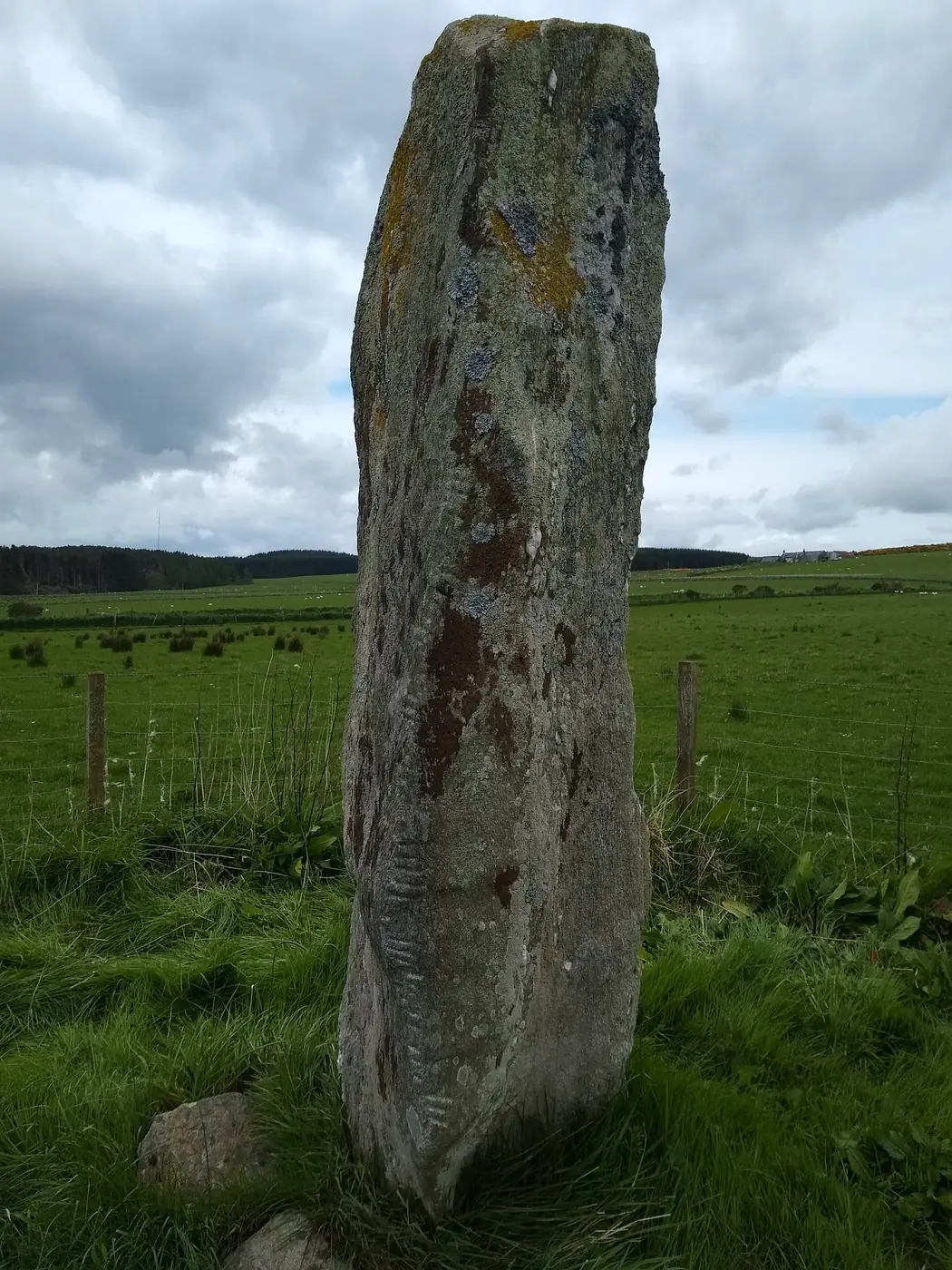
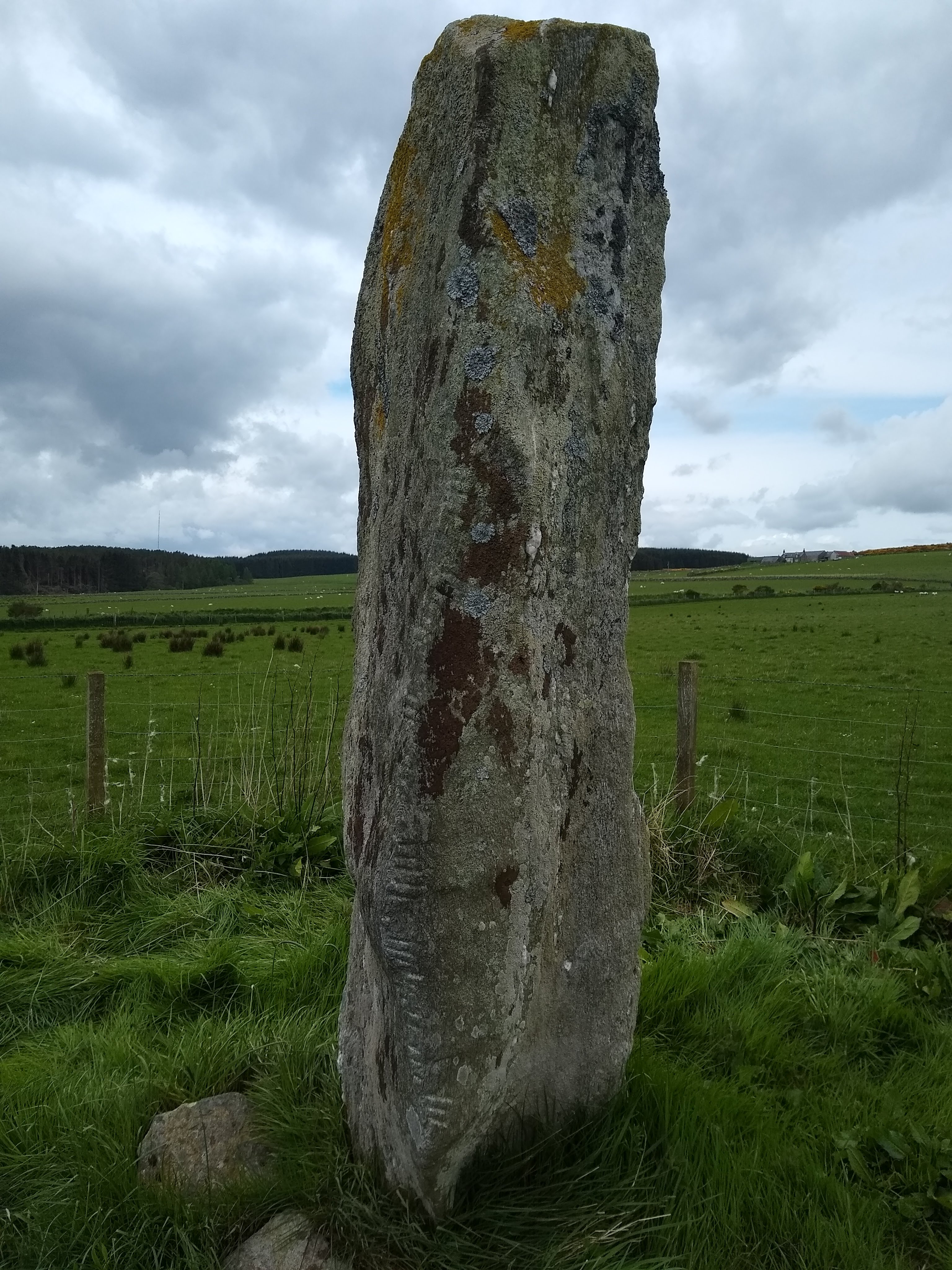
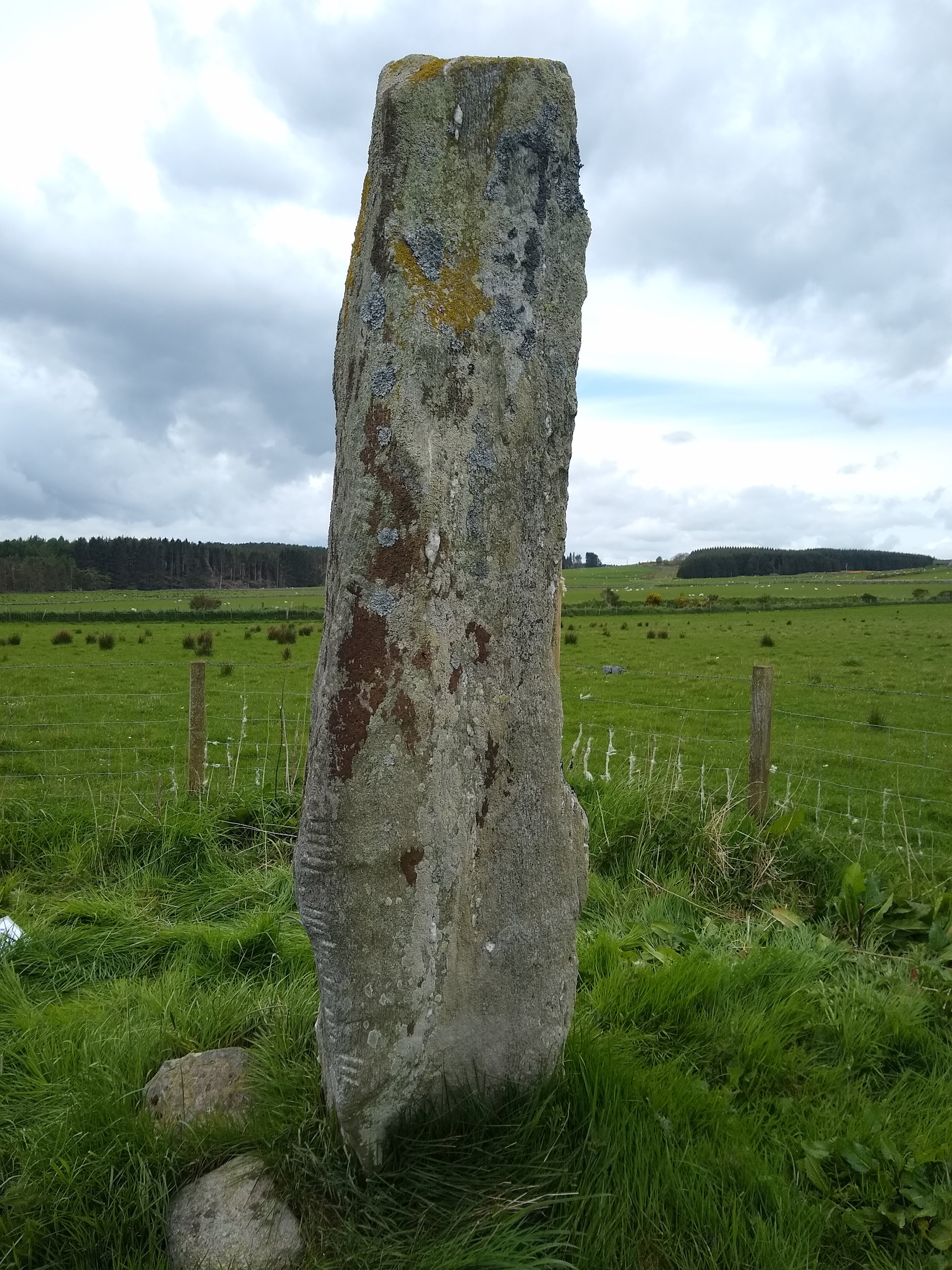
Provenance
Discovery: Allegedly once part of a stone circle of which all the stones were removed, except for this ogham-inscribed pillar. The presence of an ogham inscription was noted in 1886 by Rev. John G. Michie, of Dinnet, Aberdeenshire (Southesk 1886, 37).
Findspot: Fetteresso, Kincardineshire, Scotland (National Grid Reference: NO 82326 90797)
Last recorded location(s): Recorded in situ on a hillside near Nether Auquhollie farmhouse on May 20th 2022.
Support
Trove 37143
Object type: Pillar
Material: Quartzose gneiss
Dimensions: H 2.35 × W 0.7 × D 0.43 m
Decoration: According to Forsyth (1996, 43) previous commentators claimed to have found Pictish symbols on the stone. However, the presence of Pictish symbols has been dismissed since there are no traces of these alleged symbols on the stone and given the durability of the stone it is unlikely that the symbols would have weathered away.
Condition: The stone is hard and as a consequence the inscription is for the most part very clear and in reasonably good condition. The only area affected by weathering is the arris where ‘notches have become obscure in the middle portion and at the end’ (Forsyth 1996, 43). For the seventh letter in the inscription the arris is so worn that virtually nothing survives and ‘it is safe to assume that this portion contained letters now obscure’ (Forsyth 1996, 46). Additionally, most of the strokes and notches were ‘re-cut with a sharp tool in modern times’ and while the re-cutting obscured ‘the base of each stroke, the original sides are largely intact’. However, since ‘the more doubtful strokes were not touched up, they now look even more questionable in contrast to the ones which were sharpened’ (Forsyth 1996, 43).
Inscription
Text field: The ogham inscription ‘is carved up the south-east edge of the stone, beginning about 0.3m from the bottom and continuing for a further 1.25m’. The natural edge of the stone serves as the stem-line, although the arris wavers considerably (Forsyth 1996, 44). Although the weathering makes it difficult to determine the spacing throughout the inscription, it seems that the strokes constituting individual letters are evenly spaced and there is a slightly greater gap between letters (Forsyth 1996, 47). There is no other inscription or carving on the stone.
Letters: The inscription was likely pocked and rubbed (Forsyth 1996, 44). The vowels are indicated with very short notches on the arris and the strokes are generally broad enough to accommodate fingers comfortably (Forsyth 1996, 47). ‘The stem wavers to such an extent that it is not always easy to evaluate the slope of letters, but most seem roughly perpendicular to the stem’ (Forsyth 1996, 47). The consonant strokes are 5cm long on average (Forsyth 1996, 44).
Date: Fifth to seventh century
Edition
Ogham text: ᚃᚒᚓᚅᚑᚅᚔ̣ᚓ̣ᚈᚓᚇᚑᚃᚒᚏ̣ᚔ̣
Transcription: VUENONỊẸTEDOVUṚỊ
Critical apparatus:
- The reading of the inscription from the second to the fourth letter is problematised by the ‘sharp left-wards twist of the stem and the unusal spacing of the extant strokes’ (Forsyth 1996, 45). 2. Although it is clear that the inscription lacks the central MAQI, typical of Irish pillar oghams, it can be assumed that the inscription represents names (Forsyth 1996, 51). Given the length of the inscription, Forsyth (1996, 51) suggests it is too long for a single name and therefore represents two names linked together. There would almost be room in the weathered central section for AVI, but insufficient evidence remains to support such a reading.
Translation
An exact translation of the inscription cannot be readily determined.
Commentary
As a Type I pillar, the Auquhollie ogham could be expected to be an Irish-language text representing Irish names; however, this is complicated by its geographical location within sight of the eastern coast of Pictland (Forsyth 1996, 48). Even if the names were Pictish; however, ‘the orthography would have to have been derived from Irish ogham, and so an Irish aspect would be inevitable’ (Forsyth 1996, 51).
Forsyth (1996, 53) notes that no satisfactory explanation of the first element, with its double vowel, is immediately apparent, although in Old Irish texts vowel length was signified by doubling. The second element may contain a name beginning with DOV- ‘black’ and similar names ‘appear in a number of inscriptions from both sides of the Irish sea’.
The exact dating of the ogham cannot be readily determined, though it is most likely to date between the fifth and the seventh century (Forsyth 1996, 54). If found in Ireland, Forsyth (1996. 48) argues, a pillar with these characteristics would be dated to the sixth or, at the latest, the seventh century; however, this is cast into doubt by its geographical location. The only known Irish settlement in this period is understood to be in Argyll, so such a strong Irish influence in the North-East is difficult to explain.
References
- Allen and Anderson 1903, 203-204
- Forsyth 1996, 41-54
- Southesk 1886, 37