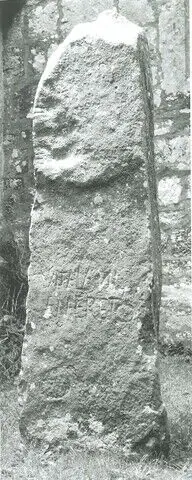
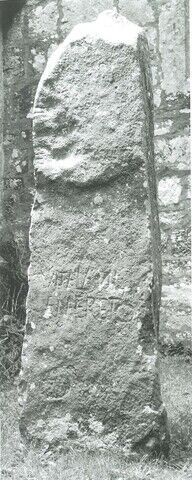
Provenance
Discovery: First mentioned by Lhuyd in 1695 but there was no ogham in Lhyud’s sketch. The ogham was first identified in 1874
Findspot: Nevern, Pembrokeshire, Wales (National Grid Reference: SN 0835 4005)
Last recorded location(s): Standing in the churchyard near the south wall of the nave east of the porch.
Support
Monument Dyfed Archaeological Trust Historic Environment Record: 1599 Nanhyfer; St Brynach’s Church
Object type: Slab
Material: Dolerite
Dimensions: H 1.855 × W 0.61 × D 0.48 m
Inscription
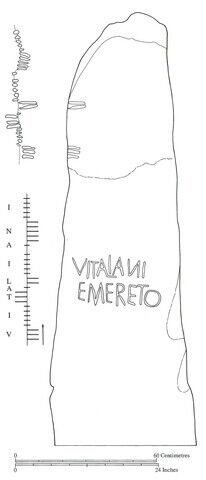
Text field: The ogham inscription is ‘on the left angle (A/D) towards the top of the stone, reading upwards’. ‘Towards the bottom of the face is a roman-letter, Latin inscription in two horizontal lines’ (Edwards 2007, 394).
Letters: The inscriptions are chiselled. Macalister (1945, 423) notes that both the ogham and Latin inscriptions are ‘cut, not pocked’. Edwards (2007, 394) describes the ogham inscription as ‘finely incised’ and the Latin inscription as ‘lightly and finely incised’.
Date: Fifth or early sixth century A.D. (linguistic)
Edition
Ogham text: ᚃᚔᚈᚐᚂᚔᚐᚅᚔ
Transcription: VITALIANI
Translation
Ogham: of Vitalianus
Commentary
‘Vitalianus is a Latin name which could have been used by both the Irish and the British, as Vitalinus may well have been Irish, in view of the use of ogham, but there is nothing in the form of his name to prove this… The use of T rather than D in the ogham may be influenced by the Latin spelling, or the name may have been borrowed into Irish before lenition of /t/ to /d/ had occurred in British Latin’ (Edwards 2007, 394).
‘The combination of an ogham inscription with a horizontal roman-letter inscription is comparatively rare… Both inscriptions consist of the same Latin name in the genitive case, with the addition of EMERETO in the roman. The disposition of the roman inscription would suggest that a compound name, Vitalianus Emeritus, is the most likely interpretation despite the lack of grammatical agreement… EMERETO for Emeritus shows Vulgar Latin… -o for -us. If the nominative -O is taken seriously, we should perhaps consider the ogham inscription as primary, commemorating Vitalianus, and the roman one as secondary, commemorating Emeritus son of Vitalianus…’ (Edwards 2007, 394).
References
- Edwards 2007, 392-394
- Macalister 1945, 423