Provenance
Discovery: The stone was first recorded as ‘standing upright at Pen y Mynidd’ (or Pen-y-mynydd) and a later record places the stone close to Caer Madre, however, the precise location of the original site cannot be determined. The ogham was first recorded in a sketch published in Archaeologia Volume IV 1776 and a drawing of the stone may have been included in Gough’s Camden. Sometime before 1894, the stone was moved to Fedw Hir house near Aberdâr where it was first used as a gatepost and later re-erected on the lawn. T. H. Thomas subsequently made a rubbing of the stone in March 1901. By 1933, the stone was at Cyfartha Museum.
Findspot: Ystradfellte, Brecknockshire (Brycheiniog), Wales (Approximate location only)
Current repository: Wales Cyfarthfa Museum (inv. no. SH.Z.C. no 1.1149)
Last recorded location(s): Now in Cyfarthfa Museum, Merthyr Tydfil.
Support
CPAT Regional Historic Environment Record (PRN): 3226
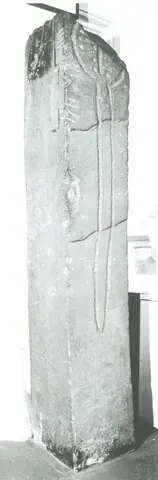
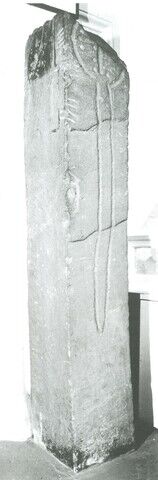
Object type: Cross-carved pillar
Material: Sandstone
Dimensions: H 1.35 × W 0.26 × D 0.27 m
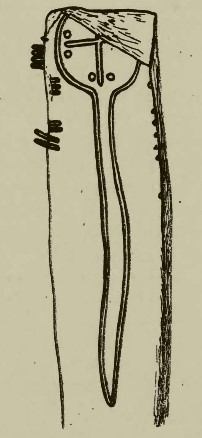
Decoration: After the ogham inscription, a linear Latin ringed cross was incised without inverting the stone (Redknap and Lewis 2007, 254-256). Nash-Wiliams (1950, 82) also notes ‘pairs of dots symmetrically disposed in the outer angles of the four quadrants’ of the cross and ‘a long round-ended outline stem below’.
Condition: Redknap and Lewis (2007, 254) note that early drawings show the stone complete, though with an apparently fractured top and no evident ogham strokes along the top edge. The top of the stone is now partly fractured away. Consequently, ‘the inscription is probably incomplete, the top edge of the stone and the upper part of the right-hand edge not being present’ (Redknap and Lewis 2007, 255).
Inscription
Text field: The stone is inscribed with an ogham inscription along the upper-left-hand edge of the stone, reading upwards. Macalister (1945, 332) noted that ‘on the H-surface there are some modern graffiti, and on the angle opposite to the inscription some vowel-like notches’.
Letters: The ogham inscription is pocked.
Date: Fifth or sixth century A.D. (textual context)
Edition
Ogham text: ᚌᚂᚒ̣ᚃ̣ᚑ̣ᚉ[---
Transcription: GLỤṾỌC[---]
Critical apparatus:
- The vowels of the inscription in particular are uncertain, Redknap and Lewis (2007, 255) propose that the ‘spacing suggests that the missing vowels could have been A, O or U in each case’. The fourth letter in the inscription may be a V but Redknap and Lewis (2007, 256) maintain that close examination of the ogham suggests a fourth horizontal stroke from the bottom ‘which has clearly been truncated by the circle around the cross’, confirming that the cross is later than the ogham inscription. This fourth horizontal stroke would make the fourth letter an S but Redknap and Lewis (2007, 255) also highlight that ‘if a fifth stroke had also been removed this would give an N’. 2. Although there seems to be no evidence for a second line, according to Redknap and Lewis (2007, 255), Rhys (1896) and Nash-Williams (1950, 82) both read: GLUVOCA [ ] I[ ] 3. Macalister (1945, 332) read: GL(U)V(0)C(I)
Translation
A translation cannot be provided.
Commentary
Sims-Williams (Redknap and Lewis 2007, 255-256) notes that the etymology is obscure but proposes *kliwoko- ‘ridge’ which later becomes OI. clíu (gen. cliach), an element which is also found in Ireland (CIIC: no, 86 (Macalister 1945, 86): CLIUCUNAS and I-COR-035: CLIUCOANAS).
References
- Macalister 1945, 331-332, no. 345
- Nash-Williams 1950, 82, no. 74
- Redknap and Lewis 2007, 254-256
- Rhys 1896, 98-128