Provenance
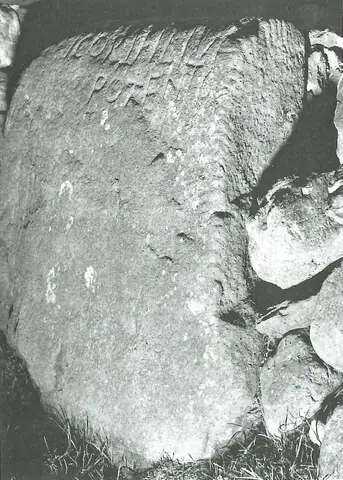
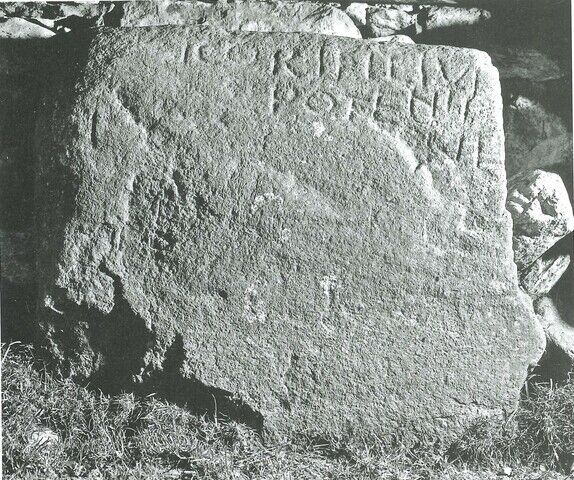
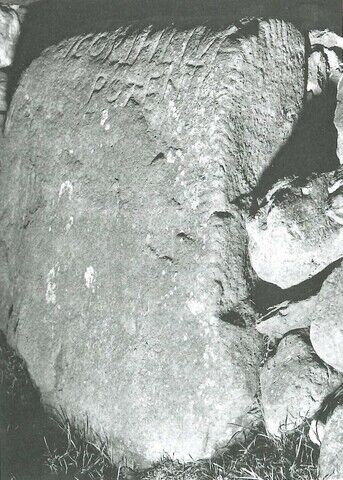
Discovery: Locally derived stone, first found in 1901 when it was removed to avoid obstructing a gateway approximately 300m north-north-east of Pen Llystyn Roman fort. The ogham inscription was discovered in 1903 when the stone was moved and set the right way up.
Findspot: Dolbenmaen, Caithness, Wales (National Grid Reference: SH 4828 4529)
Last recorded location(s): Set into the stone wall on the south side of the farmyard west of the farmhouse (SH 4821 4553).
Support
Gwynedd Archaeological Trust Regional Historic Environment Record: 136 Llystyn-gwyn Farm
Object type: Slab
Material: Dolerite
Dimensions: H 1.02 × W 1.09 × D 0.36 m
Condition: The stone is partially obscured by vegetation and rubbish. There is minor damage to the surface of the stone. The ogham and roman-letter inscriptions are very weathered (Edwards 2013, 270).
Inscription
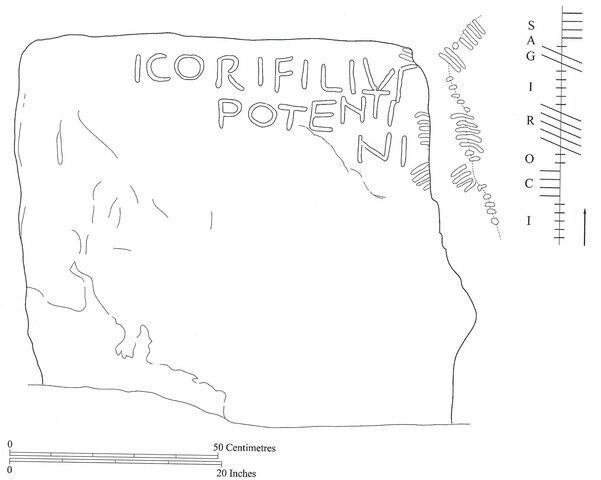
Text field: The stone is inscribed with an ogham inscription on the right edge of the stone beginning about halfway to the top of the stone continuing over the top, reading vertically upwards. The placement of the ogham inscription on the right angle is more unusual but is paralleled in the north on Llanfaelog (W-AGY-001). The stone is also inscribed with a roman-letter inscription in three lines at the top of the face, justified to the right, reading horizontally. Edwards (2013, 272) notes that the combination of a horizontal roman-letter inscription with ogham is unusual and that the positioning of the roman-letter inscription towards the right angle of the stone where the ogham is located is surely intentional and signals a relationship between the two inscriptions.
Letters: Macalister (1945, 361) described the ogham inscription as pocked and rubbed and Edwards (2013, 271) described the inscription as ‘incised using broad lines and a punch’. The roman-letter inscription is set out unevenly in capitals with miniscule S (Edwards 2013, 270-271).
Date: Late fifth or earlier sixth century A.D. (linguistic)
Edition
Ogham text: ᚔᚉᚑᚏᚔᚌᚐᚄ
Transcription: ICORIGAS
Critical apparatus:
- Edwards (2013, 272) remarked that although the details of the ogham inscription are difficult to see due to the location of the stone, the inscription has been consistently read as ICORIGAS.
Translation
Ogham: of Icorix
Roman: (of?) Icorix, son of Potentinus
Commentary
Sims-Williams (Edwards 2013, 273) maintains that the name Icorix has no known descendants in later Welsh or Irish. In theory, Old Irish Echrí could continue *Icorix, but it is more likely to be from *Ekworix ‘horse-king’ (Edwards 2013, 273). If the name is British, Sims-Williams (Edwards 2013, 272-3) contends that the ogham presumably uses C rather than G either following the roman lettering or following the Irish cognate.
The roman-letter inscription is in the ‘X son of Y’ formula. The first name in the inscription, Icorix appears to have both British and Celtic influence while Potentinus is Latin and use of this name is paralleled elsewhere in Britain and Ireland (Edwards 2013, 272-273).
References
- Edwards 2013, 270-273
- Macalister 1945, 361-362