
Ireland’s Ancient East covers a broad sweep of the country’s southeast, from the Boyne Valley in the north to the headlands of Co. Waterford in the south. It is better known for the monastic ruins, Norman castles, and passage tombs that define much of Irish heritage tourism. But threaded through the same landscape is a quiet parallel history told in Ogham: inscribed pillars set up in the fifth and sixth centuries to mark territory, commemorate the dead, and record the lineages of the early Irish dynasties.
The region holds more than twenty recorded Ogham stones. Some are now in the National Museum of Ireland in Dublin. Others remain in the landscapes where they were first set up, or built into the walls of churches that replaced earlier sacred sites. This guide focuses on the stones you can actually stand in front of, grouped into three county clusters that form a logical route from Carlow through Kilkenny and down into Waterford.
The Ancient East Ogham Stones at a Glance
| Stone | Location | Inscription | Status |
|---|---|---|---|
| Rathglass | Co. Carlow | DUNAIDONAS MAQI MARIANI | In situ |
| Tuckamine | Co. Carlow | [---] MUCOI MUCCI[---] | In situ |
| Clonmore | Co. Carlow | GUSCU | In situ |
| Patrickswell | Co. Carlow | [---]MAQI[---] | In situ |
| Churchclara 1 | Co. Kilkenny | TA[EGA]GN[I MAQ] MUC[O] MAC[O][BO] | Built into church |
| Legan | Co. Kilkenny | LOBB[I] K[OI] MAQQI MUC[COI] RINI | In situ at castle |
| Ballyspellan | Co. Kilkenny | Medieval names inscription | National Museum, Dublin |
| Island | Co. Waterford | CUN[A]NETAS MAQI MUC[OI] NETASEGAMONAS | In situ (lying) |
| Kilgrovan 1 | Co. Waterford | [CU]NAMAQI LUGUDECA MUCO[I] CUNEA | Mount Mellary Heritage Centre |
| Ardmore 1 | Co. Waterford | LUGUDECCAS MAQI[---] MUCOI NETASEGAMONAS | In situ in cathedral |
| Ardmore 3 | Co. Waterford | AMADU | In situ in cathedral |
| Portersgate | Co. Wexford | SEDAN[I MA]Q[I CA-T]TABBO-TT AVVI DERCMASOC | National Museum, Dublin |
| Ballybarrack | Co. Louth | MAQICORABIR MAQI TAN[.]B[---]… | National Museum, Dublin |
You can plot all locations on our Ogham stones map before you travel.
Planning the Route
The visitable stones fall into three geographic clusters. Carlow sits in the northeast of the region, roughly two hours from Dublin, and has the densest concentration of in-situ stones. Kilkenny is about forty minutes southwest, with two accessible sites of very different character. Waterford is an hour south of Kilkenny and holds the most dramatic setting of the whole route: the cathedral ruin at Ardmore with three inscribed stones on display inside its walls.
Kilkenny city is the most practical base for the middle sections of the trip, with Waterford city working well for the southern stretch.
Open the full route in Google Maps — 7 visitable sites in order, ready to navigate.
Day 1: The Carlow Ogham Stones
Carlow has four recorded Ogham stones, all in the eastern part of the county on the western slopes of the Wicklow Mountains. Three of them are in a loose cluster within a few kilometres of each other near the town of Hacketstown. The fourth is a few kilometres northwest near Rathvilly.
Rathglass Ogham Stone (I-CAR-003)
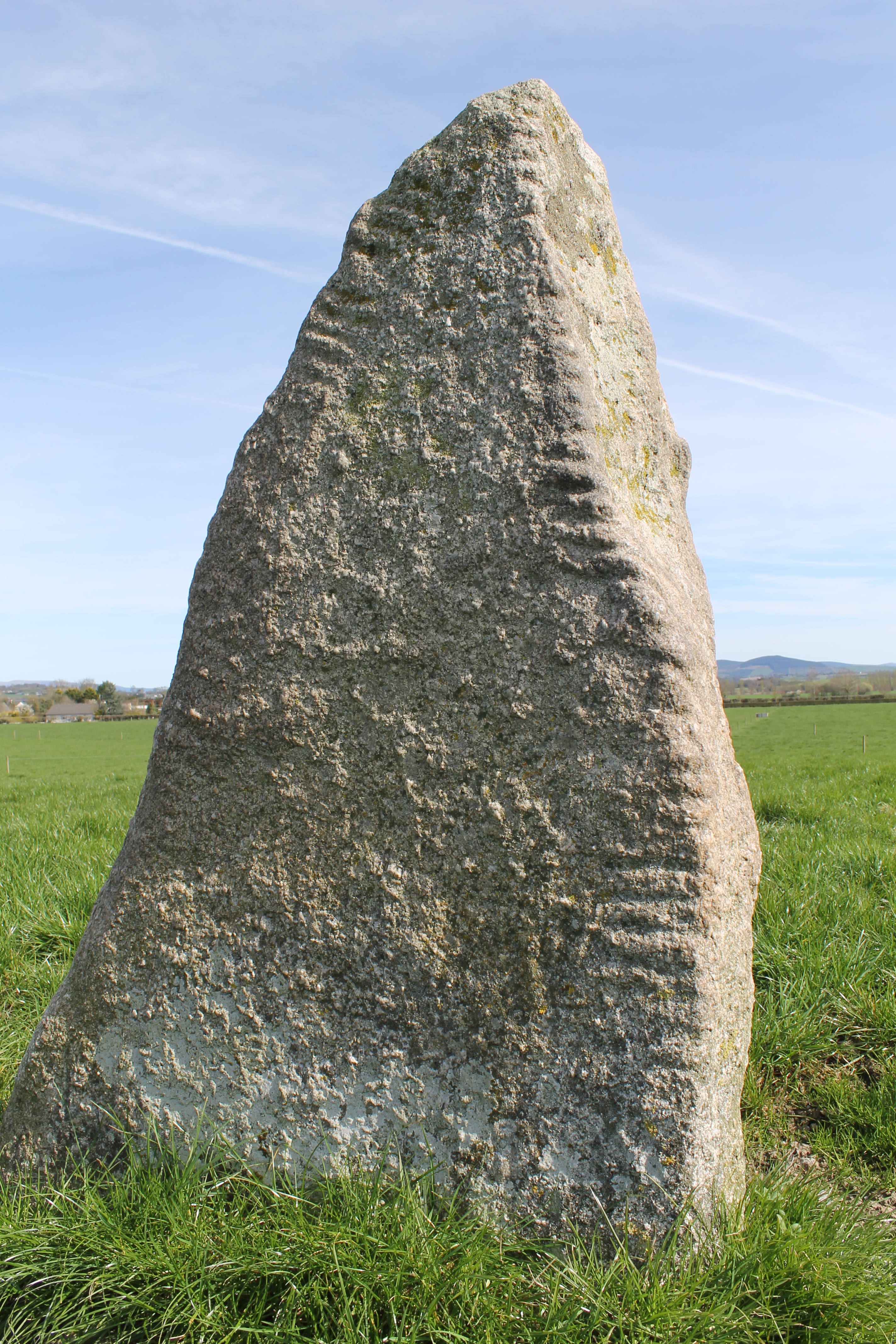
The Rathglass stone is one of the more striking examples in Leinster, not least because it is part of a pair: two standing stones set three metres apart on a low east-west ridge. Only the eastern stone carries an inscription; the western partner appears to be a plain prehistoric standing stone that was already ancient when the Ogham carver arrived.
The inscription reads DUNAIDONAS MAQI MARIANI, “of Dúnadach, son of Marianus.” The father’s name is a Latinised form, Marianus, used as a personal name in early Christian Ireland, which gives the stone a transitional quality: native Ogham formula, Roman name. The stone was first published in the Irish Independent in 1910 and is still standing in the field where it was found.
Worth seeing nearby: Altamont Garden, one of the finest informal gardens in Ireland, is about twenty minutes west. The southern Wicklow Mountains are immediately to the northeast and the Slaney valley runs north from here through some of the quieter walking country in Leinster.
Tuckamine and Clonmore Ogham Stones (I-CAR-004 and I-CAR-001)
These two stones sit within a few kilometres of each other in the same upland landscape north of Hacketstown.
The Tuckamine stone was discovered around 1938 by Edward O’Toole, who found it propping up a gateway on farmland near the village of Clonmore. It had likely been removed from the nearby graveyard at Kilmagarvoge, of which no surface traces remain. What survives of the inscription reads MUCOI MUCCI, a kin group name, the personal name having been lost from the damaged beginning of the text.
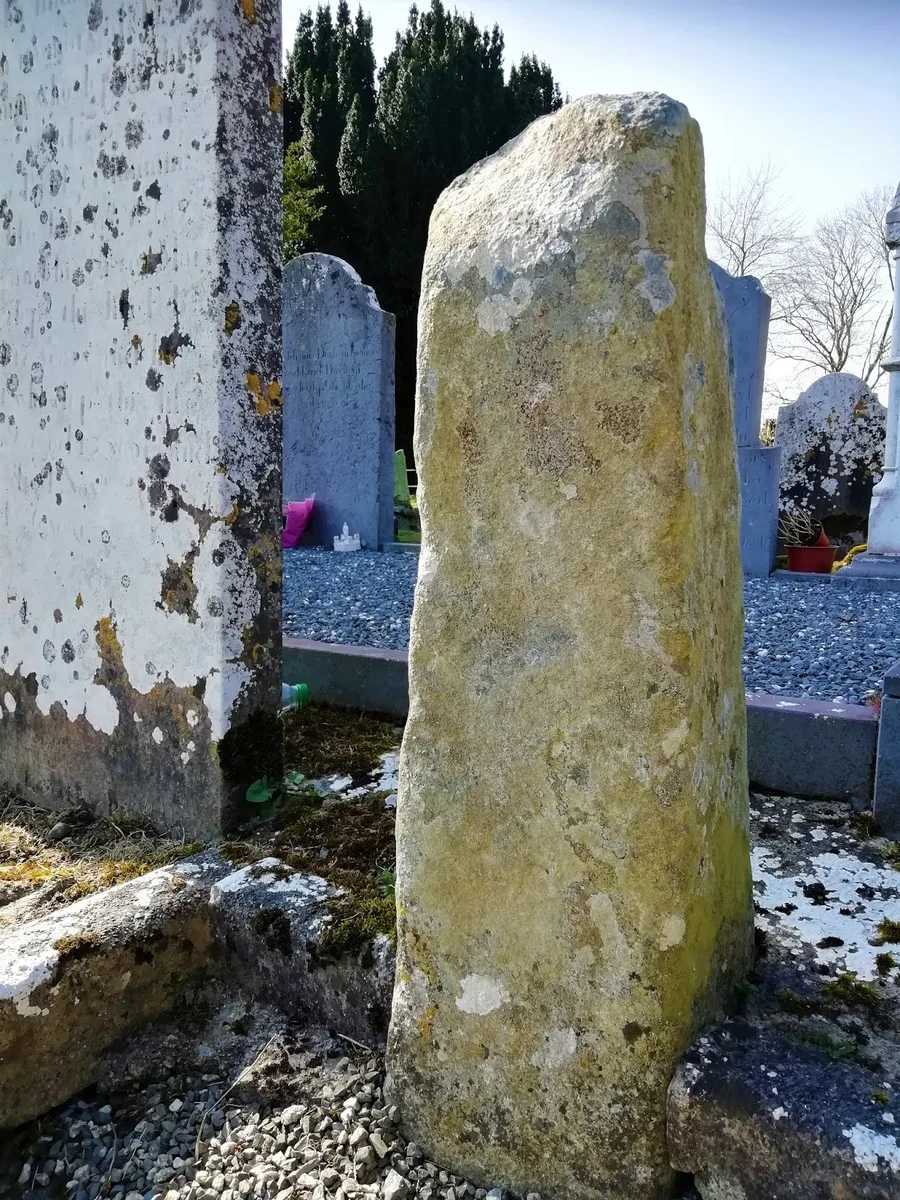
The Clonmore stone stands in the graveyard at the early ecclesiastical site of Cluain Mhór M’Áedóc, a foundation with significant heritage in its own right. The graveyard contains two large granite solid-wheeled crosses, nineteen cross-carved stones, a holy well, and two bullaun stones, as well as the Ogham pillar, which was first noticed in 1940. Its inscription, GUSCU, is a single personal name in an unusually bare commemorative formula.
Worth seeing nearby: Clonmore Castle, a Norman motte and gatehouse in the village, is a short walk from the graveyard. Ferns in Co. Wexford, one of the great early medieval ecclesiastical sites, is about twenty minutes east and worth a detour.
Patrickswell Ogham Stone (I-CAR-002)
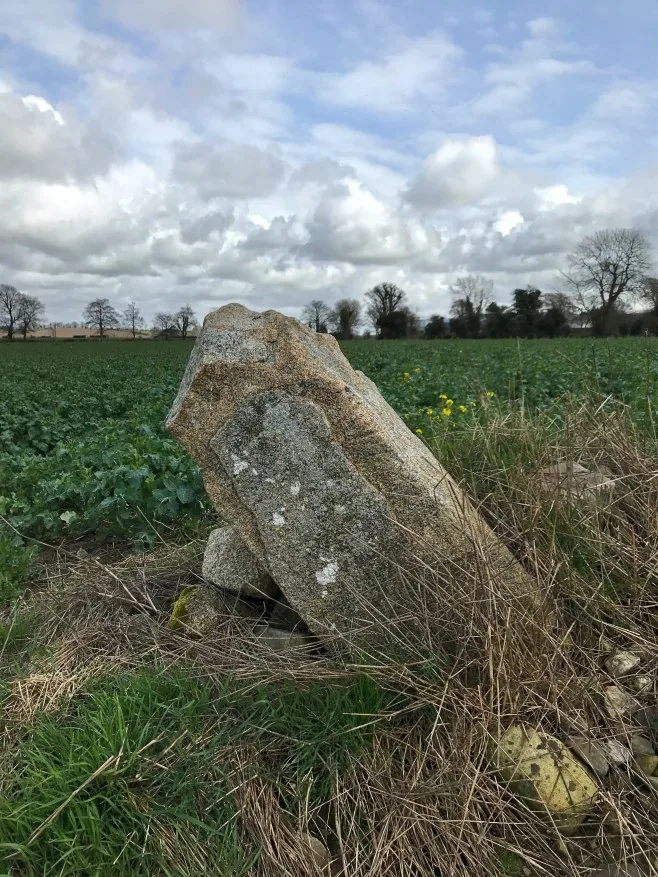
The Patrickswell stone stands on a gentle north-facing slope near the village of Rathvilly, close to a holy well associated with St Patrick and an early ecclesiastical site at Waterstown. Discovered around 1984, it is a relatively recent addition to the recorded inventory. The surviving inscription reads [---]MAQI[---], a fragment that preserves only the formula word for “son of” with both names lost to damage or erosion.
The stone matters less for its text than for its setting, which connects it to an older sacred landscape: holy well, early church, Ogham pillar all within sight of each other. The view northeast to the Wicklow Mountains from the crest of the hill is genuinely good.
Worth seeing nearby: Rathvilly village has a well-preserved motte and bailey. Baltinglass Abbey, a 12th-century Cistercian foundation in impressive ruins, is about fifteen minutes northwest along the Slaney valley.
Day 2: The Kilkenny Ogham Stones
Churchclara Ogham Stone (I-KIK-002)
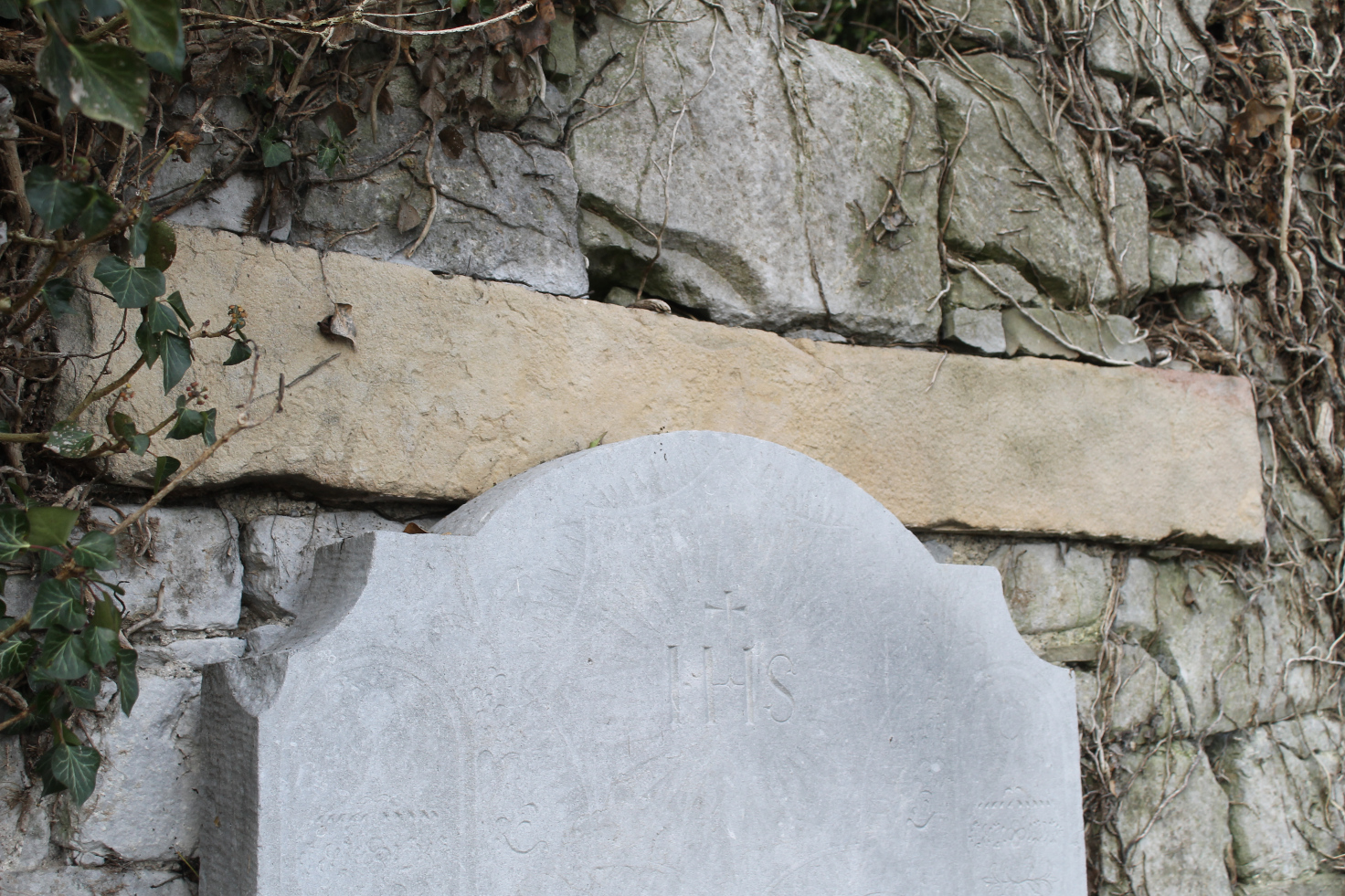
The Churchclara stone is built into the fabric of an old church, reused by medieval masons as a window sill. It was first noticed in 1869, sitting in a round-headed window of what is clearly a pre-Norman foundation, identified by the antae (projecting side walls) on the chancel. The church was dedicated to St Colmán, probably Colmán Cláraig, who gave his name to the deanery of the medieval diocese. A holy well and two bullaun stones are associated with the site.
The inscription, TA[EGA]GN[I MAQ] MUC[O] MAC[O][BO], is fragmentary and the personal names are partially obscured, but the kin group formula (MUCOI) is legible. The stone’s survival as a building element, rather than being buried or destroyed, gives it an odd double life: ancient monument and construction material simultaneously.
Worth seeing nearby: Kilkenny city is about forty minutes south and is one of the best heritage destinations in Ireland, with Kilkenny Castle, St Canice’s Cathedral, the medieval streetscape of Parliament Street, and the Black Abbey all worth your time. Kells Priory, a 12th-century Augustinian fortified monastery with extensive intact walls, is about twenty minutes south of the city.
Legan Ogham Stone (I-KIK-008)
The Legan stone has one of the more unusual histories in the Kilkenny Ogham record. It was reused as a corner quoin in Legan Castle, where it was first noticed by John Moore in 1891. At some point after 1945 it was set in concrete at the front of the ruins. Legan Castle Farmhouse is now a guesthouse and the preserved ruins, with the Ogham stone still in position, are part of the grounds.
The inscription reads LOBB[I] K[OI] MAQQI MUC[COI] RINI, “of Lobbus (?), son of the kin of Ren.” The formula includes the less common KOI alongside MAQQI (the doubled Q is an archaic spelling), and the kin group name RINI has been connected by scholars to a Connacht dynasty. The townland name, An Liagán (“the pillar stone”), suggests the stone was standing and well-known long before it ended up in the castle wall.
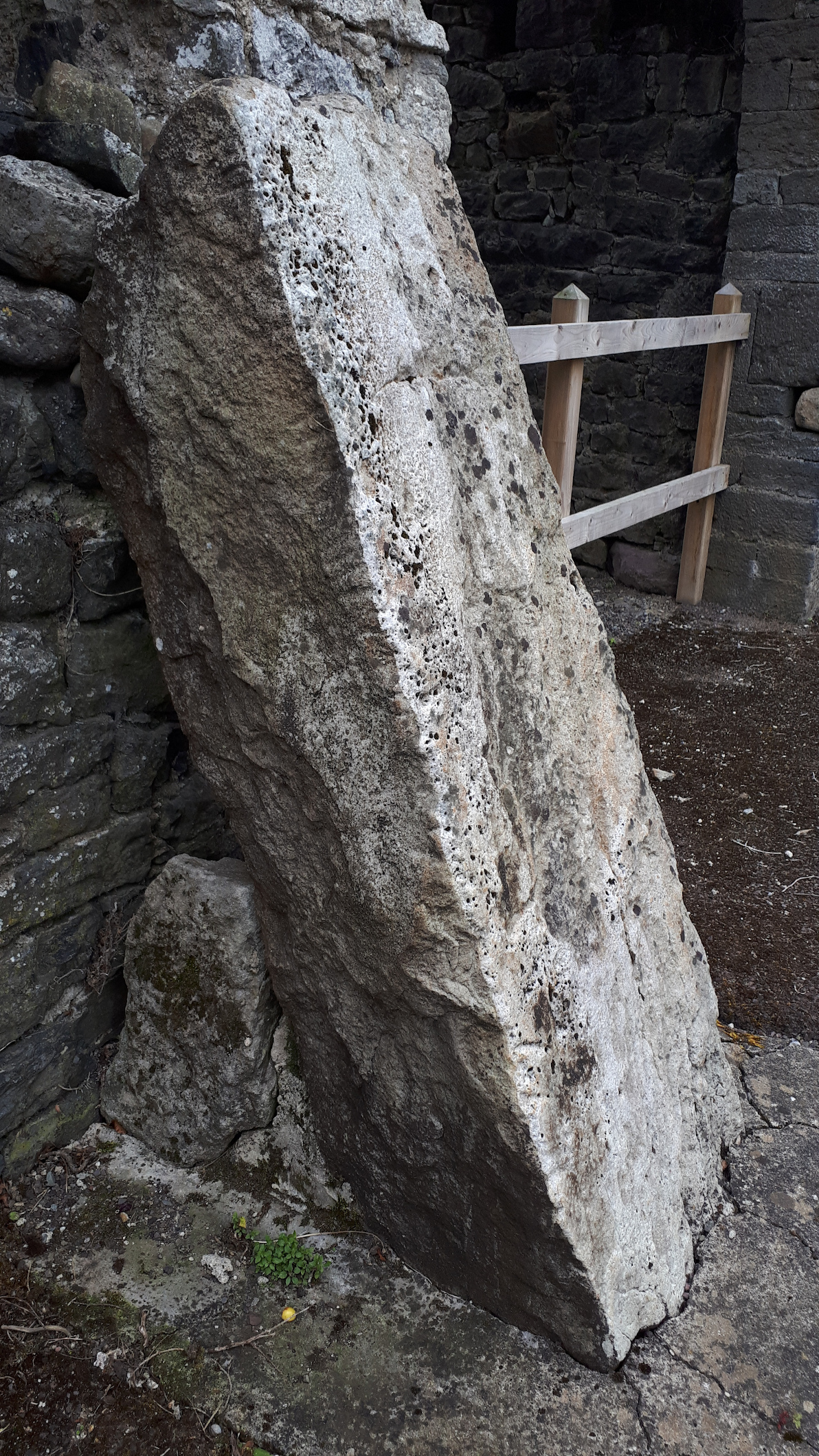
Worth seeing nearby: Jerpoint Abbey, a 12th-century Cistercian foundation with remarkable Romanesque carvings and a well-preserved cloister arcade, is about fifteen minutes south and among the finest monastic ruins in Ireland. The Nore Valley south of Kilkenny passes through some of the best farmland landscape in Leinster.
Day 3: The Waterford Ogham Stones
Island Ogham Stone (I-WAT-042)
The Island stone lies in pieces in a circular enclosure on a northeast-facing slope, with sea cliffs about 130 metres to the south. It was already broken when first recorded in the 19th century, lying alone in the centre of the enclosure. A small cross-carved stone lies beside it. The site is thought to be an early ecclesiastical enclosure, with an oral tradition of a killeen (children’s burial ground) associated with it.
The inscription, CUN[A]NETAS MAQI MUC[OI] NETASEGAMONAS, is one of the oldest in the Waterford corpus, dated by McManus to the first half or early second half of the fifth century. The kin group name NETASEGAMONAS also appears on the Ardmore 1 stone, twenty kilometres to the southwest, suggesting both stones belonged to the same dynasty that controlled this stretch of the Waterford coast in the mid-fifth century.
Worth seeing nearby: Dungarvan, about twenty minutes west, is one of the liveliest market towns on the south coast. The castle, medieval town walls, and the harbour are all worth an hour. The Comeragh Mountains rise directly behind the town and the coast road east toward Tramore is particularly scenic.
Kilgrovan Stones at Mount Mellary (I-WAT-025 and others)
Seven Ogham stones from the Kilgrovan townland are now housed at Mount Mellary Abbey Heritage Centre in the Knockmealdown Mountains, about twenty-five kilometres north of Ardmore. They were discovered in two phases: five stones found in 1857 by William Williams and two more in 1966, all from the same early ecclesiastical enclosure at Cill Ghruabháin. The find site is a bivallate enclosure — two concentric banks — that geophysical survey has confirmed as an early ecclesiastical site, with internal circular features that may represent the original church building or associated hut-sites.
Mount Mellary Abbey was founded in 1833 by Irish and French Cistercian monks, the first Cistercian foundation in Ireland after the Reformation. The community had fled post-revolutionary France and settled in what was then largely bare mountain bog in the Knockmealdowns, which they cleared and cultivated themselves. The monastery has been in continuous occupation since.
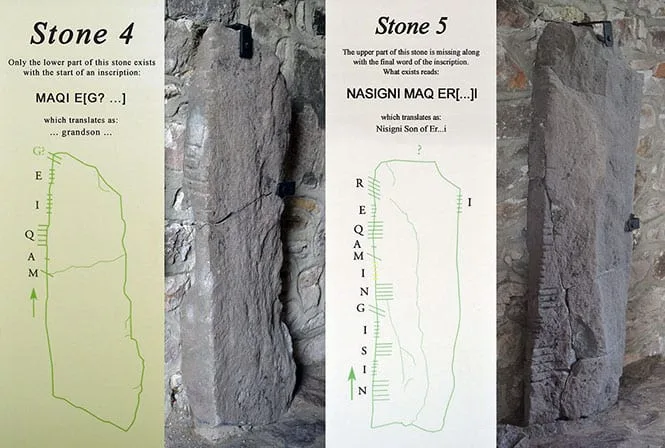
The five principal stones stood in a fenced grove of trees on the abbey grounds for over forty years before being moved indoors in 1977 to the foyer of the old secondary school, now the Heritage Centre. They stand in a line, each clearly inscribed, allowing close inspection of all five. The collection is one of the largest single-site Ogham assemblages in Ireland outside of a national museum.
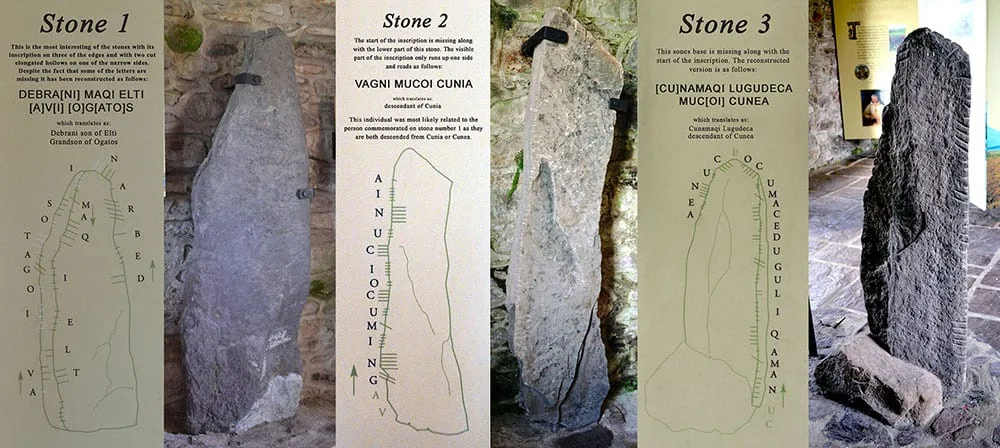
The principal stone, Kilgrovan 1 (I-WAT-025), reads [CU]NAMAQI LUGUDECA MUCO[I] CUNEA — “of Conmac of Luguid from the sept of Con[?]”. Another of the five, probably Kilgrovan 2, reads DEBRANI MAQI ELTI AVI OGATOS, “of Debrán, son of Elta, grandson of Ogatos.” A shared kin group name, MUCOI CUNIA, appears on at least two of the stones, suggesting all five commemorate members of the same dynasty that controlled this part of west Waterford in the fifth and sixth centuries.
The abbey church contains notable stained glass. A grotto and holy well in the grounds draw visitors year round. The monastery remains an active Cistercian community and offers retreat accommodation.
Worth seeing nearby: Mount Mellary sits in the heart of the Knockmealdown Mountains, which have good walking trails and mountain passes. Lismore, about fifteen minutes south, is one of the most beautiful estate towns in Ireland — the castle gardens are open to visitors and the town sits on a dramatic bend of the Blackwater river. The Vee Gap road through the Knockmealdowns north toward Tipperary is one of the finer mountain drives in Munster.
Ardmore Ogham Stones (I-WAT-002 and I-WAT-004)
Ardmore is the centrepiece of any Ogham tour in the south of Ireland and one of the most rewarding heritage sites in the entire Ancient East region. St Declan’s monastery here was one of the earliest Christian foundations in Ireland, predating Patrick’s mission according to local tradition. The site within its D-shaped enclosure holds cathedral ruins, a round tower, St Declan’s oratory, and three Ogham stones.
Two of those stones are displayed in niches in the chancel of the ruined Romanesque cathedral, facing each other across the interior. Ardmore 1 (I-WAT-002) is the more substantial: a 1.27-metre sandstone pillar bearing an inscription on three angles. The main text reads LUGUDECCAS MAQI[---] MUCOI NETASEGAMONAS, “of Luguid, son of […], from the kin of Nad-Segamon,” and connects this stone directly to the Island stone further east: both record men from the same dynasty, the Netasegamons, who appear to have dominated west Waterford in the fifth century. Pre-apocope endings on both personal names confirm a pre-sixth century date.
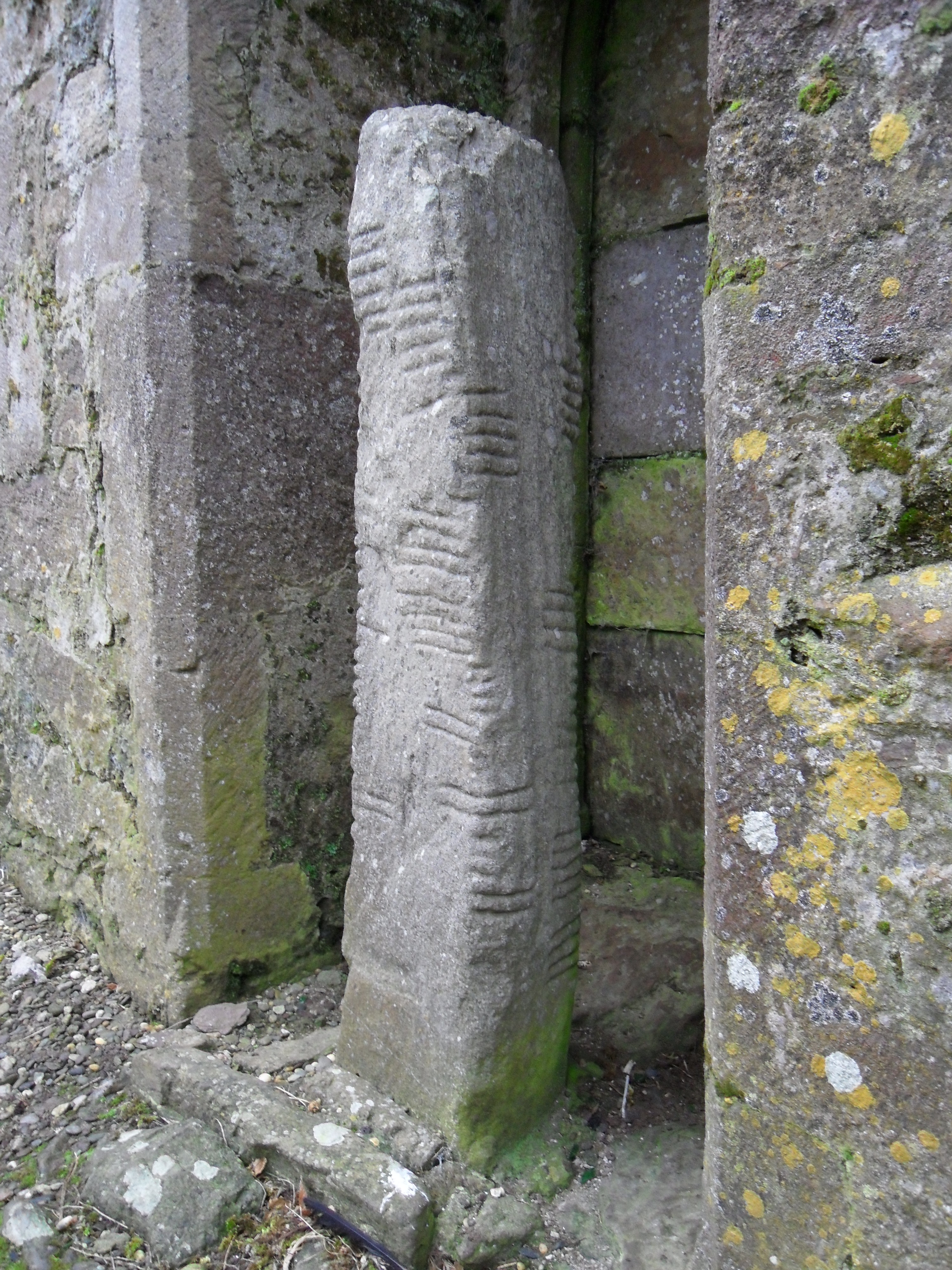
Ardmore 3 (I-WAT-004) stands opposite: a shorter pillar with a small incised cross on the sloping top and a brief inscription, AMADU, a Latin name (Amatus, “beloved”) carved in an Irish Ogham formula. It is one of a handful of inscriptions in the corpus that use a Roman personal name, evidence of the early Christian community at work here in the fifth and sixth centuries.
The round tower at Ardmore, 29 metres tall and one of the most complete in Ireland, dominates the headland. St Declan’s oratory beside the cathedral is said to hold the saint’s grave. The whole site, on a cliff above the sea with views across Ardmore Bay, is genuinely exceptional.
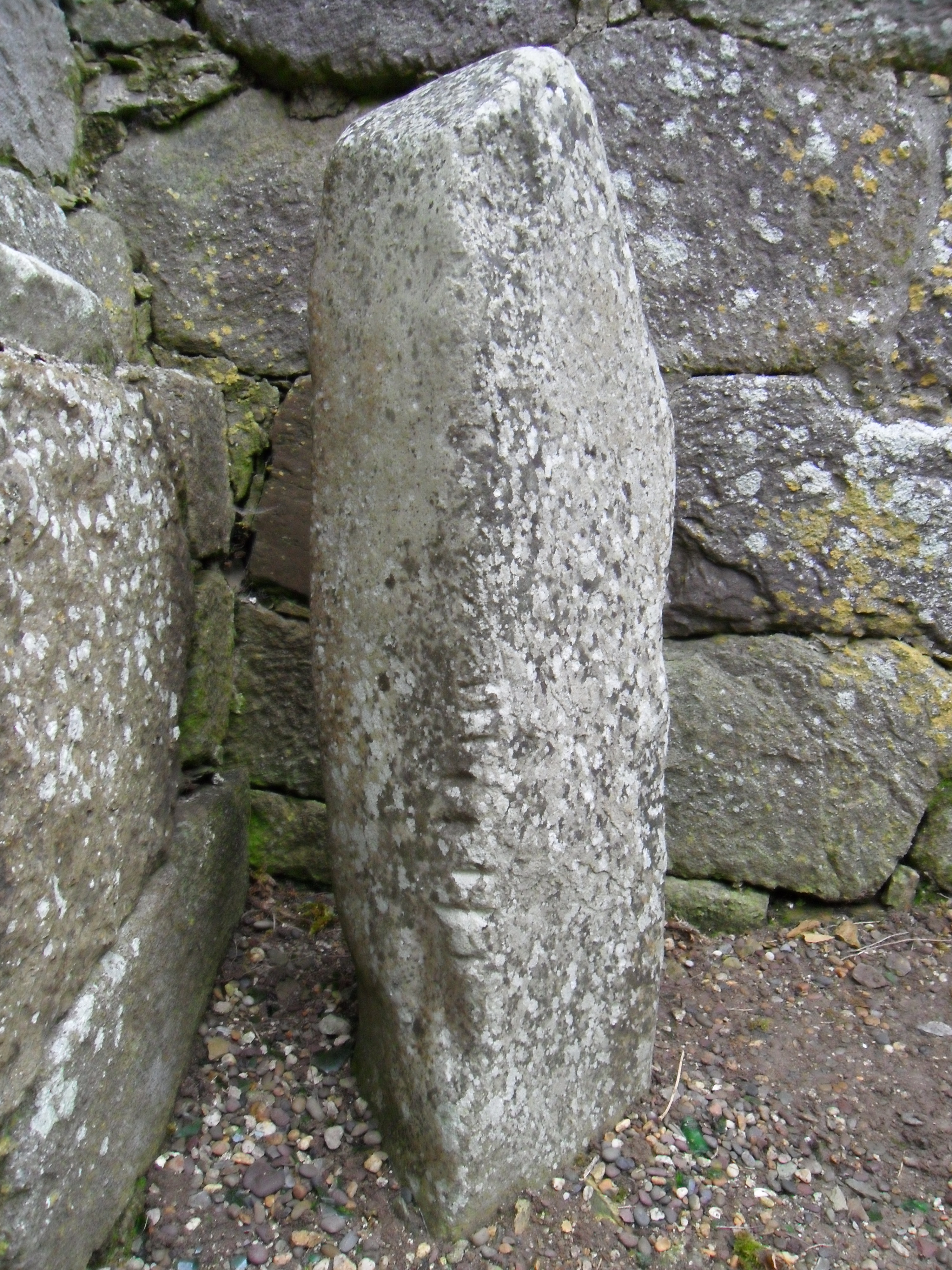
Worth seeing nearby: Ardmore village has good restaurants and the cliff walk east from the headland is one of the best short coastal walks in Waterford. Dungarvan is twenty minutes west and Youghal, just across the Cork border, is thirty minutes west: a walled medieval town with a fine gatehouse and one of the best-preserved church ruins in Munster.
Where to Stay
Kilkenny city suits the Carlow and Kilkenny sections, with good transport links and a wide choice of accommodation. Waterford city works well as a base for the coastal Waterford stones, with Dungarvan as a quieter alternative if you prefer to be closer to Ardmore.
Practical Tips
Most of the in-situ Carlow stones are on farmland near public roads. The Clonmore stone is in an accessible graveyard. The Kilkenny stones are both in publicly accessible settings: the Churchclara stone is part of an old church ruin and the Legan stone is on the grounds of a farmhouse guesthouse. Ardmore is a national monument in state care and has no access restrictions. Mount Mellary Heritage Centre is at the Cistercian abbey, which maintains its own visiting hours.
The Ardmore stones, along with several others in the Waterford corpus, were recorded in 3D by the Discovery Programme as part of the Ogham in 3D project, so high-resolution photogrammetric models are available online if you want to examine the inscriptions in detail before you visit.
The full records for all these stones, including inscriptions, coordinates, and photographs, are in our Ogham stone database.
Frequently Asked Questions
How many Ogham stones are in Ireland’s Ancient East?
More than twenty Ogham stones have been recorded across the region, spanning counties Louth, Meath, Carlow, Kilkenny, Waterford, and Wexford. A number are now in the National Museum of Ireland in Dublin.
Where is the best single Ogham stone site in Ireland’s Ancient East?
Ardmore in Co. Waterford is the standout. Two inscribed pillars are displayed inside the ruined Romanesque cathedral on the headland, alongside a complete round tower, St Declan’s oratory, and spectacular coastal views.
Are the Ireland’s Ancient East Ogham stones suitable for visiting year round?
Yes. The major sites are open throughout the year. Ardmore is a national monument with no seasonal restrictions. Mount Mellary Abbey Heritage Centre has its own opening hours, so it is worth checking those in advance.
What is the connection between the Ardmore and Island stones?
Both inscriptions include the kin group formula MUCOI NETASEGAMONAS, meaning “of the kin of Nad-Segamon.” The presence of the same dynastic identifier on two stones in the same area of west Waterford suggests a single family controlled the territory in the fifth century and used Ogham stones to mark that claim.
Are any Ogham stones in Ireland’s Ancient East on private land?
Some of the Carlow stones are on farmland near public roads. As with rural Ogham stones generally, an OS map, some patience, and a willingness to knock on a door usually works well. All of the stones mentioned in this guide are recorded national monuments and landowners are generally aware of them.