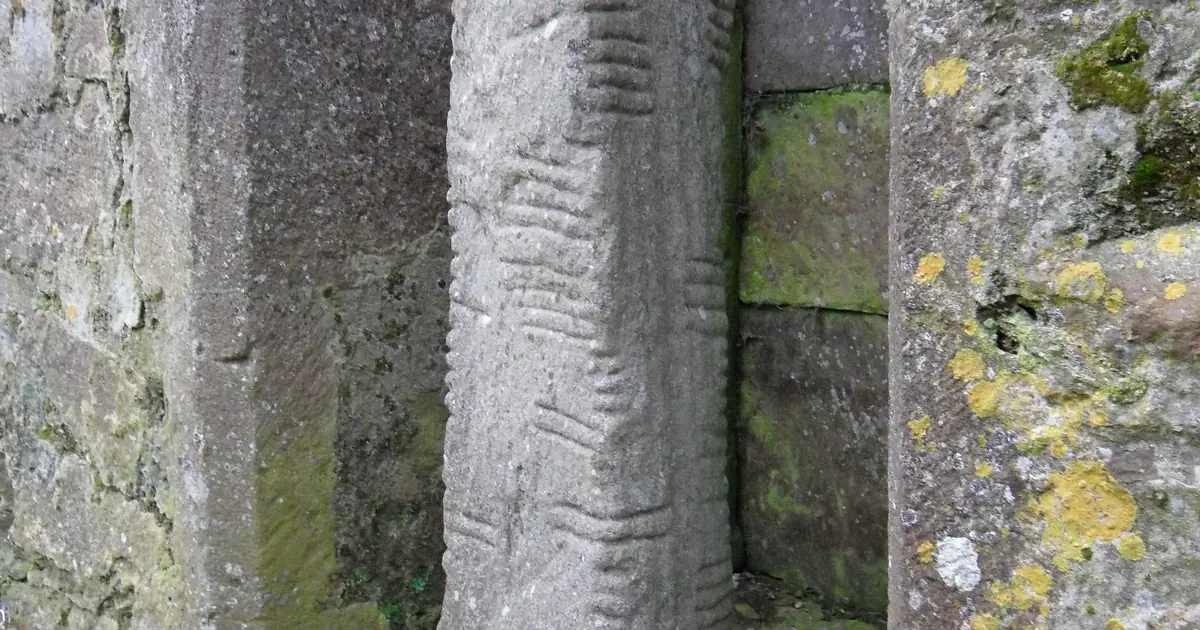
Read enough ogham inscriptions and a pattern jumps out fast. Most of the roughly 400 surviving stones aren’t saying anything unique. They’re running the same short genealogical script over and over: a name, a word meaning “son of,” and another name. That word is MAQI, and it’s the single most useful thing to know if you want to actually read a stone rather than just admire the notches.
The Basic Formula: X MAQI Y
MAQI is Primitive Irish for “son,” the ancestor of the modern Irish mac. On a stone, it sits between two personal names in the genitive case, and the whole thing reads as “of X, son of Y.”
One of the clearest examples is the St Dogmaels stone in Pembrokeshire, Wales. It carries two inscriptions cut side by side, one in ogham, one in Latin, both saying the same thing: SAGRANI MAQI CUNATAMI, “of Sagranus, son of Cunatamus.” Because the two texts run in parallel, this stone became known among early antiquarians as the ogham Rosetta Stone. It was one of the first bilingual inscriptions ever found, and it helped confirm how the formula worked before scholars had catalogued enough Irish examples to be sure.
Not every stone is so generous. The Patrickswell stone in Co. Carlow is badly weathered, and only fragments of its inscription survive. But even reduced to a few strokes, what’s left reads [---]MAQI[---]. That’s often enough. Once you can spot the shape of MAQI in worn stone, you know you’re looking at a name formula even when both names themselves are gone.
Filling in the Family Tree: MUCOI
Plenty of inscriptions don’t stop at a father’s name. They add a second formula word, MUCOI, meaning roughly “tribe” or “kin group,” followed by the name of a shared ancestor or founding figure. The pattern expands to X MAQI Y MUCOI Z: “X, son of Y, of the kin of Z.”
The Ardmore 1 stone in Co. Waterford, shown above, is a good full example. It reads LUGUDECCAS MAQI [---] MUCOI NETASEGAMONAS, “of Luguid, son of […], from the kin of Nad-Segamon.” The father’s name is lost to damage at the top of the pillar, but the kin group survives clearly. That detail turns out to matter. A Nia Segamon appears in the historical record as a prehistoric king of Cashel, and the same MUCOI NETASEGAMONAS formula shows up on other stones nearby in west Waterford. It’s a reasonable guess that this cluster of inscriptions marks the territory of a single dynasty in the fifth century, not just a coincidence of shared ancestry.
MUCOI formulas like this are also why some nineteenth-century scholars argued ogham stones were being deliberately vandalised by Christian converts erasing a “pagan” word. The linguist Damian McManus, in A Guide to Ogam (1991), pushed back on that theory. He pointed out that MUCOI turns up fine in later Christian manuscript sources, and that the wear on many stones is better explained by centuries of reuse as building material than by targeted defacement.
The Rest of the Formula Toolkit
MAQI and MUCOI cover most inscriptions, but they’re not the only formula words carved into ogham stones. A handful of others show up often enough to be worth knowing:
ANM, meaning “name,” sometimes opens an inscription before the person’s name follows, similar to writing “Name: X” today.
AVI, meaning “descendant of,” is used the way MAQI is, but for a grandparent or more distant ancestor rather than a father.
CELI, meaning “follower” or “devotee,” turns up on some of the later, more clearly Christian inscriptions.
NETA, meaning “nephew” or “champion,” appears in formulas like NETA-CARI, “nephew of Cari.”
KOI, meaning “here is” or “here lies,” functions like the Latin hic iacit. It’s an unusual letter in its own right too: the K sound is always written using ogham’s first supplementary character rather than the standard alphabet, because Primitive Irish didn’t otherwise need a K.
Between them, these formula words account for the overwhelming majority of the roughly 400 known inscriptions. Once you can recognise the shape of MAQI, MUCOI, and a couple of the rarer words, most stones stop being mysterious blocks of notches and start reading like what they are: short, formal genealogical statements, not unlike a gravestone.
Where the Formula Breaks Down: Pictish Scotland
Scotland is where the pattern falls apart, and that’s part of what makes its stones interesting. Ireland and Wales together account for the overwhelming bulk of surviving ogham, and nearly all of it follows the MAQI formula in one form or another. Scotland’s ogham corpus is different. Most of it comes from the Picts, and a large share of it doesn’t use the standard formula at all.
The Inchyra stone in Perthshire is a striking case. It carries three separate ogham inscriptions across five lines, cut by what looks like three different hands at three different times. None of them resolve into a recognisable X MAQI Y statement. The archaeologist Katherine Forsyth, who re-examined the stone in detail, noted that the text simply doesn’t conform to the standard formulas, and that without knowing what the monument was for, there’s little basis for guessing what kind of message to expect from it. Some sections may even be informal graffiti rather than a formal memorial at all.
Nearby, the fragmentary Abernethy stone offers a possible echo of the pattern rather than a clean example of it. Only three letters survive clearly, but Forsyth suggested the sequence might preserve a variant of MAQQI, the doubled-Q spelling of the formula word found on some of the earliest Irish stones. If so, it’s one of the only hints of the familiar formula surviving anywhere in the Pictish ogham corpus, and even that reading is far from certain.
Scholars still don’t agree on why Pictish ogham looks so different. It may reflect a different language underlying the inscriptions, since Pictish is only thinly attested and not well understood. It may reflect different social functions, since several Scottish stones are paired with Pictish symbol carvings rather than standing as texts alone. Either way, the contrast is useful. It shows that the MAQI formula wasn’t some inherent property of the ogham alphabet itself. It was a convention, developed and shared among Irish and Irish-influenced communities, and one that other ogham-using cultures were free to ignore.
Reading a Stone for Yourself
Next time you’re looking at a photograph of an ogham inscription, or standing in front of one, try picking out MAQI before anything else. It’s usually the easiest word to spot: five strokes for the Q, a single stroke for the A, then two more consonants. Once you have it, the names on either side start to organise themselves, and a stretch of notches on a stone edge turns into a sentence someone carved fifteen hundred years ago to make sure a name, and the family it belonged to, would still be legible.
For the full mechanics of the alphabet itself, our guide to reading ogham covers the letterforms and stem-line conventions this formula runs along. And if you want to see how widely the formula travels, our map of ogham stones lets you browse inscriptions county by county, from Kerry to Pembrokeshire to Perthshire.
Further Reading
- Damian McManus, A Guide to Ogam (An Sagart, 1991)
- Katherine Forsyth, “Language in Pictland: The Case Against ‘Non-Indo-European Pictish’” and her 1996 doctoral survey of Pictish ogham, cited in the Inchyra and Abernethy stone records
- Ogham in 3D, the Discovery Programme’s 3D survey of Irish ogham stones
- Ogham inscription, Wikipedia, for the full list of formula words and their frequency across the corpus