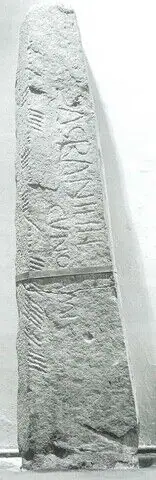
Ogham stones in Wales are the largest group outside Ireland. About 35 stones carry certain ogham inscriptions, and they sit almost entirely in the south-west and south-east of the country, with only a handful in the north. That pattern is no accident. It traces the footprint of Irish settlers who crossed the Irish Sea after the Roman army left Britain, and of the Welsh kingdoms that grew up around them.
Why Irish script ended up in Wales
In the late fourth and early fifth centuries, groups known as the Déisi crossed from the Waterford area of Ireland into south-west Wales, the land of the Demetae. Their leaders took over and founded the kingdom of Dyfed, roughly modern Pembrokeshire and western Carmarthenshire. Brycheiniog, around modern Brecknockshire, also had rulers of Irish descent.
The stones follow the settlers. Of the roughly 35 certain Welsh ogham stones, around 22 are in Dyfed and 8 in Brycheiniog. If you want to see where Irish speakers held land and status, a map of Welsh ogham gets you most of the way there. Our stone map lets you browse them, and our guide to ogham’s history and origins explains the wider story.
Stones that speak two languages
Many Welsh ogham stones are bilingual. The same name is carved once in ogham and once in Latin capitals, a sign of a community with a foot in two worlds.
The St Dogmaels stone in Pembrokeshire reads SAGRANI MAQI CUNATAMI, “of Sagranus, son of Cunatamus.” Sagranus is an Irish name. Cunatamus is typically Welsh. One memorial, two cultures, and two alphabets. Antiquarians nicknamed it the “ogham Rosetta stone” because it was among the first bilingual examples found, and it helped scholars confirm how ogham worked. We cover that formula in our piece on the MAQI formula.
At Nevern, a dolerite slab in St Brynach’s churchyard carries VITALIANI in ogham and a two-line Latin text. The name Vitalianus is Latin, yet someone chose to cut it in ogham, which hints at a mixed community where the line between Irish and British was already blurry.
A king in stone
The most famous Welsh ogham stone is at Castell Dwyran in Carmarthenshire. Its ogham reads VOTECORIGAS. Its Latin reads MEMORIA VOTEPORIGIS PROTICTORIS, “the memorial of Voteporix the Protector.”
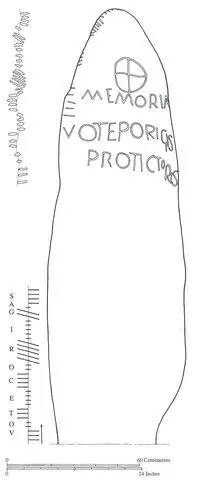
Voteporix is widely identified with Vortiporius, the king of Dyfed whom the monk Gildas called “the tyrant of the Demetians” in the sixth century. Gildas wrote to condemn him, so if the identification holds, a king’s own memorial and a hostile contemporary account describe the same man. The word “protector” may be a hereditary title going back to Roman military rank. The stone was first read by the scholar John Rhys in 1895 and is now kept in Carmarthen Museum.
A woman’s memorial
Eglwys Gymyn in Carmarthenshire has something unusual: a stone for a woman. The ogham reads AVITTORIGES INIGENA CUNIGNI, “of Avitoria, daughter of Cunignas.” The ogham word for daughter, INIGENA, appears nowhere else in the corpus. The stone was found in 1855 under the chancel of the parish church during restoration, and it still sits inside the church.
Where the Irish formula survives
Most Welsh stones use a short “name of father” pattern. The Bridell stone in Pembrokeshire is the exception. It reads NETTASAGRI MAQI MUCOI BRIACI, “of Nettasagri, son of the kindred of Briacus.” According to the corpus editor Nancy Edwards, it is the only Welsh stone that certainly uses the full MAQI MUCOI formula so common in Ireland. It stands in St David’s churchyard, possibly where it was first raised, with a cross added later.
Ogham on top of Latin
The Aberhydfer stone, now fixed inside Llywel church in Brecknockshire, is a rarity. An ogham inscription, TARICORO, was cut over an earlier Latin one, and the two texts do not seem to be related. It is the only known case of ogham overlying Latin. Someone reused an older monument for a new purpose, a habit that shows up across Britain and Ireland.
What the Welsh stones tell us
Taken together, the Welsh stones record a small, confident Irish-speaking elite living beside British neighbours, burying their dead with Irish-style formulas, and often adding Latin for good measure. They push ogham’s story beyond Ireland and show it as a script of migration as well as memory.
To read one yourself, start with our guide on how to read ogham, then pick a stone from the map.
Further Reading
- Nancy Edwards, A Corpus of Early Medieval Inscribed Stones and Stone Sculpture in Wales, Volume II: South-West Wales (University of Wales Press, 2007)
- Damian McManus, A Guide to Ogam (An Sagart, 1991)
- Stone records in our database, which cite Edwards (2007) and R.A.S. Macalister, Corpus Inscriptionum Insularum Celticarum (1945)
- The Ogham Stones of Wales, BabelStone Blog
- Vortiporius, Wikipedia